Choosing a Commercial LED Lighting Company in Texas: Solutions, Proposals & How to Get an Accurate Quote
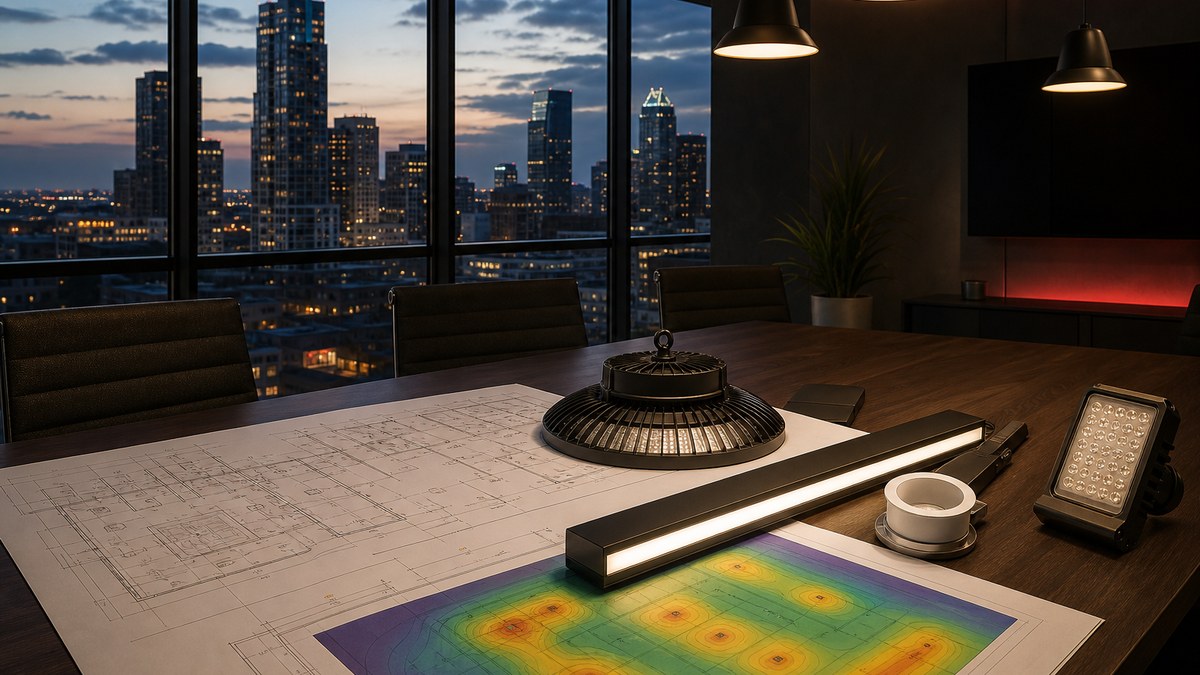
Choosing a commercial LED lighting company in Texas is rarely about the fixtures alone. Two proposals for the same building can look completely different: one is a fixture list with a unit count, another is a full design with photometrics, controls, installation, incentive paperwork and service. One vendor manufactures, another distributes, another installs, another designs and coordinates the whole project. Unless you know what you are comparing, it is easy to pick the proposal that looks simplest and discover the gaps after the lights go up.
This guide is written for Texas building owners, property and facility managers, school district and municipal staff, developers, general contractors and multi-site operators who are about to ask for commercial LED lighting solutions. It explains the different kinds of LED lighting companies, what a complete solution includes, the main ways projects are bought, exactly what to send so you get an accurate quote, how to compare proposals line by line, the questions worth asking and the warning signs worth noticing. It does not list prices: every serious commercial project is a project-specific proposal, and this article shows you how to make that proposal precise.
The right commercial LED lighting company is the one whose proposal matches your actual scope. Before you compare anyone, decide what you are buying and give every bidder the same information.
- Know the company type: manufacturer, distributor or supplier, electrical contractor, energy services company, or a design-and-coordination lighting company
- Define the solution: design, fixtures, controls, installation, incentive paperwork, commissioning and service, not just a fixture count
- Send a complete package: drawings or a fixture inventory, photos, ceiling heights, operating hours, controls goals, utility provider and schedule constraints
- Compare like for like: photometric plans, exact fixture and controls specs, listings, labor scope, exclusions and documentation
- Watch for red flags: guaranteed savings numbers without a study, vague "equivalent" fixtures, no photometrics, rebate promises
- Pricing: always a project-specific proposal after the scope and site conditions are known
The five kinds of commercial LED lighting companies
Search results for "commercial LED lighting company" mix very different businesses. Each can be the right partner for a certain kind of project, but they are not interchangeable. Knowing which one you are talking to explains why their proposals look the way they do.
| Company type | What they usually provide | Best fit | What to check |
|---|---|---|---|
| Manufacturer | Their own fixture lines, spec sheets, sometimes layouts using their products | Projects already designed around a specific product family | Who installs, who handles controls, local support in Texas |
| Distributor / supplier | Fixtures and controls from many brands, quotes from a fixture schedule | Contractors and owners with a finished design who need materials | Substitutions, lead times, who owns the photometric result |
| Electrical contractor | Licensed installation, permits, wiring, sometimes material supply | Clearly specified work, new construction electrical packages | Lighting design capability, controls programming, commissioning |
| Energy services company | Audits, efficiency measures bundled across lighting, HVAC and more | Large public or institutional portfolios using performance contracting | How savings are measured, contract structure, lighting quality |
| Lighting design & coordination company | Design, product selection, controls, installation coordination, incentives, service | Owners who want one accountable partner from walkthrough to close-out | Licensed installation partner, documentation, follow-through |
Texas LED Lights works in the last category. We have 15+ years as an authorized architectural lighting dealer and project coordinator. Installation is performed with licensed partners. Our licensed installation partner has completed over 200 major sports and commercial projects across the US and Canada — NFL, NBA, NHL, MLS, NCAA and NASCAR. That structure lets one team own the design, product, schedule and paperwork while licensed crews do the field work. You can see the range of work we coordinate on our commercial lighting services page.
What a complete commercial LED lighting solution includes
"Commercial LED lighting solutions" is a marketing phrase, but it points at something real: a lighting system is more than the fixtures. When a proposal leaves out one of the following pieces, someone still has to do it, usually you or your electrician at the last minute.
1. Survey and inventory
A walkthrough or drawing review that records every existing fixture type, mounting height, circuit and control, plus the conditions that affect the new system: ceiling type, structure, access equipment needed, heat, moisture, dust and hours of operation. Retrofit projects live or die on this step. Our Texas commercial LED retrofit guide walks through the survey in detail.
2. Lighting design and photometrics
Light levels, uniformity and glare control matched to how each space is used, checked with photometric calculations against recognized guidance from the Illuminating Engineering Society (for example IES RP-8 for parking lots and roadways, or IES RP-6 for sports), and against any owner or tenant standards. For exteriors this also includes backlight, uplight and glare (BUG) ratings and any local dark-sky rules.
3. Fixture and controls specification
Exact models, lumen packages, color temperature, color rendering, optics, mounting, finishes and driver types. Controls are specified with the fixtures, not added later: occupancy and vacancy sensors, daylight harvesting, timeclocks, photocells, dimming protocols such as 0-10V, DALI or DMX, and networked lighting controls where they make sense. Our commercial LED fixtures buyer's guide covers each fixture family.
4. Code and energy compliance
Texas applies the commercial energy code adopted at the state level, and many cities enforce their own adopted and amended editions of the IECC. Lighting power limits and mandatory controls depend on which edition and amendments apply to your project, so the design should be checked with your local building department or authority having jurisdiction (AHJ).
5. Installation and logistics
Licensed electrical work, permits where required, lifts and access, after-hours phasing, removal and recycling of old lamps and fixtures, and protection of tenants and inventory. The commercial LED installation guide explains how installers plan this.
6. Incentive paperwork
Utility programs from Oncor, CenterPoint, Austin Energy, CPS Energy, AEP Texas, El Paso Electric and others may apply depending on program availability. Most require pre-approval or pre-installation inspection before existing fixtures are removed, so the paperwork has to be built into the schedule rather than filed afterward.
7. Commissioning, documentation and service
Programming and testing controls, adjusting aiming, confirming emergency lighting, handing over as-built fixture schedules, control settings and manufacturer documentation, and arranging ongoing maintenance and repair.
How commercial lighting projects are bought in Texas
The way you buy the project shapes what a quote can contain. Most commercial lighting work in Texas follows one of five paths.
| Delivery path | How it works | Strength | Watch out for |
|---|---|---|---|
| Design-build / turnkey | One company designs, supplies, coordinates installation and closes out | Single point of accountability, fastest decisions | Make sure the design is documented so you can verify it |
| Plan and spec (bid) | An engineer or designer prepares drawings; contractors bid them | Easy line-by-line comparison | "Or equal" substitutions that change the lighting result |
| Supply only | You buy materials; your own electrician installs | Works for in-house teams | Nobody owns the result if light levels or controls fall short |
| Performance contracting | Efficiency measures paid for from verified savings under a long-term agreement | Large public or institutional portfolios | Measurement and verification terms, scope bundling |
| Cooperative purchasing | Public entities buy through existing competitively awarded contracts | Shorter procurement for schools and cities | Confirm the vendor actually holds the contract and that it covers your scope |
Public buyers have specific statutory rules. Texas school districts, for example, have energy conservation and performance contracting provisions in Education Code section 44.901, and local governments in Local Government Code chapter 302. Procurement rules change and depend on your entity type, so confirm the method with your purchasing department or legal counsel before asking vendors to price under it.
What to send so you get an accurate commercial LED lighting quote
The fastest way to get a usable quote is to give every company the same information. A vague request ("we want LED in our building") produces vague answers that cannot be compared. This checklist turns a request into a scope.
- Address and building type: office, warehouse, retail, hotel, school, church, sports facility, aquatic center, parking structure or site lighting.
- Drawings if you have them: reflected ceiling plans, electrical lighting plans, site plans, or at least a floor plan with dimensions.
- Fixture inventory or photos: a photo of each fixture type and its label, plus approximate counts per area. For exteriors, photos of poles, heads, wall packs and bases.
- Mounting heights and ceiling types: drop ceiling, open structure, hard lid, high bay, pole height.
- Operating hours: by area, including nights and weekends, because they drive control strategy and incentive calculations.
- What is wrong today: too dark, glare, flicker, frequent failures, uneven parking lot light, tenant complaints, energy use, failed inspections.
- Controls goals: sensors, daylight dimming, scheduling, scenes, central monitoring, integration with a building automation system.
- Electric utility and account type: needed to check which incentive programs may apply.
- Schedule and access limits: occupied hours, after-hours work, inventory or equipment that cannot move, events, school calendars.
- Standards you must meet: owner or brand standards, tenant lease requirements, insurer requests, league or event requirements for sports venues.
- Decision process: who signs, whether you need multiple bids, and the target date for a decision.
If you do not have drawings, that is normal for older Texas buildings. A walkthrough fills the gap. Use the contact form to share what you have, and we will tell you what else is needed.
Get a proposal that matches your building
Send us your address, photos or drawings and what you want to fix. We will follow up to review the site and prepare a project-specific proposal with design, fixtures, controls and installation clearly defined.
How to compare proposals like for like
Once proposals arrive, resist comparing only the bottom line. Line them up against the same questions. A side-by-side table like this one makes gaps obvious.
| Compare | What a strong proposal shows | What a weak proposal shows |
|---|---|---|
| Design basis | Photometric plan or calculation summary per area, with target light levels and uniformity | "One-for-one replacement" with no calculations |
| Fixtures | Exact model numbers, lumen output, color temperature, color rendering, optics and finish | Generic descriptions such as "LED high bay" or "equivalent" |
| Listings | Safety listing (UL or equivalent NRTL) and, where incentives apply, DesignLights Consortium (DLC) or ENERGY STAR listing as the program requires | No listing information |
| Controls | Sensor locations, control zones, dimming protocol, programming and commissioning | "Controls available" or nothing at all |
| Labor scope | Who installs, license, permits, lifts, after-hours work, disposal and recycling | "Installation included" with no detail |
| Incentives | Which program may apply, who files, and the required approvals before work starts | A rebate figure presented as certain |
| Schedule | Lead times, phasing plan and inspection holds | "Ships fast" with no plan |
| Exclusions | Written list: structural work, patching, painting, pole bases, utility fees | No exclusions listed, which means surprises later |
| Close-out | As-built schedule, control settings, manufacturer documents, written warranty terms | Nothing after installation |
The comparison often reveals that the "cheaper" proposal simply covers less. Two quotes are comparable only when they light the space to the same result, with the same controls, under the same scope.
Questions to ask any commercial LED lighting company
- Who will design the lighting, and can I see the calculations? A layout you cannot verify is a guess.
- Who will install it, and are they licensed? In Texas, electricians and electrical contractors are licensed by TDLR. Ask for license information and who pulls permits.
- What happens if a specified product is unavailable? Substitutions should be submitted for approval with matching photometrics, not swapped silently.
- How are controls programmed and handed over? Ask who commissions them and what documentation you receive.
- Which incentive programs might apply, and who files? Confirm whether pre-approval or pre-inspection is needed before work starts.
- How will work be phased around our operations? Especially for occupied offices, schools, hotels, retail and 24-hour warehouses.
- What is excluded? Get the list in writing.
- What do we receive at the end? As-built fixture schedule, control settings, manufacturer documents and warranty terms in writing.
- Who do we call when something fails? Service after installation matters more than any brochure.
- Have you worked on this building type? A gym, a natatorium, a parking lot and a hotel lobby each demand different skills.
Red flags in commercial LED lighting proposals
Most LED companies in Texas are honest and competent. The warning signs below are still worth knowing, because each one tends to cost owners time and money later.
- Guaranteed savings without a study. Energy savings depend on your existing system, hours, controls and rates. A credible company explains its assumptions rather than quoting a headline number.
- Rebate amounts promised up front. Utility incentives depend on program availability, eligibility, listings and pre-approval. Treat any guaranteed figure with caution.
- No photometrics on a redesign. Replacing fixtures one for one can work, but changing optics, lumen packages or pole layouts without calculations risks dark spots, glare or light trespass.
- "Equivalent" everywhere. Vague fixture descriptions make proposals impossible to compare and easy to downgrade.
- Controls as an afterthought. Energy codes frequently require controls in new and altered spaces; leaving them out can create compliance and incentive problems.
- No mention of permits or licensing. Electrical work in Texas must be done by properly licensed professionals; some work also requires a local permit.
- Pressure to sign before a site visit. Good proposals for commercial buildings are built on real site conditions.
- No plan for old lamps. Fluorescent and HID lamps contain mercury; in Texas they can be managed as universal waste under TCEQ rules. Ask how they will be handled.
Solutions by building type
A strong commercial LED lighting company adjusts its approach to the building. Here is what changes from one type to the next and where to read more.
| Building type | What the solution must handle | Related guide |
|---|---|---|
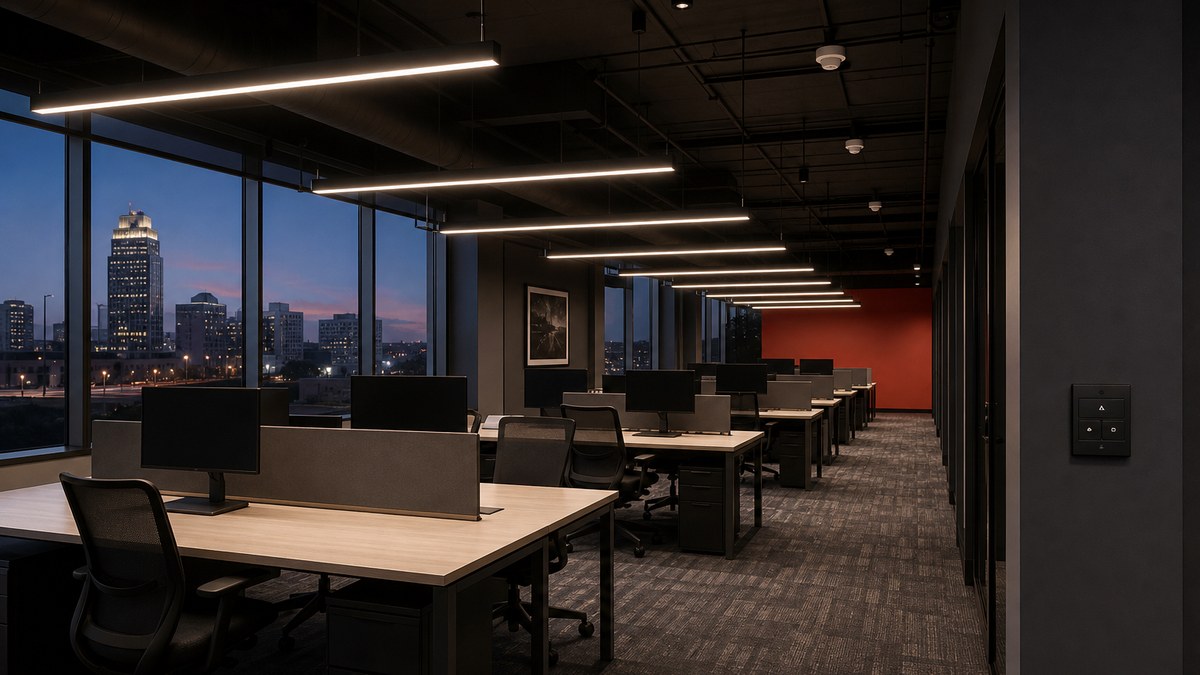
| Offices | Visual comfort, glare at screens, daylight dimming, occupancy controls, tenant phasing | Houston commercial LED lighting |
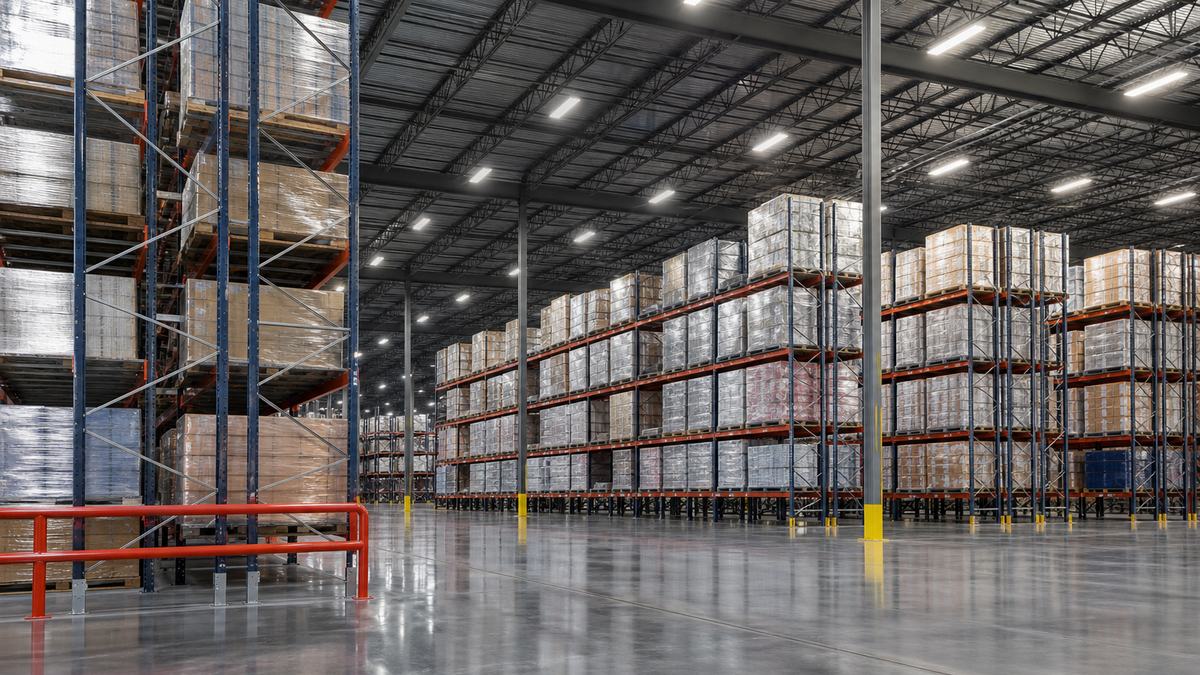
| Warehouses & industrial | High bays, aisle optics, sensors, forklift traffic, heat at the roof deck, classified locations | Austin commercial lighting |
| Retail & shopping centers | Storefronts, canopies, parking lots, facades, after-hours phasing | Shopping center LED lighting |
| Hotels | Layered warm light, dimming scenes, ballrooms, pools and exteriors, guest-friendly scheduling | Texas LED hotel lighting |
| Sports & gyms | Play levels, glare for athletes and spectators, streaming, impact protection | LED sports lighting · gym lighting |
| Pools & natatoriums | Corrosion, glare on water, lifeguard visibility, maintenance access, NEC 680 | Natatorium lighting |
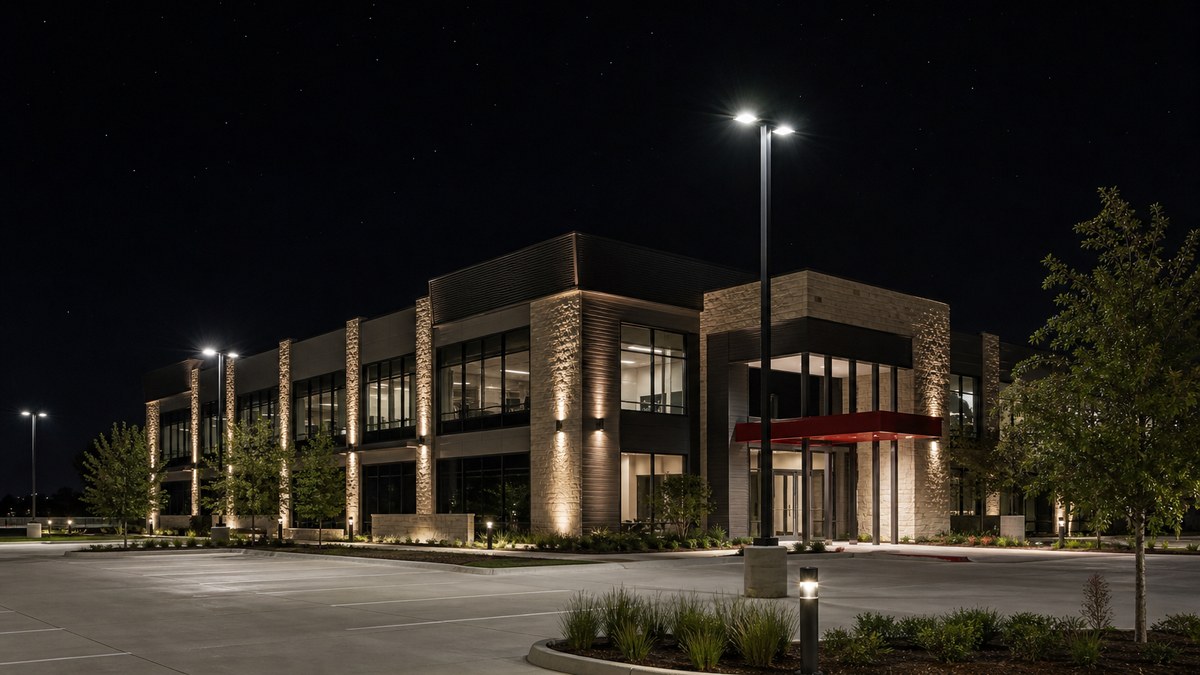
| Exteriors & parking | Pole layout, BUG ratings, light trespass, photocells and dimming, storm exposure | Exterior LED lighting |
| Lobbies & display walls | Architectural accent lighting, video walls, starlight ceilings | LED video walls · starlight ceilings |
Why Texas conditions change the proposal
Texas is large enough that a solution designed for one city can be wrong for another. A commercial LED lighting company working statewide should account for:
- Heat: roof decks, attics, canopies and west-facing walls get very hot; drivers and fixtures need ratings that suit the actual ambient temperature, not a showroom.
- Storms and wind: hail, high winds and hurricanes on the Gulf Coast affect poles, heads and mounting. Coastal areas may fall within the TDI windstorm program; confirm requirements with your AHJ.
- Humidity and salt air: coastal and pool environments call for corrosion-resistant finishes and wet-location listings.
- Dust and UV: West Texas sun and dust affect lenses, gaskets and finishes. Our South Texas guide and San Antonio guide cover regional differences.
- Local rules: city energy-code amendments, dark-sky ordinances, the San Antonio Military Lighting Overlay District, observatory-county outdoor lighting rules under Local Government Code chapter 240, and Health and Safety Code chapter 425 for certain state-funded outdoor lighting. Each project should be checked with the AHJ.
- Utility territory: incentive options differ between Oncor, CenterPoint, Austin Energy, CPS Energy, AEP Texas, El Paso Electric, municipal utilities and co-ops, and may qualify depending on program availability. For energy-efficient commercial building deductions such as 179D, confirm with your tax advisor.
What working with Texas LED Lights looks like
Every project starts with a conversation and ends with documentation. Here is the path a typical commercial project follows with us:
- Intake: you share the address, building type, photos or drawings and what you want to fix, by form, phone or a scheduled call.
- Site review: a walkthrough or drawing review to confirm fixture types, heights, controls, access and conditions.
- Design: layouts and photometrics where the result needs to be verified, plus fixture and controls specifications.
- Proposal: a project-specific proposal with scope, exclusions, schedule and incentive steps in writing.
- Approvals: utility pre-approval or pre-inspection where a program applies, and permits where required.
- Installation: licensed crews, phased around your operations.
- Commissioning and close-out: controls programmed and tested, emergency lighting confirmed, documentation handed over.
- Service: repairs, adjustments and maintenance planning after the project.
For coverage across the state, see our service area. For examples of the project types we coordinate, visit our portfolio and our services overview. Facilities interested in architectural and hospitality programs can also review Luminance.
Frequently Asked Questions
What does a commercial LED lighting company do?
What are commercial LED lighting solutions?
How do I get an accurate commercial LED lighting quote?
Should I hire a supplier or a contractor for commercial LED lighting?
How do I compare two commercial lighting proposals?
Do LED fixtures need to be DLC listed?
Can Texas utility incentives help with a commercial LED project?
Who is allowed to install commercial lighting in Texas?
How much does commercial LED lighting cost?
What areas of Texas does Texas LED Lights serve?
One partner from walkthrough to close-out
Tell us about your building and what you want the lighting to do. We will follow up to review the site and prepare a clear, project-specific proposal.
Related
Our Texas lighting network: Dallas commercial LED lighting, Fort Worth LED lighting, Arlington LED lighting, Irving LED lighting, Plano LED lighting, wholesale LED components, fiber optic starlight ceilings, 360° fiber optic lighting, premium pool lighting, commercial LED signs and message centers, modular building solutions, and Dallas modular structures. Read more lighting guides on our blog, see commercial LED services, or contact us to talk about your property.