Texas Gym Lighting: LED Design for School Gyms, Field Houses & Rec Centers
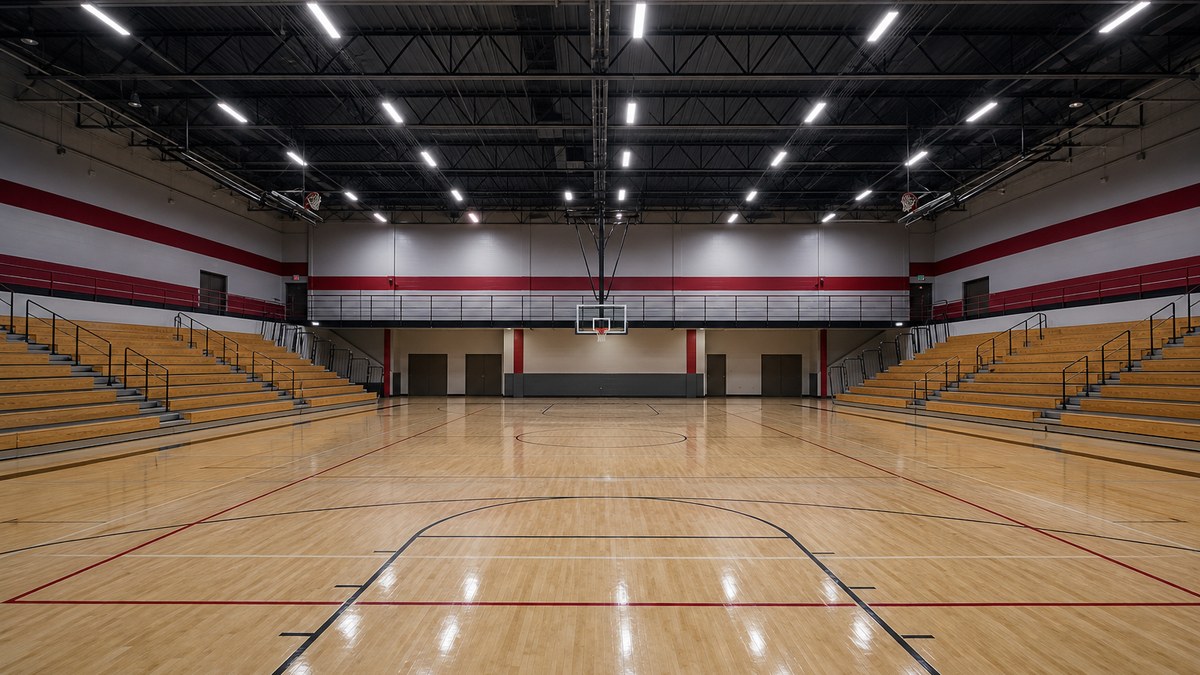
Texas gym lighting has to do more than light a basketball court. A single school gymnasium in Texas may host physical education in the morning, volleyball and basketball practice in the afternoon, a varsity game streamed online at night, a pep rally, a graduation, a community meeting or a polling place, and in some towns it doubles as a shelter during severe weather. When that room still runs on aging metal halide or fluorescent high-bays, the problems are familiar: long warm-up after the breaker trips, dark spots near the corners, glare that makes volleyball players squint, lamps that need a lift to replace, and a noisy, buzzing ceiling.
This guide is written for Texas school district facility directors, athletic directors, college and university operations teams, city parks and recreation departments, YMCA and church recreation centers, private clubs and sports complex owners. It explains how LED gymnasium lighting is designed, which standards apply, how to control glare for basketball, volleyball and pickleball, how to protect fixtures from impact, which controls make sense, how Texas heat affects equipment selection, and how a gym lighting project runs from assessment to commissioning. If you are comparing a Texas LED gym lighting company for an upcoming project, the questions at the end will help you evaluate any proposal.
Texas gym lighting today means LED high-bay or sports-rated fixtures, laid out from a photometric design, shielded against glare, protected against ball impact and tied to simple controls for practice, game and event modes.
- Standards: designs follow the current edition of ANSI/IES RP-6 for sports and recreational areas, plus any governing-body or broadcast requirements
- Glare control: optics, lenses and placement matter most for volleyball and basketball, where players look straight up
- Impact protection: wire guards or impact-rated fixtures keep balls from damaging the ceiling system
- Instant on: no warm-up or restrike delay after a power interruption
- Controls: practice, game and event scenes, scheduling, occupancy and daylight response where code requires it
- Texas heat: fixtures and drivers rated for the high ambient temperatures under a gym roof
- Pricing: quoted per facility as a project-specific proposal after a site review and photometric design
Why Texas gyms are moving to LED
Texas has an enormous inventory of indoor athletic space: high school competition gyms and auxiliary gyms, middle and elementary school gyms, college arenas and practice facilities, municipal recreation centers, church family life centers, private volleyball and basketball clubs and a fast-growing number of indoor pickleball venues. Many of these buildings were lit decades ago with metal halide high-bays or multi-lamp fluorescent fixtures. LED changes the day-to-day experience for everyone who uses the room:
- Athletes: more uniform light across the court reduces dark spots, and better optics reduce the bright fixture images that make it hard to track a ball in the air.
- Coaches and officials: a cleaner, brighter court makes it easier to see plays, lines and fouls.
- Spectators and families: better color quality and less glare make the bleachers more comfortable and photos and video look better.
- Custodial and maintenance staff: long-life LED dramatically reduces lamp and ballast changes from a lift over the court.
- Administrators: instant on/off, dimming and scheduling cut wasted run hours when the gym is empty.
- Event coordinators: scene control lets the same room switch from PE to a pep rally to a graduation ceremony at the push of a button.
For a statewide view of how gym lighting fits with stadiums, fields and arenas, see our LED sports lighting guide for Texas.
Gym lighting standards and play levels
Indoor sports lighting in the United States is guided by the Illuminating Engineering Society's recommended practice for sports and recreational area lighting, ANSI/IES RP-6 (the current edition is RP-6-24). Like outdoor venues, indoor facilities are grouped by level of play and spectator capacity, and the class sets the targets for light level and uniformity:
| Facility type | Typical Texas example | What it means for design |
|---|---|---|
| Competition arena | College arenas and large high school competition gyms with significant seating and streaming | Highest light levels and uniformity, strong vertical light for cameras, flicker-free drivers |
| Competition gym | Most varsity high school gyms and larger middle school gyms | Competitive-level light and uniformity across the full court, good glare control |
| Practice / auxiliary gym | Auxiliary gyms, practice courts and PE spaces | Moderate levels focused on safe, comfortable play and easy maintenance |
| Recreational | Elementary gyms, church family life centers, community rec centers | Comfortable, even light, durable fixtures and simple controls |
Specific light-level and uniformity targets come from the current RP-6 edition, the sport's governing body and, for televised or streamed events, the broadcaster or streaming partner. For Texas high school competition, it is worth confirming any event requirements with the University Interscholastic League (UIL) and the host district. Energy code, emergency lighting and electrical requirements come from the codes your city or county enforces, so always confirm with your AHJ. A photometric design shows how a proposed layout meets those targets before any fixture is ordered.
How LED gymnasium lighting systems work
Fixtures: high-bays, linear high-bays and sports-rated luminaires
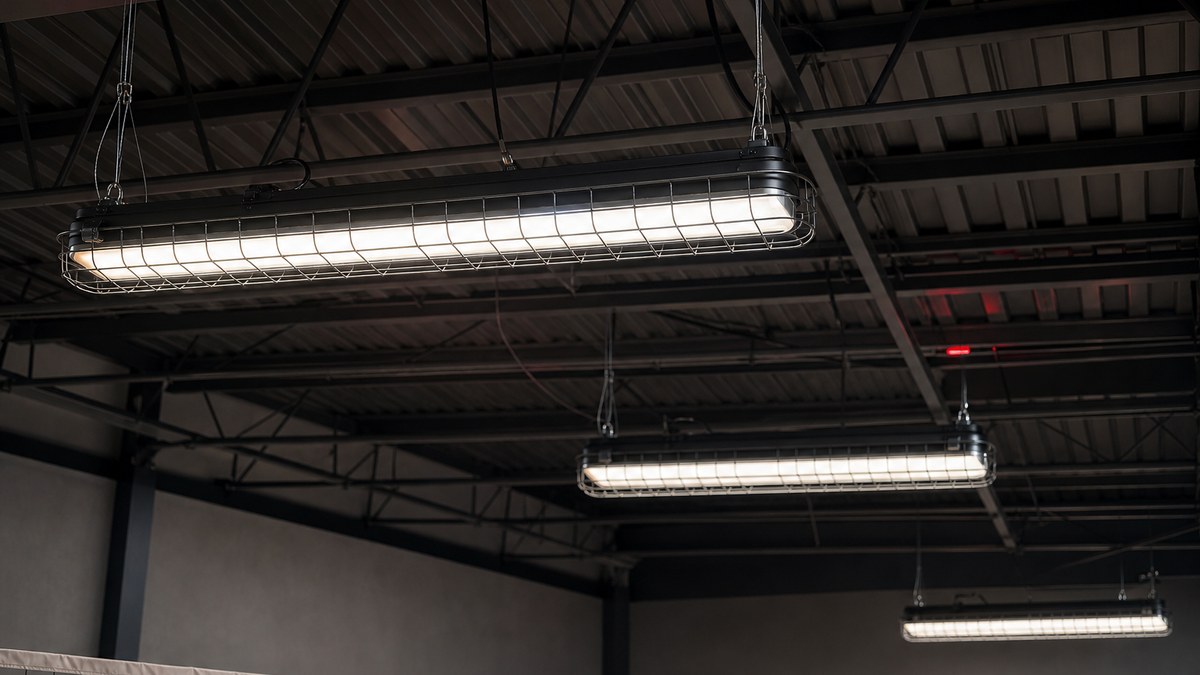
Most Texas gyms use one of three fixture families. Linear LED high-bays are common in school gyms because they spread light evenly and can be fitted with lenses and wire guards. Round (UFO-style) high-bays are compact and efficient but need careful optic selection to avoid glare. Sports-rated indoor luminaires with precision optics are used in arenas and competition gyms where uniformity, vertical light and glare control must be tightly managed. Our commercial LED fixtures guide covers the broader fixture families.
Optics and lenses
The optic decides where the light goes. Wide distributions suit lower ceilings; narrower beams push light down from very high ceilings. Frosted or prismatic lenses soften the bright LED points that athletes see when they look up. In competition gyms, asymmetric optics mounted along the sidelines can aim light onto the court while keeping fixtures out of players' upward sightlines.
Mounting height and layout
Ceiling height, joist spacing, ductwork, sprinklers, banners, scoreboards and basketball goals all shape the layout. A good layout avoids placing fixtures directly above the free-throw lane and the volleyball net zone, where players spend the most time looking up, and keeps aisles clear for lift access.
Drivers, wiring and emergency power
Drivers convert power for the LEDs and control dimming. In a gym they must be rated for high ceiling temperatures and be flicker-free if the room is filmed. Emergency lighting for egress is typically provided by emergency drivers, battery units or generator-backed circuits, designed to the life safety requirements your AHJ enforces (commonly based on NFPA 101 and the adopted building and electrical codes).
Glare: the number one gym lighting complaint
Ask a volleyball coach what is wrong with their gym lighting and the answer is usually glare. Indoor sports are played looking up: setters and passers track high balls, basketball players watch rebounds and long passes, and pickleball players follow lobs. A bright fixture in the line of sight creates a moment of blindness at exactly the wrong time.
- Placement: keep fixtures out of the zones directly above the net, the lane and the baseline where players look straight up.
- Optics and diffusion: use lenses that hide individual LED points and spread brightness over a larger surface.
- Indirect components: in some gyms, partially uplit ceilings or indirect fixtures reduce contrast between fixtures and the dark roof deck.
- Ceiling and wall finishes: lighter ceiling and wall surfaces raise the overall brightness of the room and soften contrast.
- Reflected glare: polished wood and sport floors reflect fixture images; layout and diffusion keep reflections from distracting players and cameras.
The same principles apply to indoor pools, where reflected glare off the water is the main design problem; our natatorium lighting guide explains that in detail.
Lighting by sport and space
Basketball
Basketball needs even light across the full court and enough vertical light to follow the ball above the rim. Fixtures should stay out of the zones above the baskets and free-throw lanes, and the scoreboard and shot clocks should be readable without fixtures washing them out.
Volleyball
Volleyball is the most glare-sensitive indoor sport because players constantly track high balls. Many Texas gyms run several volleyball courts across the main court, so the layout should work for both the competition court and the cross courts. Fixtures above the net line are the most common source of complaints.
Pickleball and multi-sport overlays
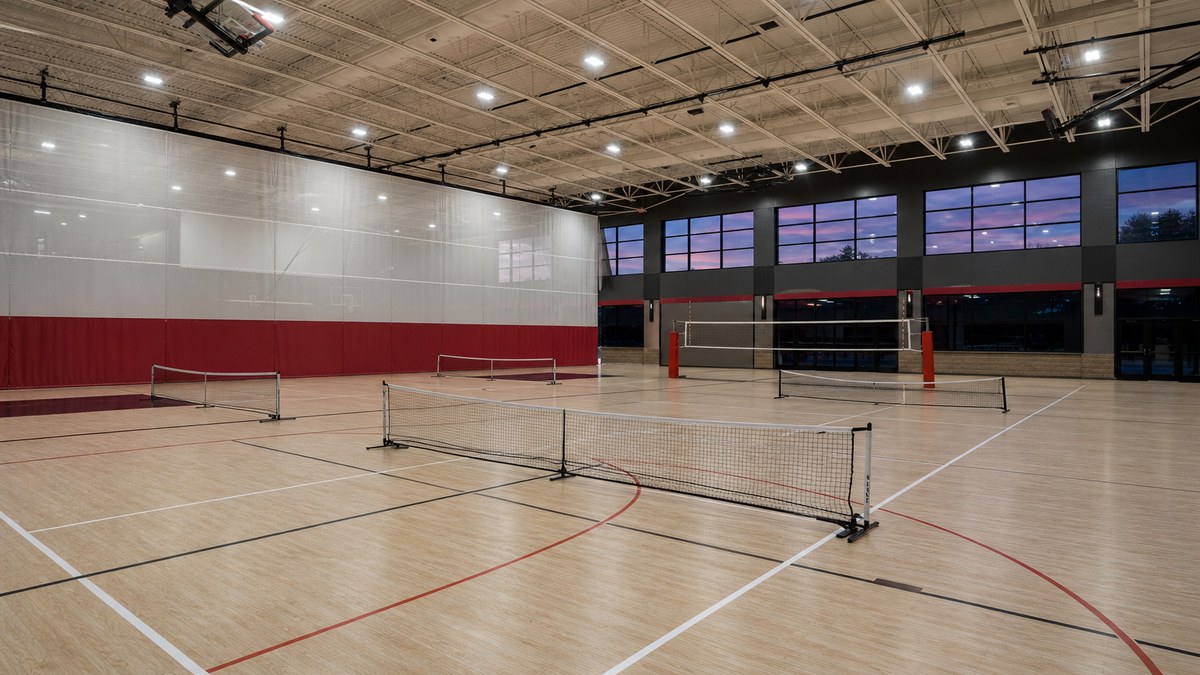
Pickleball has exploded in Texas recreation centers, churches and clubs. When lines for several sports share one floor, the lighting has to be even across every court layout, not just the main basketball court.
Wrestling rooms, weight rooms and dance studios
Auxiliary spaces often have lower ceilings, so fixture selection and shielding change. Wrestling rooms benefit from soft, even light; weight rooms need impact-resistant fixtures and good vertical light on mirrors and racks; dance and cheer rooms often add dimming and color-temperature control.
Field houses and indoor practice facilities
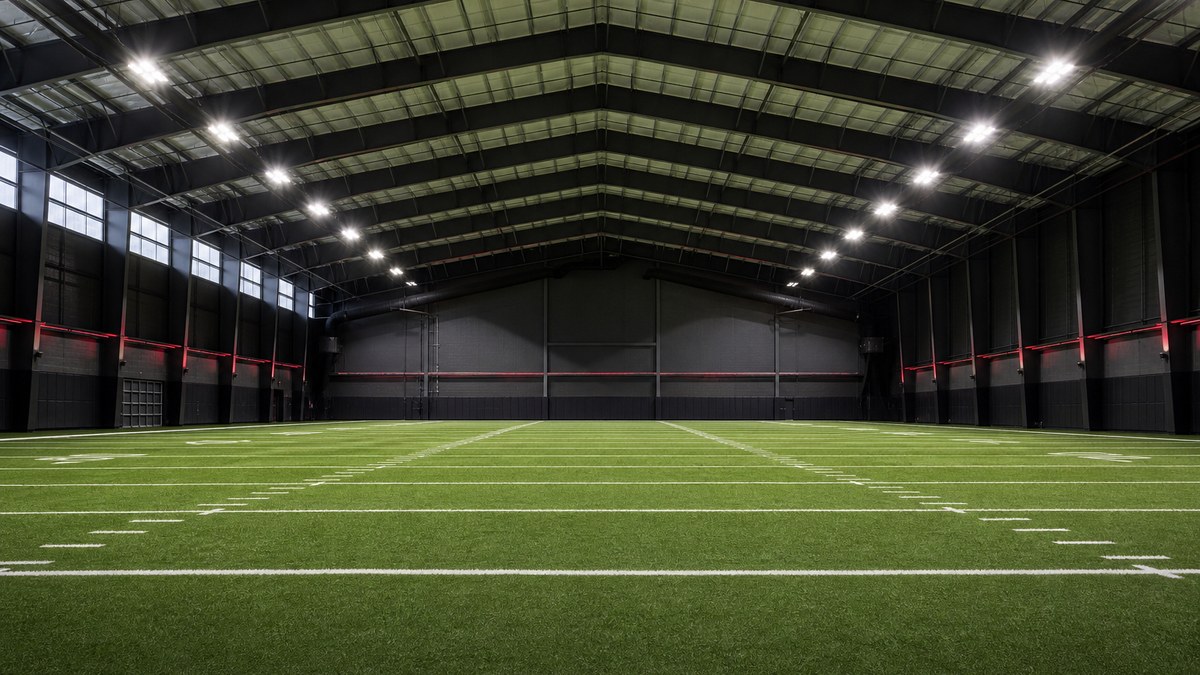
Large field houses used for football, baseball and soccer practice have very high ceilings and fast-moving balls in the air. They usually need sports-rated optics, high impact protection and zoned controls so a single team can light only its area.
Concourses, lobbies and exteriors
The gym experience starts at the door. Lobby, concession and trophy-case lighting, plus parking lot and exterior lighting for evening events, should be planned along with the court.
Planning a gym lighting upgrade in Texas?
Tell us about your gym, field house or rec center and we will follow up to schedule an assessment and prepare a project-specific proposal.
Impact protection and durability
Every gym fixture will be hit by a ball eventually. Protection is part of the design, not an afterthought:
- Wire guards: steel guards around linear high-bays keep balls from striking lenses and housings.
- Impact-rated fixtures: some luminaires are built and tested for impact resistance with polycarbonate lenses and reinforced housings.
- Secure mounting: safety cables and rigid mounts keep fixtures in place when struck.
- Lenses that stay clear: UV-stable, non-yellowing lens materials keep light output consistent over the years.
- Serviceability: fixtures and drivers that can be serviced quickly from a lift reduce disruption to the athletic calendar.
Texas heat and the gym ceiling
Many Texas gyms are not fully air-conditioned, and even conditioned gyms trap heat high under the roof. LED drivers and electronics are sensitive to temperature, so fixtures must be rated for the ambient conditions at mounting height, not at floor level. Good thermal design matters for long-term reliability in a Texas summer. Coastal facilities in Houston, Corpus Christi and the Rio Grande Valley also deal with humidity, so housings and finishes should suit the environment; our South Texas lighting guide covers Gulf Coast considerations.
Lightning and utility disturbances are common across the state, so surge protection at the panel and fixture level is a standard part of a well-designed system.
Controls: practice, game and event modes
LED makes controls practical in a way metal halide never did. A well-designed gym control system is simple for staff and flexible for events:
| Control feature | What it does | Why it matters in a gym |
|---|---|---|
| Scene presets | One-button PE, practice, game and event looks | Staff do not need to know which breaker controls what |
| Dimming | Lowers output for practice, assemblies or cleaning | Reduces run hours and glare when full output is not needed |
| Zoning | Lights only the half court or cross court in use | Ideal for divided gyms with curtains |
| Occupancy sensing | Turns lights down or off when the gym is empty | Stops lights running all night after the last practice |
| Daylight response | Adjusts output where clerestories or skylights bring in daylight | Required in some spaces by the energy code your AHJ enforces |
| Scheduling and remote access | Time-based control and remote fault alerts | Facility teams manage many campuses from one place |
| Show effects | Blackout, spotlight and color effects for introductions | Game-night atmosphere and pep rallies |
Whatever the system, controls should be commissioned on site, labeled clearly and handed over with training so the night custodian and the head coach can both use them confidently.
Streaming, broadcast and video
A growing number of Texas high school and college games are streamed, and more families record games on phones. Video changes what good lighting means:
- Vertical light: cameras need light on athletes' faces and jerseys, not just on the floor.
- Uniformity: bright and dark patches are far more obvious on camera than to the eye.
- Flicker: drivers should be flicker-free at the frame rates used for slow-motion replays.
- Color quality: consistent color temperature and good color rendering keep team colors and skin tones accurate.
Arenas often add LED video boards, ribbon displays and digital signage; see our guide to LED video walls and displays in Texas and our video wall services.
Retrofit or redesign?
Most Texas gym projects follow one of three paths:
- One-for-one replacement: new LED fixtures at existing locations. Fast and minimally disruptive, but it carries forward any layout problems, such as fixtures directly above the volleyball net.
- Re-layout with new fixtures: fixtures moved or added to fix uniformity and glare, often reusing much of the existing circuiting.
- Full redesign: new layout, fixtures, circuiting, emergency lighting and controls, often as part of a broader renovation or a new building.
A site assessment and photometric comparison of the options makes the decision clear. Our Texas commercial LED retrofit guide explains how retrofits are planned and phased across building types, and our installation guide covers how professional installers plan and commission the work.
Incentives, code and paperwork
Gym lighting upgrades may qualify for utility energy-efficiency programs from Oncor, CenterPoint Energy, Austin Energy, CPS Energy or AEP Texas, depending on program availability, your service territory and the project scope. Many programs require an application and pre-approval or pre-installation inspection before any work starts or existing fixtures are removed, so check before ordering anything. Public and nonprofit owners may also want to discuss the federal 179D deduction and related rules; confirm with your tax advisor.
On the code side, new construction and major alterations must meet the energy code adopted in your jurisdiction (the Texas statewide commercial code is the IECC edition adopted by the State Energy Conservation Office, and several large cities adopt newer editions with local amendments), plus emergency lighting and electrical requirements. Confirm with your AHJ. City-specific notes are in our Houston, Austin and San Antonio guides.
How a Texas gym lighting project works
- Assessment: walk the gym, measure existing light levels, inventory fixtures, circuits and controls, and note ceiling obstructions, ceiling temperature and lift access.
- Goals: confirm sports, levels of play, streaming plans, events and community uses.
- Photometric design: model light levels, uniformity and glare for each option.
- Electrical and controls review: confirm circuits, panel capacity, emergency lighting and control strategy.
- Incentive paperwork: submit any utility applications and get pre-approval before work begins.
- Proposal and approvals: a project-specific proposal plus any board, procurement or bid steps.
- Scheduling: install over summer, winter break or between seasons to avoid the athletic calendar.
- Installation: licensed professionals install fixtures, guards, wiring and controls with floor protection in place.
- Commissioning: verify light levels, program scenes, test emergency lighting and train staff.
What drives project cost
Every gym is different, so we price each one as a project-specific proposal after an assessment and photometric design. The main factors are:
- Play level and uses: competition and streaming need more fixtures and tighter uniformity than PE-only gyms
- Room size and ceiling height: fixture count, optics and lift requirements
- Layout changes: one-for-one replacement versus re-layout or full redesign
- Impact protection: wire guards or impact-rated fixtures
- Controls: basic switching through scenes, zoning, sensors and remote monitoring
- Emergency lighting and electrical: emergency drivers, circuit changes and panel work
- Schedule and access: floor protection, after-hours work and the athletic calendar
Public entities often buy through competitive bids or cooperative purchasing programs; we can work within your procurement process.
Who builds it: our experience
Texas LED Lights brings 15+ years as an authorized architectural lighting dealer and project coordinator. Our licensed installation partner has completed over 200 major sports and commercial projects across the US and Canada — NFL, NBA, NHL, MLS, NCAA and NASCAR. The same attention to glare, uniformity and commissioning that big venues demand goes into school gyms, college practice facilities and community recreation centers across Texas.
We also handle the rest of the campus: classroom and office LED retrofits, outdoor sports fields, aquatic centers, architectural facade lighting and LED signage and message centers. See our services, portfolio and coverage area, or learn about our Luminance design-build program. For ongoing support after installation, see our service and maintenance options.
Questions to ask before you buy
- What RP-6 play level is the design based on, and why?
- Can we see the photometric report, including uniformity across volleyball and pickleball courts?
- Where are fixtures placed relative to the net, lanes and baselines, and how is glare controlled?
- Are the fixtures impact-rated or guarded, and how are they secured?
- Are fixtures and drivers rated for the temperature under our roof?
- Are the drivers flicker-free for streaming and slow-motion video?
- What controls, scenes and sensors are included, and who trains our staff?
- How is emergency lighting handled, and has it been coordinated with our AHJ?
- Have utility incentive applications been filed before work starts?
- What warranties apply to fixtures, drivers and controls, and who provides service?
Frequently Asked Questions
What is the best lighting for a school gym in Texas?
What standards apply to gymnasium lighting?
How do you reduce glare in a gym?
Do gym lights need wire guards?
Can we replace our gym lights one-for-one with LED?
Does Texas heat affect LED gym lights?
Is LED gym lighting good for streaming games?
Are there rebates for gym lighting upgrades in Texas?
How much does LED gym lighting cost?
What areas of Texas do you serve?
Give your gym light worth playing under
Request a consultation and we will follow up to schedule an assessment of your gymnasium, field house or recreation center.
Related
Browse more guides on the Texas LED Lights blog. Our Texas lighting network: Dallas commercial LED lighting, Fort Worth LED lighting, Arlington LED lighting, Irving LED lighting, Plano LED lighting, wholesale LED components, fiber optic starlight ceilings, 360° fiber optic lighting, premium pool lighting, modular building solutions, and Dallas modular structures.