Commercial LED Lighting Fixtures in Texas: The Buyer's Guide to Every Fixture Type
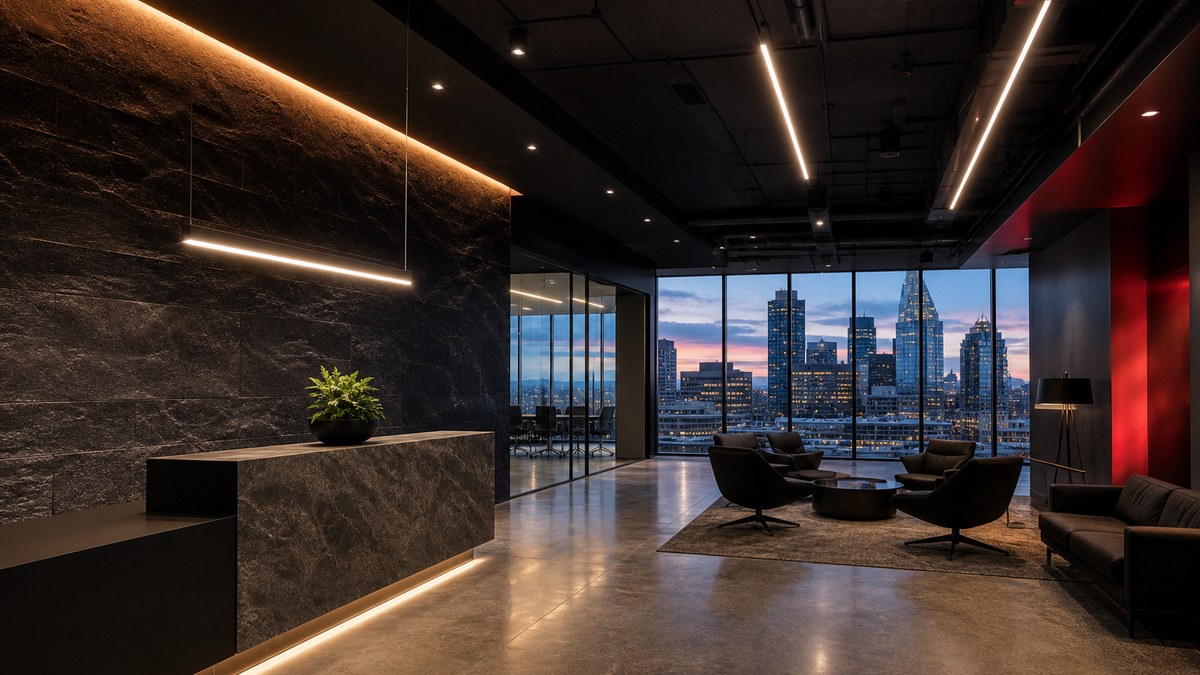
Choosing the right commercial lighting fixtures in Texas is one of the decisions that shapes a building for years. The fixture type sets how a space looks, how comfortable it is to work in, how easy it is to maintain and how well it handles Texas heat, humidity, dust and storms. Yet many owners and facility managers only see a long product schedule full of model numbers and abbreviations: high-bays, troffers, wall packs, area lights, linear pendants, downlights, vapor-tights, canopy lights, floods.
This guide explains every major family of commercial LED fixtures in plain language: where each one belongs, what to look for in the specification, how Texas conditions change the choice, which controls and code requirements apply, and how to move from a list of fixtures to a working, commissioned lighting system. It is written for property managers, facility directors, business owners, architects, general contractors and anyone responsible for a commercial building anywhere in the state, from Dallas–Fort Worth and Houston to Austin, San Antonio, El Paso, Lubbock and the Rio Grande Valley.
The right commercial LED fixture depends on the space, mounting height, environment and the job the light has to do. Most Texas commercial buildings use a combination of these families:
- Offices and schools: LED troffers and flat panels, linear pendants, downlights and wall washers
- Warehouses and plants: LED high-bays (round or linear) and vapor-tight fixtures
- Building exteriors: wall packs, area/pole lights, canopy lights and floodlights
- Retail and hospitality: track lights, accent downlights, decorative pendants and architectural linear
- Facades and landscapes: linear grazers, projectors and color-changing architectural fixtures
- What matters most: right distribution, color quality, glare control, controls compatibility and ratings for heat, moisture and dust
- Pricing: every fixture package is quoted per project after a site review and lighting layout
Why fixture choice matters more than the bulb
With older technology, the lamp did most of the work and the fixture was just a housing. LED changed that. In an LED fixture, the light source, the optic, the driver and the heat sink are designed as one system. That means the fixture you choose determines:
- Where the light goes: the optic sets the beam pattern, whether it floods a warehouse aisle, a parking row or a single display.
- How it feels: color temperature, color rendering and glare control decide whether a space feels clinical, warm, premium or harsh.
- How long it performs: thermal design and driver quality determine how well light output and color hold up in a hot Texas ceiling or on a sun-baked wall.
- How it can be controlled: the driver determines dimming type and whether the fixture can work with sensors, networked controls or a building management system.
- How easy it is to maintain: serviceable drivers, accessible wiring and sensible mounting save lift trips later.
Two fixtures that look identical on a spec sheet photo can perform very differently once installed. That is why a professional layout and a fixture schedule matched to each space are worth more than a catalog shortcut. Our commercial LED lighting installation guide covers how that layout fits into the full project.
Indoor fixtures for offices, schools and healthcare
LED troffers and flat panels
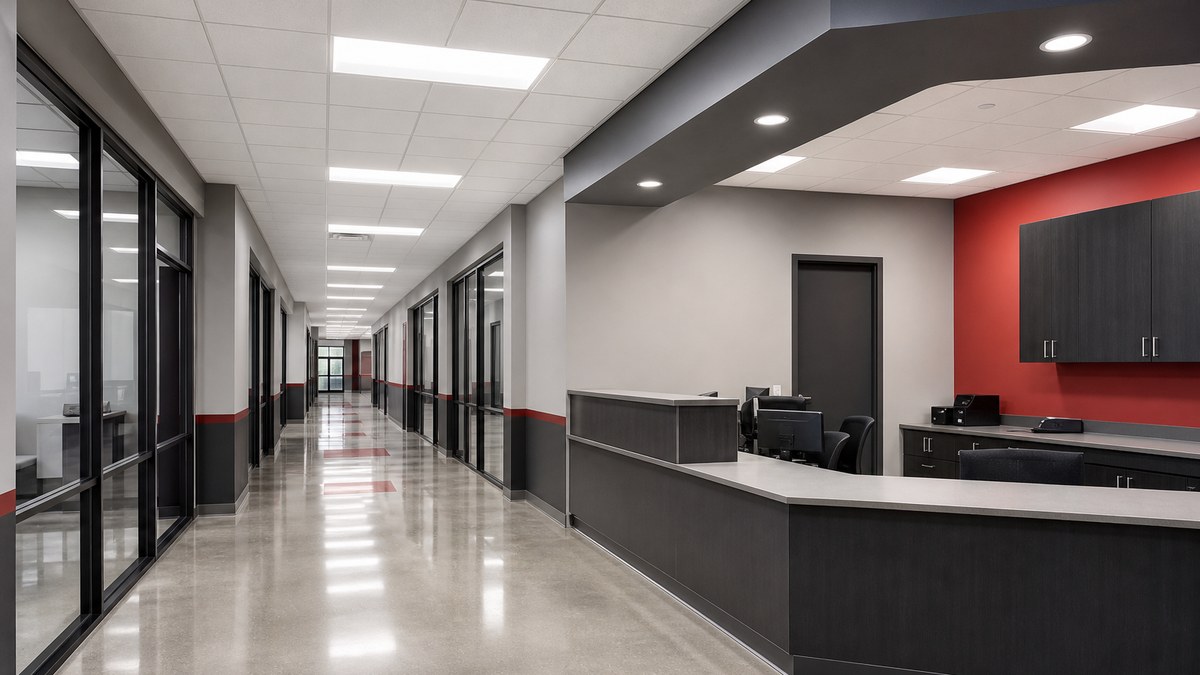
Troffers are the recessed fixtures that sit in a grid ceiling, the workhorse of Texas office buildings, schools, clinics and government facilities. Modern LED troffers come in several styles: center-basket designs with a soft, diffused look, volumetric troffers that spread light up onto the ceiling plane, and thin edge-lit or back-lit flat panels. For retrofits, many buildings use LED retrofit kits that install into existing troffer housings, which reduces ceiling disruption.
What to look for: low glare for screen-heavy work, uniform appearance across the ceiling, dimming drivers, and compatibility with occupancy and daylight sensors.
Linear pendants and surface linear
Suspended linear fixtures have become the signature look of modern offices, lobbies, conference rooms and open ceilings. They can provide direct light down, indirect light up, or both. Continuous runs create clean architectural lines, and many systems integrate sensors, emergency battery packs or tunable white.
Downlights
Recessed and cylinder downlights handle corridors, lobbies, restrooms, reception areas and hospitality spaces. Options include wide general-purpose distributions, narrow accent beams, adjustable gimbals and wall-wash trims. Deep regressed trims and quality reflectors are the difference between a calm ceiling and a ceiling full of glare.
Wall washers, coves and accent lighting
Lighting vertical surfaces makes rooms feel brighter and larger without adding glare. Wall washers, cove lights and linear accent fixtures highlight feature walls, artwork, signage and reception desks, and they are a big part of the premium look in lobbies and amenity spaces. For truly distinctive ceilings, see our guide to fiber optic starlight ceilings.
Healthcare and cleanroom fixtures
Clinics, labs and healthcare spaces often need sealed or gasketed fixtures that can be cleaned, specific color rendering for examinations, and patient-room fixtures that combine ambient, reading and night lighting. Specification here is driven by the facility's infection-control and clinical requirements.
Industrial fixtures for warehouses, plants and distribution
Round (UFO) and linear high-bays
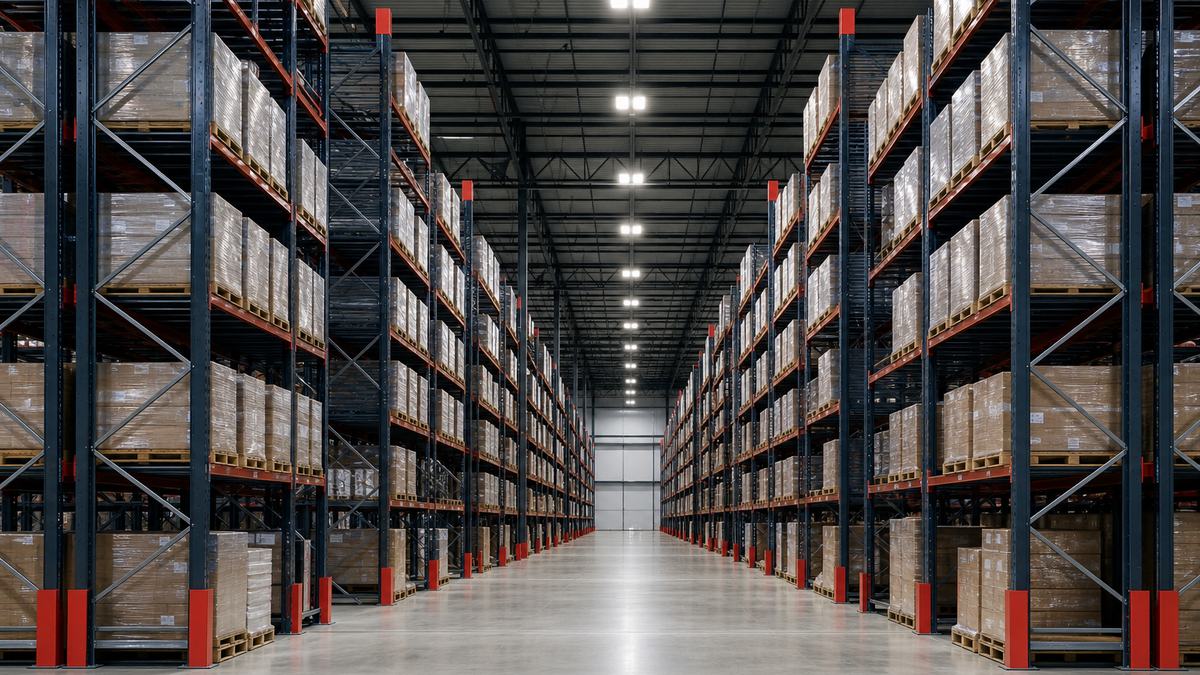
High-bay fixtures light spaces with tall ceilings: warehouses, distribution centers, manufacturing plants, big-box retail, hangars, gymnasiums and maintenance shops. Round "UFO" high-bays are compact and simple to install. Linear high-bays spread light along aisles and are often preferred for racked storage. Optics matter: narrow aisle optics put light down between tall racks, while wide distributions suit open floor areas and production lines.
Low-bays
Low-bay fixtures handle lower ceilings in workshops, back-of-house areas, garages and smaller industrial spaces, giving even light without the glare of an overpowered fixture mounted too low.
Vapor-tight and wet-location fixtures
Sealed linear fixtures protect the LED and driver from moisture, dust and washdown. They belong in food and beverage plants, cold storage, car washes, parking garages, loading docks and agricultural buildings. Look at the ingress protection (IP) rating and the wet-location listing to match the environment.
Hazardous-location fixtures
Refineries, chemical plants, grain handling, paint booths and some oil and gas facilities, common across the Gulf Coast and West Texas, may require fixtures listed for classified hazardous locations. These are specified to the area classification set by the facility's engineers and the authority having jurisdiction.
Exterior fixtures for sites, parking and buildings
Area and pole lights
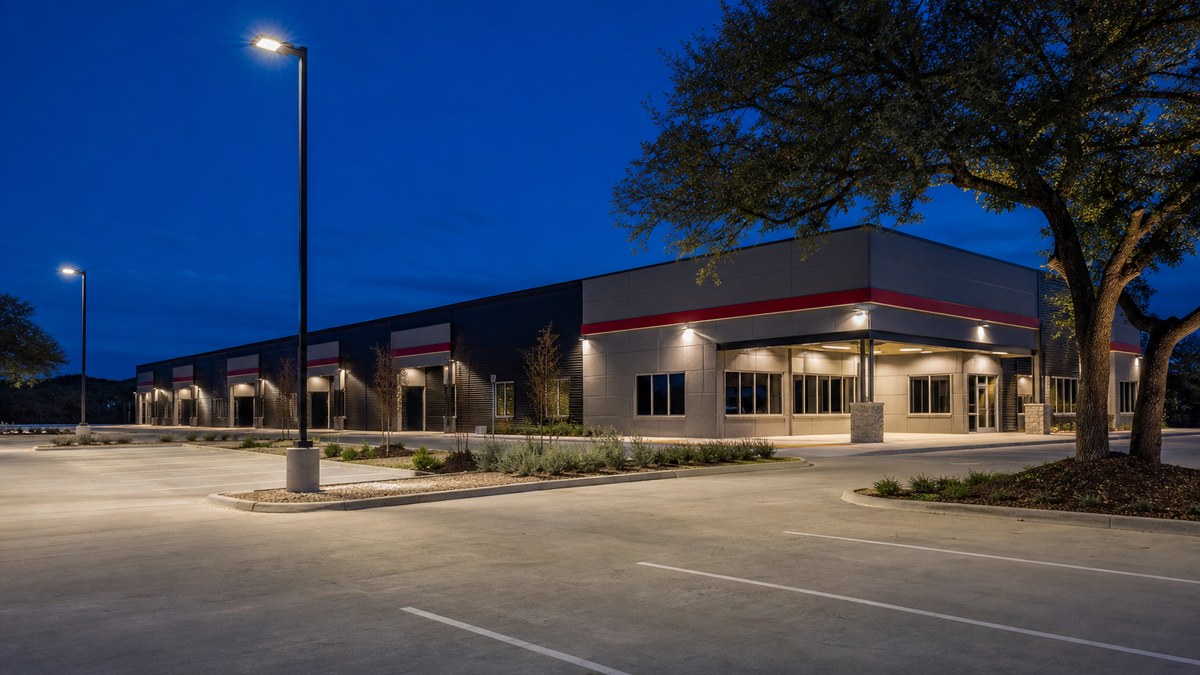
Area lights mounted on poles light parking lots, truck courts, campuses and drive aisles. The key specification is the distribution type, which shapes the light to the site: forward throw along a property line, wide patterns for the middle of a lot, or symmetric patterns for open areas. Optional house-side shields keep light off neighboring properties. Before reusing existing poles, check their condition and whether they are rated for the new fixture's weight and Texas wind loads. Our shopping center lighting guide covers retail parking in depth.
Wall packs
Wall packs are mounted on the building to light walkways, entries, loading areas and perimeters. Full-cutoff wall packs direct light down and reduce glare and sky glow, which matters for security cameras and neighbors alike. Many models offer built-in photocells and motion sensors.
Canopy lights
Low-profile canopy fixtures light fuel stations, drive-throughs, porte-cocheres, bank drive-ups and covered entries. Even, glare-controlled light under a canopy makes a site feel open and safe.
Floodlights
Floodlights light building facades, signs, flagpoles, yards and storage areas. Interchangeable optics and aiming hardware let installers put light exactly where it is needed. For stadium and field applications, see our LED sports lighting guide.
Bollards, steps and landscape lights
Pathway bollards, step lights, in-grade uplights and landscape fixtures complete the site and guide visitors from parking to the front door. For pools and water features, see our pool and aquatic center lighting guide.
Need a fixture schedule for your Texas building?
Send us your plans or tell us about your spaces and we will follow up to review the site and prepare a project-specific proposal.
Retail, hospitality and architectural fixtures
Customer-facing spaces need lighting that sells, welcomes and creates a brand impression:
- Track lighting: flexible heads that can be re-aimed as displays change, ideal for retail and galleries.
- Accent downlights: narrow beams with high color rendering to make merchandise, food and finishes look their best.
- Decorative pendants and chandeliers: the statement pieces in hotel lobbies, restaurants and event venues.
- Linear and tape light: under-cabinet, shelf, bar-front and cove lighting.
- Architectural facade fixtures: linear grazers, wall washers, projectors and color-changing systems that turn a building into a landmark at night. Learn more about our architectural lighting services.
- LED video walls and displays: for lobbies, venues and retail, see our LED video wall services and LED signage and message centers.
In hotels and restaurants, dimming quality and warm color temperatures matter more than raw output. In retail, color rendering and aiming flexibility come first. The fixture family has to match the business goal, not just the room size.
Fixture families at a glance
| Fixture family | Typical Texas applications | Key things to specify |
|---|---|---|
| Troffers & flat panels | Offices, schools, clinics, government buildings | Glare control, dimming protocol, sensor compatibility, retrofit kit vs. new |
| Linear pendants | Open offices, lobbies, conference rooms, open ceilings | Direct/indirect split, continuous runs, integrated sensors, emergency battery |
| Downlights | Corridors, lobbies, restrooms, hospitality | Beam spread, trim depth, color rendering, dimming smoothness |
| High-bays & low-bays | Warehouses, plants, big-box retail, gyms | Mounting height, aisle vs. open optics, high-ambient-temperature rating, sensors |
| Vapor-tights | Food plants, cold storage, garages, car washes, docks | IP rating, wet-location listing, washdown and chemical resistance |
| Area / pole lights | Parking lots, truck courts, campuses | Distribution type, shielding, pole condition and wind rating, photocell or controls |
| Wall packs | Entries, perimeters, loading areas | Full cutoff, mounting height, integrated photocell or motion sensor |
| Canopy lights | Fuel stations, drive-throughs, covered entries | Low glare, uniformity, wet-location rating |
| Floodlights | Facades, signs, yards, flagpoles | Optic choice, aiming hardware, glare shields |
| Architectural & color-changing | Facades, towers, hotels, venues, landmarks | Beam control, color consistency, DMX or network control, weather rating |
Specifications that actually matter
Fixture spec sheets are dense. These are the items that make the biggest difference to the result:
- Light distribution: the beam pattern and optic. The best fixture in the wrong distribution still lights the wrong place.
- Color temperature (CCT): warmer white for hospitality and lobbies, neutral white for offices and schools, cooler white where some industrial users prefer it. Keep it consistent across a space.
- Color rendering (CRI and related metrics): how natural colors look. Retail, healthcare, food service and hospitality benefit from higher color quality.
- Glare control: shielding, lenses and optics that keep bright points of light out of people's eyes and screens.
- Driver and dimming: the dimming protocol (0–10V, DALI, phase dimming or a manufacturer's networked platform) must match the control system.
- Thermal rating: the ambient temperature range the fixture is rated for. Unconditioned Texas warehouses, attics and rooftop equipment areas get very hot in summer.
- Environmental rating: damp or wet location listing, IP rating, corrosion-resistant finishes for coastal and chemical environments, and impact resistance where needed.
- Listings and qualifications: safety listings from a nationally recognized testing laboratory, and, where an incentive program requires it, qualified product lists such as the DesignLights Consortium.
- Serviceability: replaceable drivers and modules, and the manufacturer's support and parts availability.
How Texas conditions change the choice
Texas is not one climate. A fixture that works perfectly in a climate-controlled Austin office can struggle on a Corpus Christi waterfront or in an unconditioned Houston warehouse in August.
- Heat: long, hot summers push fixtures in uncooled warehouses, plant ceilings and exterior walls toward their thermal limits. Specify fixtures rated for the real ambient temperature, not just the room's design temperature.
- Humidity and salt air: along the Gulf Coast, from Beaumont and Galveston to Corpus Christi and South Padre, corrosion-resistant housings, coatings and stainless hardware extend fixture life. Our South Texas commercial lighting guide covers coastal sites in detail.
- Wind and hurricanes: exterior fixtures and poles should be specified with wind loads in mind. Coastal counties may fall under the TDI windstorm program; confirm with your AHJ and engineer.
- Hail and severe storms: impact-resistant lenses and sturdy mounting matter for exposed exterior fixtures across North and West Texas.
- Lightning and surge: surge protection at the fixture and the panel helps protect drivers from storm-related electrical events.
- Dust: West Texas, the Panhandle and industrial sites need sealed optics that resist dust buildup.
Controls and code requirements
In most new construction and major renovation work, lighting controls are not optional. Texas sets a statewide minimum energy code for commercial buildings through the State Energy Conservation Office, and many cities adopt and enforce their own editions and amendments. Energy codes typically address lighting power, automatic shutoff, occupancy sensing, daylight-responsive controls and exterior lighting controls. The exact requirements depend on the code edition your jurisdiction enforces, so confirm with your AHJ and design team early.
| Control strategy | Where it is used | Fixture requirement |
|---|---|---|
| Occupancy and vacancy sensing | Offices, restrooms, storage, warehouse aisles | Sensor-ready or integrated sensor fixtures |
| Daylight harvesting | Perimeter offices, skylit warehouses, atriums | Continuous dimming drivers |
| Time scheduling | Whole buildings, exteriors, retail sales floors | Compatible relays or networked control |
| Exterior photocell and dimming | Parking lots, wall packs, canopies | Photocell receptacle or integrated control |
| Networked lighting controls | Campuses, multi-site portfolios, large facilities | Fixtures listed for the chosen platform |
| Scenes and DMX | Hotels, venues, facades, worship spaces | DMX or architectural control-compatible drivers |
Emergency egress lighting is another code item that touches fixture selection. Many fixtures can include integral battery packs or connect to emergency inverters; the right approach depends on the building and the applicable codes.
Retrofit kits vs. new fixtures
When upgrading an existing Texas building, there are three common paths:
- Lamp replacement: LED tubes or lamps in existing fixtures. Quick, but it keeps old housings, lenses and sockets and can limit controls.
- Retrofit kits: new LED modules and drivers installed inside existing housings, common for troffers, high-bays and some exterior fixtures. Less disruption to ceilings and walls.
- Full fixture replacement: new fixtures designed as a complete system. Best performance, appearance and controls, and the natural choice when housings are damaged, the layout is wrong or the space is being renovated.
Many projects mix all three: retrofit kits in a grid ceiling that is staying, new high-bays in the warehouse and new area lights on the parking lot. If you are planning a phased upgrade, our guide to choosing commercial lighting contractors in Texas explains how to evaluate who will deliver it.
From fixture list to finished project
- Site review: walk the building, document existing fixtures, ceilings, mounting heights, controls and electrical conditions.
- Goals: confirm how each space is used, operating hours, appearance goals, maintenance pain points and any incentive or code targets.
- Lighting layout: a photometric layout to confirm light levels, uniformity and glare before anything is ordered.
- Fixture schedule: a schedule listing each fixture type, distribution, color temperature, driver, mounting and control requirements.
- Submittals and approvals: cut sheets for owner, architect and engineer review, plus any permit or utility program paperwork.
- Procurement and scheduling: order lead times and installation planned around occupied hours and operations.
- Installation: licensed electricians install fixtures, wiring and controls.
- Commissioning: sensors calibrated, schedules programmed, scenes set and light levels verified.
- Handover: as-built documentation, control training and a plan for service.
Incentives and tax considerations
Some Texas utilities run commercial energy-efficiency programs. Customers of Oncor, CenterPoint Energy, Austin Energy, CPS Energy and AEP Texas may qualify for incentives on qualifying LED and controls projects, depending on program availability. Programs often have product requirements, such as listing on a qualified product list, and pre-approval steps, so check before fixtures are ordered. Building owners may also want to ask whether the federal 179D energy-efficient commercial buildings deduction applies to their project; confirm with your tax advisor.
What drives the cost of a fixture package
Texas LED Lights prices every project individually after a site review and layout. The main factors are:
- Fixture families and quantities: standard commercial, specification-grade or architectural
- Performance requirements: color quality, optics, high-ambient or hazardous-location ratings
- Controls: basic sensors through networked controls and DMX scenes
- Retrofit vs. new: lamp replacement, kits or full replacement
- Installation conditions: ceiling heights, lift access, occupied spaces and after-hours work
- Exterior work: pole condition, wind-rated poles and foundations, underground electrical
- Schedule and phasing: one shutdown, phased floors or multi-site rollouts
Who supplies and installs it
Texas LED Lights brings 15+ years as an authorized architectural lighting dealer and project coordinator. Our licensed installation partner has completed over 200 major sports and commercial projects across the US and Canada — NFL, NBA, NHL, MLS, NCAA and NASCAR. That means one team can handle the full fixture package, from troffers and high-bays to parking lots, facades and controls, instead of leaving you to coordinate separate suppliers and installers. See our full commercial lighting services, our service overview, recent work in our portfolio, and the cities in our coverage area. For complete design-build transformations, explore Luminance.
Questions to ask before you buy fixtures
- Is there a photometric layout showing light levels and uniformity for each space?
- What distribution, color temperature and color rendering is specified for each fixture type, and why?
- What dimming protocol do the drivers use, and is it compatible with our control system?
- Are the fixtures rated for the real ambient temperatures and environment in our building?
- Do the products meet the requirements of the utility incentive program we plan to use?
- Which code edition does our jurisdiction enforce, and how does the design meet its control requirements?
- What warranties apply to fixtures and drivers, and who handles service calls?
Frequently Asked Questions
What are the most common types of commercial LED lighting fixtures?
What is the difference between a high-bay and a low-bay fixture?
Should I use LED retrofit kits or replace the fixtures?
What color temperature is best for commercial lighting?
Do commercial LED fixtures in Texas need special ratings for heat?
Are lighting controls required in Texas commercial buildings?
Can new LED fixtures qualify for utility incentives?
What exterior fixtures are best for an office or industrial site?
How much do commercial LED lighting fixtures cost?
What areas of Texas do you serve?
Get the right fixtures for every space
Request a consultation and we will follow up to review your building and prepare a project-specific fixture and installation proposal.
Related
Our Texas lighting network: Dallas commercial LED lighting, Fort Worth LED lighting, Arlington LED lighting, Irving LED lighting, Plano LED lighting, wholesale LED components, fiber optic starlight ceilings, 360° fiber optic lighting, premium pool lighting, modular building solutions, and Dallas modular structures. Browse more guides on our blog.