Pool & Aquatic Center LED Lighting in Texas: The Safety & Design Guide
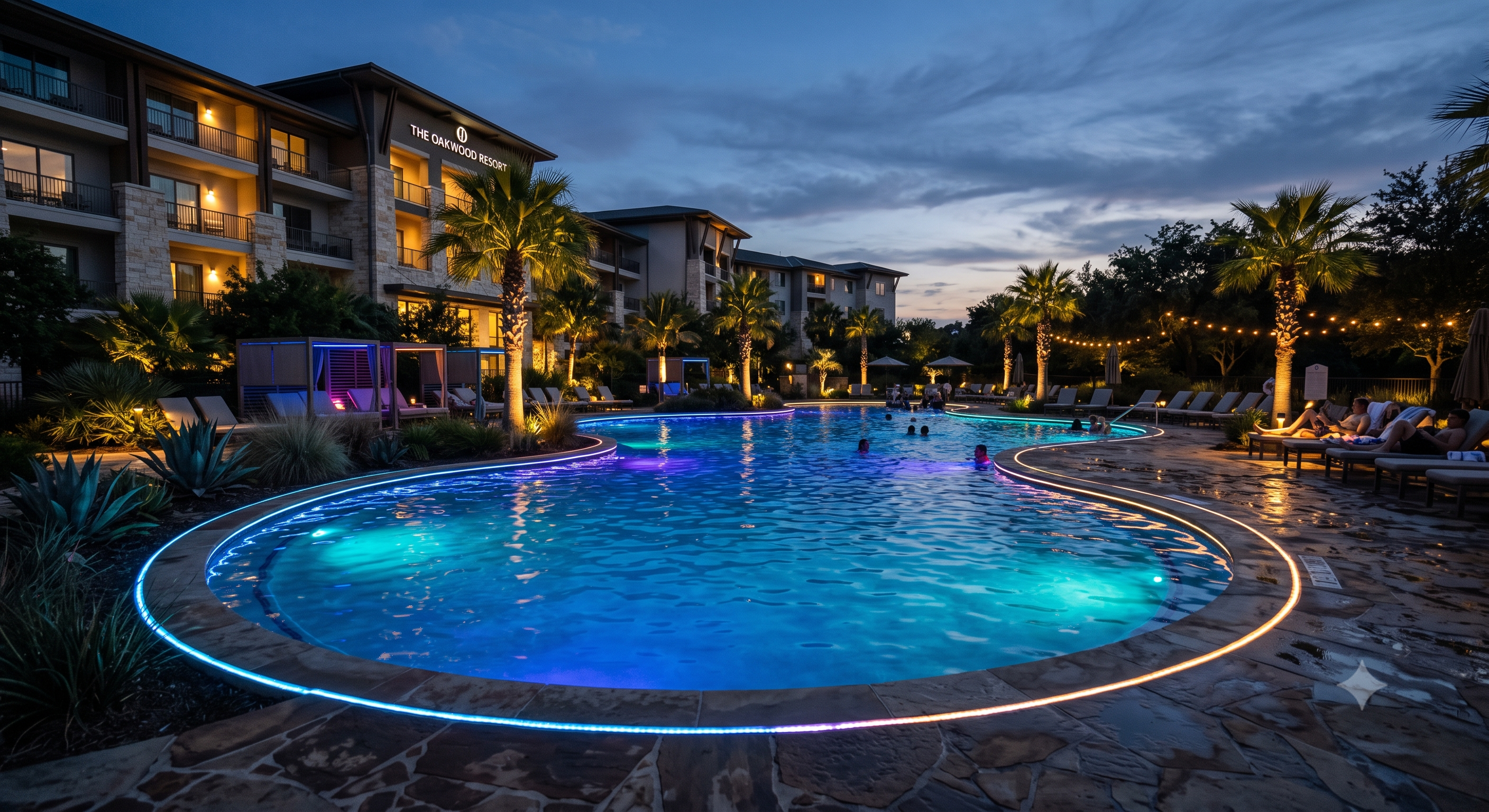
When the sun sets over Texas and swimmers still want to enjoy the water, the difference between a forgettable pool and a breathtaking aquatic experience comes down to one element: lighting. From luxury resort pools in Austin to municipal aquatic centers in Dallas, from hotel amenities in Houston to water parks across the state, professional LED and fiber optic lighting systems transform ordinary water features into stunning visual destinations while addressing the critical safety requirements that commercial pool operators cannot ignore.
The stakes for commercial pool lighting couldn't be higher. Inadequate illumination creates serious liability concerns, and the U.S. Consumer Product Safety Commission has long warned that faulty underwater lighting and wiring can cause electrical shock and electric shock drowning. Meanwhile, outdated halogen and incandescent systems drain energy budgets while delivering poor visibility and requiring frequent, expensive maintenance. For Texas facilities operating pools year-round in a competitive hospitality market, substandard lighting directly impacts guest satisfaction, operational costs, and regulatory compliance with Texas DSHS pool standards.
This comprehensive guide explores everything Texas pool operators, facility managers, hotel owners, and architects need to know about modern commercial pool and aquatic center lighting. You'll discover the critical differences between LED and fiber optic systems, understand how Texas codes apply, learn what drives the cost of a commercial installation, and find out why the safest pool lighting option puts zero electricity in the water. Whether you're building a new facility, retrofitting an aging system, or upgrading for guest experience, this guide lights the way forward.
Quick Answer: What is the Safest Commercial Pool Lighting?
Fiber optic pool lighting is the safest option for commercial pools because the light source (illuminator) remains completely outside the pool—only non-electrical fiber strands enter the water. This eliminates any risk of electric shock drowning. LED systems are also safe when properly installed with GFCI protection and low-voltage (12V) transformers per NEC Article 680 requirements.
5 Key Takeaways:
- Safety First: Fiber optic systems deliver light with zero electricity in the water—the ultimate protection against electric shock drowning
- Texas Code: public and semi-public pools fall under Texas DSHS rules (25 TAC Chapter 265), local health departments and NEC Article 680; confirm requirements with your local authority having jurisdiction
- Efficiency: LED and laser fiber optic systems use far less energy than halogen and incandescent pool lights
- Maintenance: longer-life light sources mean far fewer lamp changes and less underwater service
- Pricing: every facility is different, so projects are quoted after a site review
Why Commercial Pool Lighting Matters
Commercial pool lighting serves far more than aesthetic purposes—it's a critical safety system, a regulatory requirement, and increasingly, a competitive differentiator for hospitality and recreational facilities. Understanding these multiple functions helps pool operators make informed decisions about lighting investments.
Safety & Visibility
The primary function of pool lighting is ensuring swimmers and lifeguards can clearly see throughout the aquatic environment. Proper illumination allows lifeguards to monitor all areas of the pool, including the bottom where distressed swimmers may sink. Adequate lighting prevents accidents by making pool edges, depth changes, steps, and ladders clearly visible. For commercial facilities governed by Texas Department of State Health Services (DSHS) standards, maintaining required light levels isn't optional—it's a condition of operating legally.
Beyond general visibility, quality pool lighting directly impacts electric shock drowning (ESD) prevention. When underwater lights malfunction or develop faults, they can introduce electrical current into the water. Underwater lighting circuits are one of the recognized sources of ESD risk, a phenomenon where AC current leaking into pool water can paralyze swimmers, preventing them from calling for help or swimming to safety. This is why choosing the right lighting technology and maintaining proper electrical safety is literally a matter of life and death.
Guest Experience & Revenue
For hotels, resorts, apartment complexes, and entertainment venues, pool areas represent significant guest amenities and potential revenue centers. Well-designed pool lighting extends usable hours well into the evening, when many guests prefer to swim in Texas's cooler nighttime temperatures. Color-changing LED and fiber optic systems create memorable visual experiences that guests share on social media, driving organic marketing for the property.
Lighting that makes guests want to linger after dark also supports poolside food and beverage service and evening events. For water parks and aquatic entertainment venues, dramatic lighting transforms attractions and supports extended operating hours during peak summer seasons.
Energy Efficiency & Operating Costs
Legacy pool lighting technologies—halogen, incandescent, and early metal halide systems—consume enormous amounts of electricity while requiring frequent lamp replacements. LED fixtures deliver the same or better light at a fraction of the wattage of halogen pool lights, and for pools lit many hours a night the difference adds up quickly.
Maintenance savings compound these benefits. LED and laser light sources last far longer than halogen lamps, eliminating frequent relamping and reducing both material costs and the labor and liability of underwater fixture service.
Fiber Optic vs LED Pool Lighting: Which is Right for Your Facility?
Modern commercial pool lighting comes down to two primary technologies: LED (Light Emitting Diode) systems and fiber optic systems. Each has distinct advantages, and the best choice depends on your facility type, safety priorities, design goals, and budget. Understanding these differences is essential for making an informed decision.
Fiber Optic Pool Lighting: Zero Electricity in Water
Fiber optic pool lighting represents the gold standard for safety because the actual light source—called an illuminator—remains completely outside the pool environment. Only thin fiber optic strands enter the water, carrying light without any electrical current. This fundamental design eliminates the possibility of electric shock drowning from the lighting system itself.
How Fiber Optic Pool Lighting Works:
An illuminator containing a high-output LED or laser light source is installed on the pool deck or in a nearby equipment area away from the water. Bundles of thin, flexible fiber optic cables connect from the illuminator to fixtures embedded in the pool walls, floor, or perimeter. The illuminator generates light, and the fiber strands transmit that light to the underwater endpoints. The result is stunning illumination with absolutely no electrical components submerged in the water.
Advantages of Fiber Optic Systems:
- Ultimate Safety: Zero electricity in the water eliminates ESD risk from lighting
- Easy Maintenance: Illuminator is accessible at deck level—no draining or underwater work for lamp changes
- Design Flexibility: Thin fibers can be routed through tight spaces and arranged in virtually any pattern
- Perimeter Effects: Side-glow fibers create stunning neon-like perimeter lighting effects
- Starfield Effects: End-glow fibers create twinkling star effects on pool floors and walls
- Color Changing: Single illuminator can power color wheels for dynamic RGB effects
- Cool Operation: Fibers don't generate heat at the underwater endpoints
Considerations for Fiber Optic:
- Best planned with the design team so fiber runs and illuminator locations are coordinated
- Older halogen-based fiber systems were dim; modern laser illuminators are much brighter
- Illuminator placement requires planning for cable routing
- Best results when designed into new construction or major renovation
For luxury installations, hospitality venues, and facilities prioritizing absolute safety, specialists like Premium Pool Lighting design and install commercial-grade fiber optic systems that transform pools into stunning visual experiences. Modern 360° laser fiber optic lighting with RGB color-changing capability creates resort-quality environments that differentiate properties and enhance guest experiences.
LED Pool Lighting: Bright, Efficient, Versatile
LED pool lights place the light source directly in the water within a sealed, waterproof housing. Modern LED pool fixtures have become extremely safe when properly installed with GFCI protection and low-voltage (12V) transformers. They deliver significantly brighter output than fiber optic systems and offer excellent energy efficiency.
How LED Pool Lighting Works:
A transformer (typically 300-600 watt capacity) steps household 120V power down to 12 volts AC. This low-voltage power feeds underwater LED fixtures mounted in niches embedded in the pool wall. The fixtures contain sealed LED arrays that produce intense, efficient light while operating at voltages that, while not harmless, are far less dangerous than line voltage. GFCI (Ground Fault Circuit Interrupter) protection on all pool lighting circuits provides an additional safety layer by instantly cutting power if current leakage is detected.
Advantages of LED Pool Lighting:
- Brightness: LED fixtures deliver significantly more lumens than fiber optic endpoints
- Efficiency: a fraction of the energy of halogen and incandescent pool lights
- Longevity: far longer rated life than halogen lamps
- Color Options: RGB+W (Red, Green, Blue, White) fixtures offer millions of color combinations
- Retrofit Friendly: Many LED fixtures fit existing incandescent/halogen niches
- Familiar Installation: standard niche fixtures many pool contractors already service
- Smart Integration: Compatible with pool automation systems for app-based control
Considerations for LED:
- Electrical components are in the water (though at low voltage with GFCI protection)
- Underwater access required for maintenance (may need pool draining)
- Fixture replacement can be complex depending on installation
- Heat generation at fixture (though minimal with LED vs. halogen)
For deck, landscape and architectural lighting around the pool, our network also provides wholesale LED components.
Fiber Optic vs LED Pool Lighting Comparison
| Feature | Fiber Optic | LED |
|---|---|---|
| Electricity in Water | None ✓ | 12V with GFCI |
| Brightness | Moderate | High ✓ |
| Energy Efficiency | Excellent | Excellent |
| Maintenance Access | Deck level ✓ | Underwater |
| Design Coordination | Plan fiber routes | Standard niches ✓ |
| Retrofit Ease | Moderate | Easy ✓ |
| Design Effects | Starfield, perimeter ✓ | Standard fixtures |
| Heat in the Water | None at fiber ✓ | Minimal |
| Best For | Luxury, safety-critical | High-output, retrofits |
The Best of Both Worlds: Many luxury commercial pools combine LED fixtures for primary illumination with fiber optic elements for accent effects. This approach delivers the brightness needed for safety and visibility while adding the dramatic starfield, perimeter glow, and specialty effects that fiber optics excel at creating.
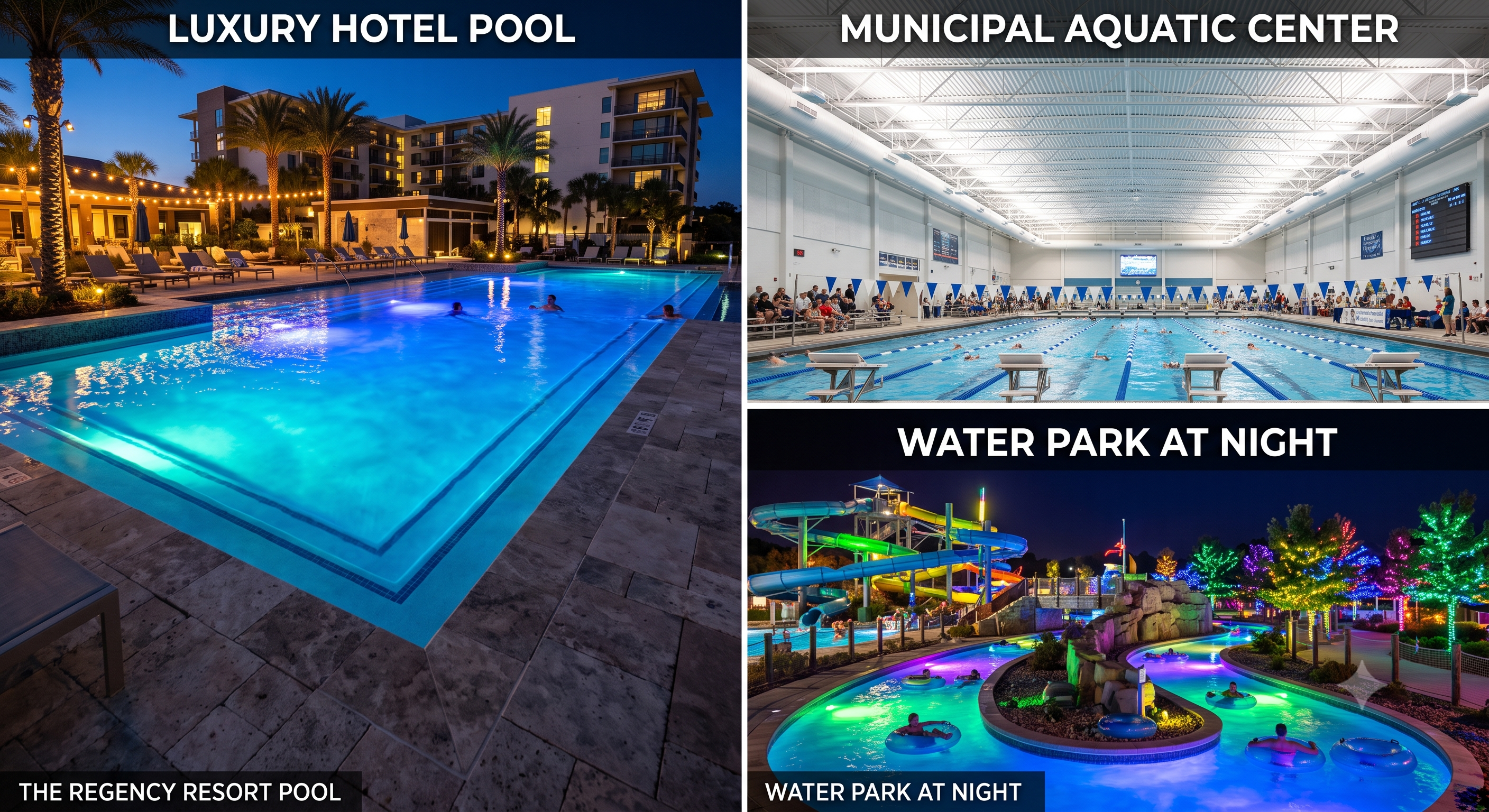
Types of Aquatic Facilities in Texas
Texas hosts an extraordinary variety of commercial aquatic facilities, each with distinct lighting requirements based on their function, operating hours, and guest expectations. Understanding these categories helps specify appropriate lighting systems.
Hotels & Resorts
Hotel pools represent critical guest amenities where lighting directly impacts perceived property value and guest satisfaction. Resort pools often operate extended hours and host evening poolside dining, entertainment, and events. Lighting systems must create inviting atmospheres while meeting commercial safety standards.
Key considerations include color-changing capabilities for events and themed experiences, integration with property management systems, minimal maintenance requirements for operations staff, and energy efficiency for 24/7 facilities. Our partners at Premium Pool Lighting focus on hospitality and community pools.
Apartment Complexes & HOA Communities
Community pools serve as shared amenities that significantly impact property values and resident satisfaction. These facilities typically operate on tighter budgets but must still meet all commercial pool standards. Lighting decisions often go through HOA boards or property management companies, requiring clear cost-benefit presentations.
Durability and low maintenance are particularly important for community pools where dedicated pool staff may not be available. LED retrofits that cut energy and maintenance appeal to cost-conscious boards.
Municipal Aquatic Centers & Natatoriums
Public aquatic centers and indoor pools (natatoriums) face the most demanding lighting requirements. Competitive swimming facilities need higher, more uniform light levels to support meets, timing systems and potential broadcasting, following the governing body's standards. Indoor pools must address high humidity, corrosive chlorine atmospheres and condensation with fixtures designed specifically for natatorium environments.
Fixtures must be corrosion-resistant, sealed against moisture, and often mounted on overhead structures requiring specialized access for installation and maintenance.
Water Parks & Aquatic Entertainment
Water parks represent the most complex aquatic lighting applications, with wave pools, lazy rivers, splash pads, water slides, and themed areas each requiring specific approaches. Lighting extends operating hours into profitable evening periods during peak summer seasons while creating the dramatic visual environment that guests expect from entertainment destinations.
Safety remains paramount in these high-traffic environments where guests move rapidly between attractions. Consistent illumination levels, clear wayfinding, and lifeguard visibility are critical design requirements.
Country Clubs & Private Clubs
Private club pools balance member expectations for luxury experiences with the operational realities of seasonal or part-time staffing. These facilities often incorporate spas, water features, and architectural elements that benefit from sophisticated lighting design integrating underwater, deck, and landscape lighting into cohesive environments.
Fitness Centers & Health Clubs
Lap pools and fitness facility pools prioritize functional illumination that supports exercise activities. Clean, bright, even lighting without glare helps swimmers see lane lines and pool edges clearly. Energy efficiency is particularly important for facilities operating extended hours.
Planning a project in Texas?
Tell us about your building and we will follow up with recommendations and a project-specific proposal.
Electric Shock Drowning Prevention
Electric shock drowning (ESD) is a hidden hazard in and around swimming pools. Understanding this risk and how proper lighting choices prevent it is essential knowledge for every commercial pool operator.
What is Electric Shock Drowning?
Electric shock drowning occurs when electrical current leaks into pool water, typically from faulty underwater lighting, pumps, or nearby electrical sources. Unlike electrocution, ESD doesn't require lethal voltage levels. Even small amounts of current can cause muscle paralysis, preventing swimmers from moving their limbs or calling for help. Victims appear to simply stop moving in the water, and without immediate intervention, they drown while conscious but unable to respond.
The U.S. Consumer Product Safety Commission has warned about electrical hazards in and around pools, pointing to faulty underwater lighting, aging wiring and improperly grounded or bonded equipment as key concerns.
⚠️ Warning Signs of Electrical Hazards in Pools:
- Flickering, dimming, or malfunctioning underwater lights
- Tingling sensations reported by swimmers
- Swimmers experiencing muscle cramps or unexpected difficulty moving
- Visible damage to light fixtures or conduits
- Pool equipment that has not been inspected in years
- Lighting systems installed before modern GFCI requirements
How Fiber Optic Lighting Eliminates the Risk
Fiber optic pool lighting provides the ultimate protection against electric shock drowning because no electrical current ever enters the water. The illuminator containing all electrical components remains outside the pool, typically on the deck or in an equipment room. Only fiber optic strands—which carry light through total internal reflection, not electricity—enter the pool environment.
This design means that even if the illuminator malfunctions, shorts out, or catches fire, there is physically no pathway for electrical current to reach swimmers. For facilities serving children, elderly guests, or populations with heightened safety concerns, fiber optic lighting offers unmatched peace of mind.
LED Safety Features
Modern LED pool lighting, while placing electrical components in the water, incorporates multiple safety layers:
- Low Voltage Operation: 12V systems reduce shock potential compared to legacy 120V fixtures
- GFCI Protection: NEC Article 680 requires ground-fault protection that cuts power when current leakage is detected
- Bonding: NEC Article 680 requires equipotential bonding of metal pool components
- Sealed Fixtures: IP68-rated housings prevent water intrusion
- Regular Inspection: Professional electrical inspection can identify developing faults before they become dangerous
When these systems are properly installed, maintained, and inspected, LED pool lighting provides safe illumination for commercial pools. However, the multiple safety layers are only effective when functioning correctly—aging systems, deferred maintenance, or improper installation can compromise protection.
Texas-Specific Safety Recommendations
Texas pool operators should follow these safety practices:
- Have pool electrical systems inspected regularly by a licensed electrician familiar with NEC Article 680
- Ensure underwater lighting circuits are protected by properly functioning GFCIs and test them on the manufacturer's schedule
- Consider upgrading legacy 120V lighting to 12V LED or fiber optic systems
- Never operate pools with damaged, flickering, or non-functional underwater lights
- Train lifeguards and staff to recognize signs of electrical emergencies
- Maintain documentation of all electrical inspections and repairs
Texas Commercial Pool Lighting Requirements
Commercial pools in Texas, including hotel, apartment, HOA and public pools, must comply with several overlapping sets of rules. The details change over time and vary by city, so always confirm current requirements with your local authority having jurisdiction (AHJ) before design.
- Texas DSHS: public and semi-public pools fall under the Texas Department of State Health Services pool and spa rules (25 Texas Administrative Code Chapter 265), which include lighting requirements for pools that operate after dark.
- Local health departments: many cities and counties inspect and permit public and semi-public pools and may add local requirements.
- NEC Article 680: the National Electrical Code article for swimming pools covers GFCI protection, bonding, underwater luminaires, transformer and fixture placement.
- Building and energy codes: as adopted by your city, including emergency and egress lighting for indoor facilities.
- Permits and inspections: most municipalities require electrical permits for pool lighting work, and health inspections may verify lighting before a pool reopens.
Teams across our network, including Dallas LED Lights and Fort Worth LED Lights, help Texas facilities plan compliant pool and deck lighting.
What Drives the Cost of Commercial Pool Lighting
Every aquatic facility is different, so we price each project individually after a site review. The main factors are:
- Pool size and shape: how many fixtures or fiber runs are needed for even coverage
- Technology: LED niche fixtures, laser fiber optic systems, or a combination
- New build vs retrofit: reusing niches and conduits versus new penetrations
- Access: whether the pool must be drained or lowered
- Electrical condition: panels, circuits, GFCI and bonding updates
- Deck and overhead lighting: deck, landscape and natatorium fixtures
- Controls: color scenes, scheduling and automation integration
- Timing: off-season or after-hours installation
For 360 Fiber laser systems, current system options are listed at 360fiberlighting.com. For everything else, you receive a project-specific proposal.
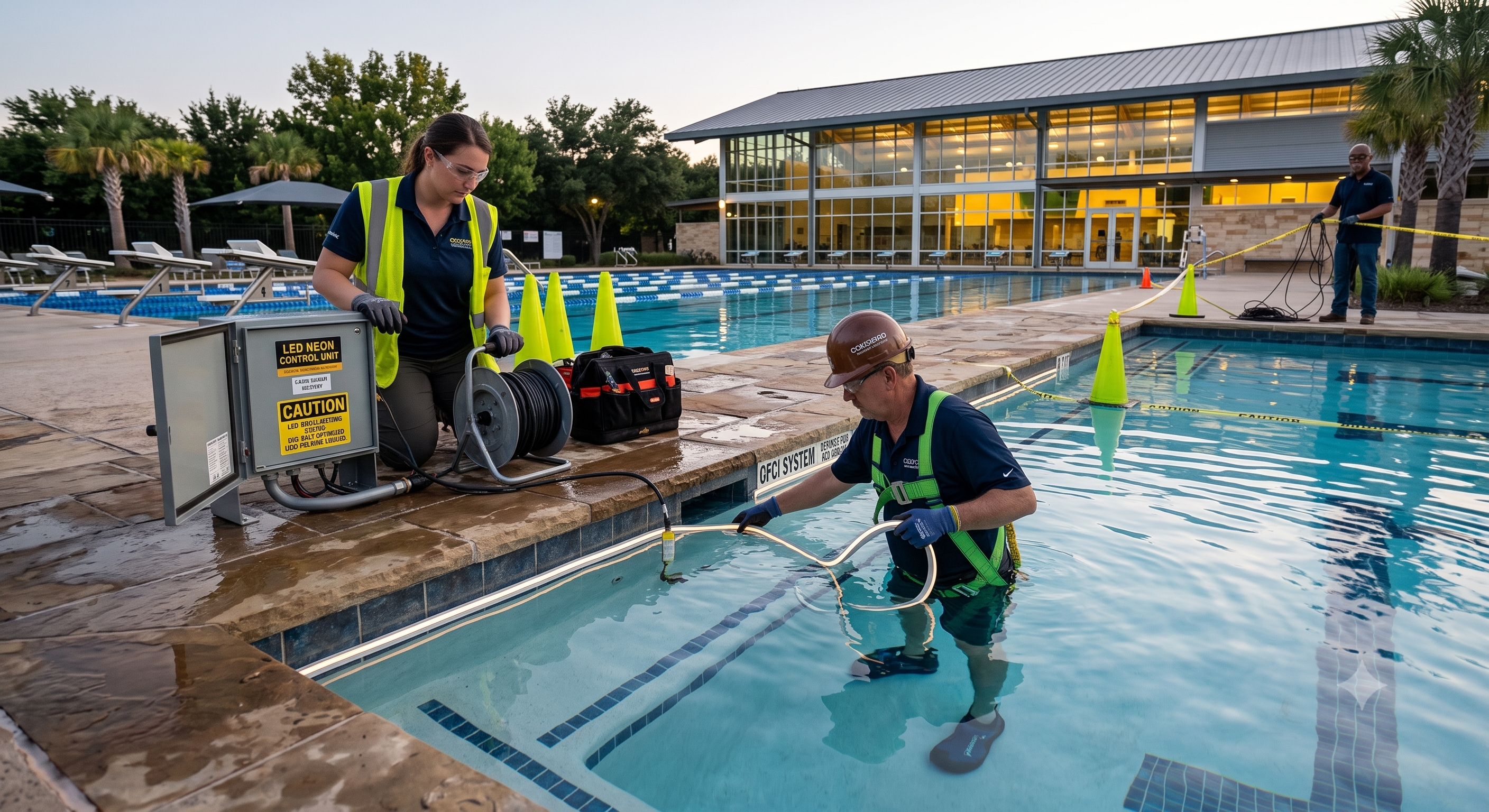
Commercial Pool Lighting Installation Process
Professional commercial pool lighting installation follows a systematic process designed to minimize pool downtime while ensuring code compliance and optimal results.
Phase 1: Assessment & Design (1-2 Weeks)
- Site Survey: Evaluation of existing lighting, electrical infrastructure, and pool conditions
- Light Level Testing: Measurement of current illumination to identify deficiencies
- Code Review: Assessment of current code compliance status
- Design Development: Photometric modeling showing proposed light levels
- Technology Selection: LED vs. fiber optic recommendation based on goals and budget
- Proposal: Detailed scope, specifications and a project-specific proposal
Phase 2: Pre-Installation (1-2 Weeks)
- Permit Applications: Electrical and/or health department permits as required
- Equipment Ordering: Fixtures, transformers, illuminators, and materials
- Schedule Coordination: Planning installation timing to minimize guest/user impact
- Pool Preparation: Scheduling any necessary draining or water level reduction
Phase 3: Installation (Varies by Scope)
Installation timelines depend on project complexity:
- LED retrofits: usually the shortest, especially when existing niches are reused
- Complete pool lighting systems: longer, depending on electrical and deck work
- Fiber optic installations: best coordinated with construction or renovation schedules
- Natatorium lighting: depends on overhead access and the facility schedule
Evening, overnight and off-season installation can be planned to avoid business disruption. Pool closures can often be minimized to just the installation period, with the pool reopening as soon as inspections are complete.
Phase 4: Commissioning & Documentation
- Testing: Verification of all circuits, GFCI function, and control systems
- Light Level Verification: Confirmation that design and code light levels are achieved
- Inspections: Electrical and health department sign-offs as required
- Training: Staff instruction on controls, programming, and basic maintenance
- Documentation: As-built information, warranty documents and maintenance guidance
Frequently Asked Questions
What is the safest type of pool lighting?
How much does commercial pool lighting cost in Texas?
What are the Texas requirements for commercial pool lighting?
How long do LED pool lights last?
What is electric shock drowning and how do I prevent it?
Can I retrofit my existing pool with LED lighting?
What's the difference between 12V and 120V pool lights?
How much energy do LED pool lights save?
Do I need permits for commercial pool lighting work?
What is natatorium lighting?
Ready to talk about your property?
Tell us about your building and we will follow up with recommendations and a project-specific proposal.
Related
Our DFW lighting network: Dallas commercial LED lighting, Fort Worth LED lighting, Arlington LED lighting, Irving LED lighting, Plano LED lighting, wholesale LED components, fiber optic starlight ceilings, 360° fiber optic lighting, modular building solutions, and Dallas modular structures.