Texas Shopping Center LED Lighting: Parking Lots, Storefronts, Facades & Common Areas
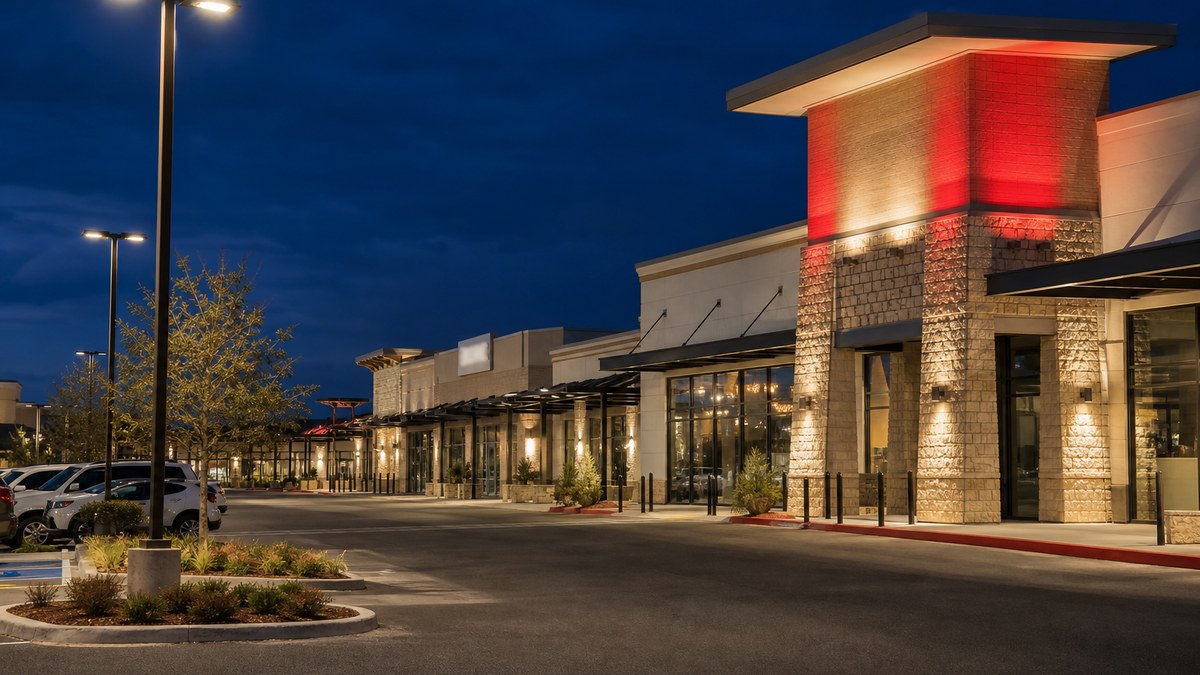
Texas shopping center LED lighting shapes how shoppers feel the moment they turn off the road: whether the parking lot looks safe, whether storefronts are easy to find, and whether the property looks well cared for after dark. For owners, property managers and asset managers of strip centers, neighborhood centers, power centers, lifestyle centers and enclosed malls across Texas, lighting is also one of the most visible maintenance items on the property. Burned-out pole heads, flickering canopy lights, yellowed lenses and dark corners are the first things tenants and customers notice, and the first things they complain about.
This guide explains how to plan a complete LED lighting program for a Texas retail property, from the parking field and drive aisles to canopies, walkways, facades, monument signs, loading docks and interior common areas. It covers the standards and local rules that apply, how to balance security with good-neighbor and dark-sky goals, which controls make sense, how to phase work around tenants and holiday traffic, and what to ask before you choose a contractor. Texas LED Lights works statewide, from Dallas–Fort Worth to Houston, Austin, San Antonio, El Paso, Corpus Christi, Lubbock and the Rio Grande Valley.
Shopping center LED lighting replaces aging metal halide, high-pressure sodium and fluorescent fixtures across the whole property with LED area lights, wall packs, canopy lights, facade lighting and controls, designed together so the center is brighter, more uniform, easier to maintain and more inviting at night.
- Parking lots and drives: LED area lights on existing or new poles with optics that put light on the pavement, not in neighbors' windows
- Storefronts and canopies: even, glare-free light that helps shoppers find tenants and feel safe walking
- Facades and towers: architectural lighting that makes the center recognizable from the road
- Back of house: wall packs and dock lights for service drives, loading areas and dumpster enclosures
- Controls: photocells, schedules, dimming after hours and occupancy sensing
- Standards: IES recommended practices, local lighting ordinances and the adopted energy code
- Pricing: a project-specific proposal after a site assessment and photometric design
Why lighting matters for Texas retail properties
Texas has an enormous inventory of retail real estate, much of it built in waves over several decades. A typical center may have parking lot poles from one era, canopy fixtures from another, tenant-installed wall packs from a third, and a facade that has never been lit at all. The result is a property that looks patchy at night: bright spots under some poles, dark gaps between others, mixed color temperatures and fixtures that cycle on and off.
Upgrading to a coordinated LED system addresses the issues that matter most to owners and tenants:
- Perceived safety: shoppers judge a parking lot in seconds. Uniform light with good vertical illumination on faces and vehicles makes people more comfortable walking to their cars after dark.
- Tenant satisfaction and retention: restaurants, gyms, grocers and service tenants depend on evening traffic. A dim or patchy center undercuts their business and becomes a lease conversation.
- Curb appeal and leasing: a well-lit facade and clean, consistent color make the property look current to prospective tenants and buyers.
- Maintenance: LED fixtures need far fewer service calls than metal halide or sodium lamps, which means fewer bucket-truck visits and fewer dark poles between visits.
- Energy and operating expenses: LED and controls reduce the common-area electric load, which flows into CAM budgets that tenants watch closely.
- Security cameras: even, white light improves the quality of surveillance video compared with the orange cast and deep shadows of older sodium lighting.
Texas conditions add their own demands. Fixtures must handle extreme summer heat, hail, high winds, coastal humidity and salt air near the Gulf, and the lightning that is common across the state. Poles, bases and electrical systems on older centers have often been through decades of that weather, so a structural and electrical review is part of any serious upgrade.
The zones of a shopping center lighting plan
A good plan treats the property as a set of zones, each with its own purpose, light level, fixture type and control strategy. The table below summarizes the main zones on a typical Texas retail center.
| Zone | Typical LED solution | Design priorities |
|---|---|---|
| Parking field | Pole-mounted LED area lights with Type III, IV or V optics | Uniformity, vertical light, glare and spill control |
| Entrances and drive aisles | Area lights and site lighting at curb cuts and intersections | Driver visibility, pedestrian crossings, wayfinding |
| Storefront canopies and walkways | Recessed or surface canopy lights, downlights, soffit lights | Even light on sidewalks, low glare, consistent color |
| Facades, towers and architecture | Linear grazing, wall washers, floodlights, color-changing fixtures | Identity, visibility from the road, seasonal flexibility |
| Monument and pylon signs | LED sign retrofits, ground-mounted floods, LED message centers | Legibility, sign code compliance |
| Service drives and loading docks | Full-cutoff wall packs, dock lights, area lights | Security, safe deliveries, minimal spill to neighbors |
| Enclosed mall common areas | Downlights, linear, high-bay, cove and accent lighting | Atmosphere, merchandising support, energy code controls |
| Parking garages | Garage luminaires with occupancy dimming | Uniformity, stairwells and entries, controls |
Parking lots and drive aisles
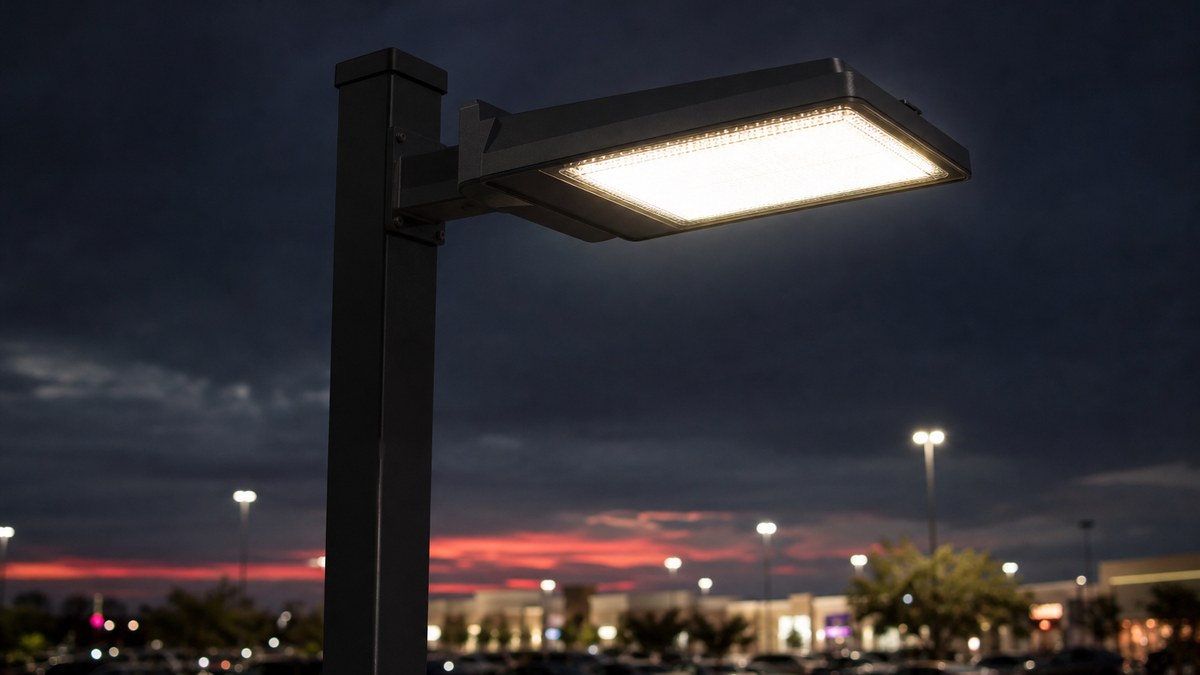
The parking field is usually the biggest part of the project and the part customers notice most. Older systems often used a small number of high-wattage metal halide heads on tall poles, producing hot spots directly underneath and dark areas between poles. LED area lights use precise optical distributions so light is spread evenly across the pavement. Choosing the right distribution for each pole location — for example, a forward-throw optic for poles along a property line and a symmetric optic for poles in the middle of the lot — is what turns a collection of fixtures into a uniform system.
Vertical illumination matters as much as light on the ground. People feel safer when they can see faces and the space between parked cars, not just bright asphalt. A photometric design should report both horizontal and vertical values across the lot.
Storefronts, canopies and walkways
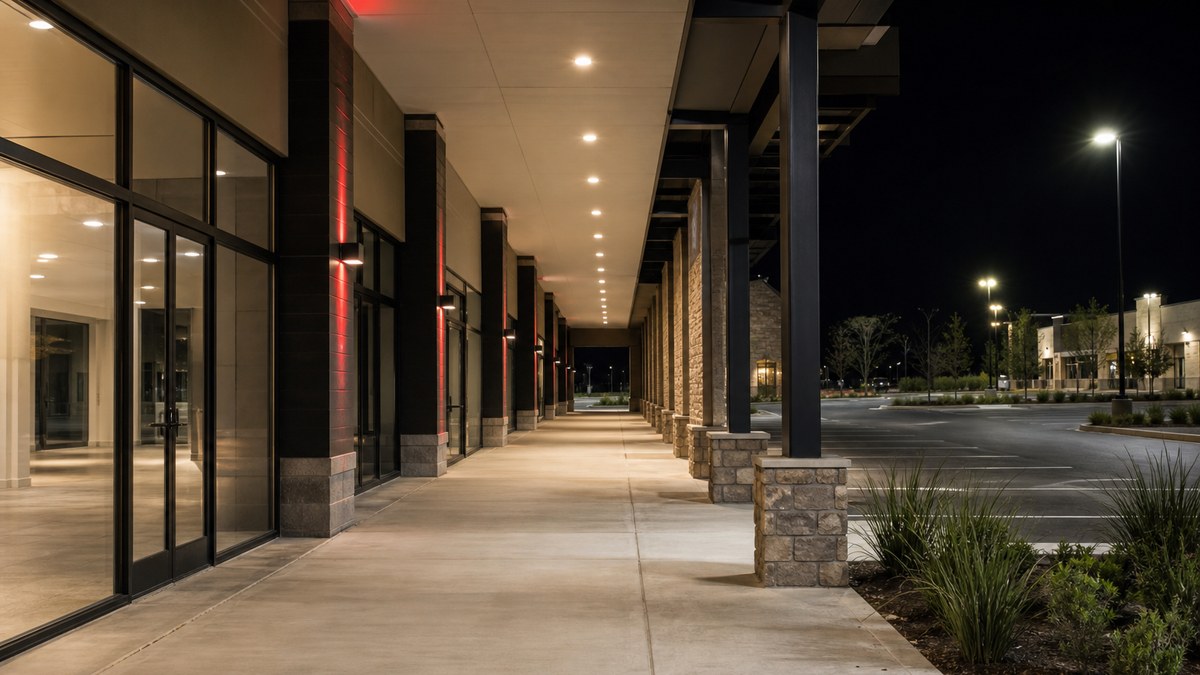
Covered walkways are where shoppers spend the most time on foot. Old canopy fixtures with yellowed lenses, mismatched lamps and failed ballasts make even a well-leased center look tired. LED canopy and soffit lights provide even light along the sidewalk, reduce glare in shoppers' eyes, and give every storefront a consistent look. Many owners choose a single color temperature for all common-area lighting so the whole center reads as one property.
Facades and architectural features
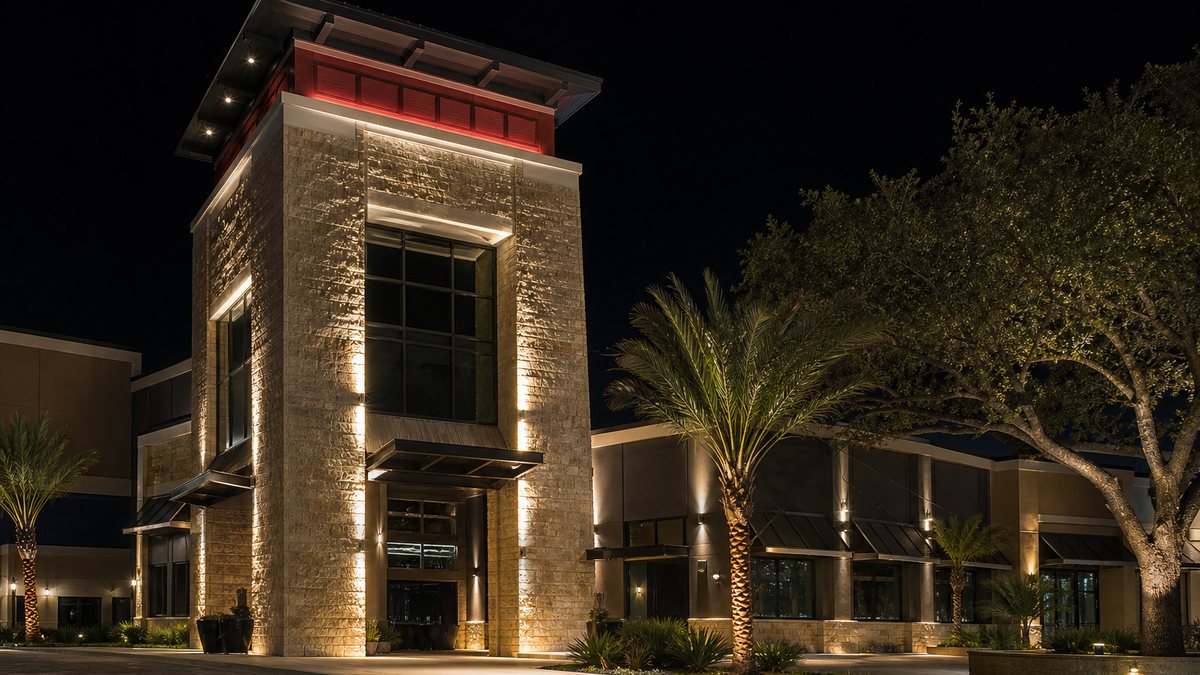
Towers, parapets, columns and entry features are the elements drivers see from the highway or the arterial road. Architectural LED lighting — grazing, washing and accent lighting — makes those elements visible at night and gives the property a recognizable identity. Color-changing systems let the center mark holidays, local sports seasons and community events without new hardware. See our architectural and facade lighting services for more on this zone.
Back of house
Service drives, loading docks, trash enclosures and rear doors are often the darkest parts of a center and the ones with the most security concerns. Full-cutoff LED wall packs and area lights improve visibility for delivery drivers, tenant staff and patrols while keeping light from spilling into adjacent homes, which is common for neighborhood centers built next to residential streets.
Standards, codes and local ordinances
There is no single number that defines "enough" light for a shopping center. Good designs draw on several sources:
- IES recommended practices: the Illuminating Engineering Society publishes guidance for exterior environments and parking facilities, including IES RP-20 for parking facilities and related practices for outdoor and retail lighting. These address light levels, uniformity and glare by area type and activity level.
- Local lighting ordinances: many Texas cities and counties regulate outdoor lighting with rules on fixture shielding, mounting height, color temperature, light trespass at property lines and hours of operation. Several North Texas and Hill Country communities have adopted dark-sky ordinances, and some counties regulate lighting near observatories.
- Energy code: the energy code adopted by your jurisdiction typically sets requirements for exterior lighting power and automatic controls such as photocells, time switches and after-hours reduction.
- Electrical code: wiring, grounding, surge protection and pole-base work must meet the National Electrical Code as adopted locally.
- Sign code: monument, pylon and electronic message signs have their own rules on brightness, animation and hours.
- Leases and REAs: tenant leases and reciprocal easement agreements sometimes specify lighting hours, minimum levels or approval rights for changes.
Specific numeric targets depend on the edition of each standard, the activity level of the site and local rules, so always confirm requirements with your AHJ (authority having jurisdiction) before finalizing a design. A photometric plan that shows light levels on the site and at every property line makes permitting and neighbor conversations far easier.
Before you request proposals, pull together the site plan, any existing photometric plans, utility bills for house meters, a list of known dark poles or fixtures, tenant complaints about lighting, and any lease or REA language on lighting hours. It shortens the assessment and leads to a more accurate proposal.
Security, comfort and good neighbors
Retail lighting has to balance competing goals. Owners want a bright, safe-looking property; neighbors want darkness in their backyards; cities want less sky glow; and drivers need to see without being blinded. Modern LED optics make it possible to meet all of these at once, but only when the system is designed for it.
- Uniformity over brute brightness: a lot with even light at moderate levels feels safer than one with a few very bright spots and deep shadows.
- Glare control: fixtures with full cutoff and the right optics keep bright LED sources out of drivers' and shoppers' direct view.
- House-side shields: on poles near property lines, shields and forward-throw optics keep light on the lot and off neighboring homes.
- Color temperature: warmer or neutral white light is often preferred near residential areas and may be required by local ordinances; cooler light can work well in large commercial lots. Consistency across the property matters most.
- Camera coverage: coordinate lighting with security camera locations so key areas have enough light and minimal backlighting for clear video.
- After-hours dimming: reduce light after stores close while keeping enough light for security patrols, late-night tenants and employees leaving work.
Planning a lighting upgrade for your Texas center?
Tell us about your property and we will follow up to schedule a site assessment and prepare a project-specific proposal.
Controls that fit retail operations
Controls are where much of the long-term value of an LED upgrade comes from. They also help meet energy code requirements for automatic exterior lighting control. The right package depends on tenant hours, security needs and how hands-on the property team wants to be.
| Control | What it does | Where it helps |
|---|---|---|
| Photocells | Turns lights on at dusk and off at dawn | Every exterior zone |
| Astronomic time clocks | Schedules by sunset and sunrise with no seasonal resets | Facades, signs, parking fields |
| After-hours dimming | Lowers output once tenants close | Parking lots and canopies |
| Occupancy and motion sensing | Raises light when people or vehicles are present | Back-of-house, garages, remote lot areas |
| Zoning | Keeps lights on near late-night tenants only | Centers with restaurants, gyms or overnight tenants |
| Networked or wireless controls | Remote scheduling, fault alerts and reporting | Large centers and multi-property portfolios |
| DMX or architectural control | Color scenes and seasonal programs | Facades, towers and holiday displays |
For owners with several centers, networked controls make it possible to manage schedules and spot outages across a portfolio from one dashboard, rather than waiting for a tenant to report a dark pole.
Retrofit, relamp or redesign?
Most Texas retail properties fall into one of four paths. The right one depends on the condition of poles and wiring, how well the current layout performs, local rules and the owner's plans for the property.
- Fixture replacement on existing poles: new LED area lights mounted on poles that pass a structural review. Often the fastest path, but limited by existing pole locations and heights.
- Retrofit kits: LED kits installed inside existing housings. Useful in some situations, but performance depends on the old fixture's optics and condition, and kits may not solve glare or uniformity problems.
- Layout redesign: relocating, adding or removing poles to fix dark areas, light trespass or a parking layout that has changed since the center was built.
- Full property program: parking, canopies, facades, signage, back of house and controls designed together, often timed with a facade renovation or re-tenanting.
A site assessment and photometric comparison of the options makes the decision clear, and it lets owners phase work over several budget cycles while still following one master plan.
Planning around tenants and traffic
Retail projects happen while the center is open. A good installation plan protects tenant sales and customer access:
- Work windows: schedule lift and pole work during low-traffic hours, and coordinate with grocers, restaurants and other early or late tenants.
- Holiday season: avoid disrupting parking during the busiest shopping weeks; many owners complete exterior work before the holiday season or after it.
- Parking area closures: close small sections at a time with clear signage and traffic control rather than blocking large areas.
- Tenant communication: give tenants advance notice of work near their storefronts and any brief power interruptions on house circuits.
- Hot weather: plan for Texas summer heat when scheduling crews and long outdoor work days.
- Storm season: keep temporary lighting and make-safe procedures ready if severe weather interrupts work on poles.
How a Texas shopping center lighting project works
- Assessment: walk the site day and night, measure existing light levels, inventory poles, fixtures and wiring, and note dark areas, glare and neighbor issues.
- Goals and constraints: confirm owner goals, tenant hours, security priorities, local ordinances, lease and REA requirements and budget timing.
- Photometric design: model light levels, uniformity and property-line trespass for each option.
- Structural and electrical review: confirm poles, bases, anchor bolts, circuits, panels and controls.
- Proposal: a project-specific proposal with fixture schedules, controls and phasing.
- Permits and approvals: submit to the city or county as required, and coordinate with ownership, lenders or associations if needed.
- Installation: licensed professionals install fixtures, poles, wiring and controls in phases around tenant operations.
- Commissioning: program controls, adjust aiming and verify light levels at night.
- Handover and service: documentation, training for the property team and ongoing service available.
Utility programs and tax considerations
Many Texas commercial customers are served by utilities that run energy-efficiency programs. Depending on program availability, projects in areas served by Oncor, CenterPoint Energy, Austin Energy or CPS Energy may qualify for incentives for efficient lighting and controls. Program rules, eligible equipment lists, pre-approval requirements and funding change over time, so check before ordering equipment; many programs require approval before work begins.
Some building owners also look at the federal Section 179D deduction for energy-efficient commercial buildings, which can involve lighting. Eligibility depends on the specific project and current law, so confirm with your tax advisor.
What drives project cost
Every shopping center is different, so Texas LED Lights prices each project after an assessment and photometric design. The main factors are:
- Property size and zones: parking only, or parking plus canopies, facades, signs and back of house
- Pole condition: reuse versus new poles, bases and foundations
- Electrical condition: wiring, underground circuits, panels and surge protection
- Fixture and optic selection: distributions, shielding, color temperature and finishes for Texas weather
- Controls: basic photocells through networked controls and architectural scenes
- Phasing and access: night work, lift access, traffic control and tenant coordination
- Permitting and ordinance compliance: local review and any required redesign for light trespass
Large owners and REITs often prefer one consistent fixture and control standard across a portfolio. We can help define that standard and roll it out property by property.
Enclosed malls and interior common areas
Enclosed malls and lifestyle centers with interior concourses add another layer: atriums, food courts, corridors, restrooms, service corridors and parking garages. LED downlights, linear fixtures, cove lighting and high-bay fixtures in tall atriums can be paired with daylight sensors where skylights bring in natural light. Interior lighting sets the mood for shoppers and supports tenant merchandising, while energy code controls such as occupancy sensing in back-of-house corridors and restrooms keep operating costs in check. Feature elements such as fiber optic starlight ceilings in entertainment and dining areas, or LED video walls in atriums, can turn a common area into a destination.
Signage, video and wayfinding
Lighting and signage work together. LED retrofits for monument and pylon signs improve legibility and reduce maintenance. Electronic message centers let owners promote tenants and events, subject to local sign codes. Our network partner delivers LED signage and message centers, and we coordinate those with the site lighting so signs, facades and parking lots look like one design. Clear, well-lit directional signs at entrances and drive aisles also help customers find parking and tenants quickly.
Who builds it: our experience
Texas LED Lights brings 15+ years as an authorized architectural lighting dealer and project coordinator. Our licensed installation partner has completed over 200 major sports and commercial projects across the US and Canada — NFL, NBA, NHL, MLS, NCAA and NASCAR. That depth in large, complex projects carries into retail work, where schedules, safety and tenant operations all have to be managed at the same time.
We coordinate the full property: parking and site lighting, canopies and walkways, commercial interior lighting, facade lighting, signage and controls. For complete design-build transformations of a property's look at night, see Luminance design-build. If your center includes a fitness club, a school sports field nearby or a community pool, our LED sports lighting guide and pool and aquatic lighting guide cover those spaces. For advice on vetting installers, read our guide to choosing commercial lighting contractors in Texas.
Questions to ask before you choose a contractor
- Will you provide a photometric plan showing light levels on the site and at every property line?
- Which IES recommended practices and local ordinance requirements is the design based on?
- Have our existing poles, bases and wiring been evaluated before you recommend reusing them?
- Which optical distributions are you using at each pole, and how do you control glare near homes and roads?
- What controls are included, and do they meet the adopted energy code?
- How will the work be phased around tenants, parking and the holiday season?
- Are the fixtures listed with the DesignLights Consortium where utility programs require it?
- What warranties apply to fixtures, drivers and controls, and who provides service after installation?
Frequently Asked Questions
Why should a Texas shopping center upgrade to LED lighting?
What standards apply to shopping center parking lot lighting?
Can we reuse our existing parking lot poles?
How do you keep parking lot light out of nearby homes?
What color temperature is best for a shopping center?
Can lighting work be done while the center stays open?
Are utility incentives available for shopping center LED upgrades?
Do you light facades, towers and signs as well as parking lots?
How much does shopping center LED lighting cost?
What areas of Texas do you serve?
Make your center shine after dark
Request a consultation and we will follow up to schedule a day-and-night assessment of your property.
Related
See our full list of services, recent project types and the areas we cover across Texas, or browse more guides on the Texas LED Lights blog. Prefer to talk it through? Schedule a meeting with our team.
Our Texas lighting network: Dallas commercial LED lighting, Fort Worth LED lighting, Arlington LED lighting, Irving LED lighting, Plano LED lighting, wholesale LED components, fiber optic starlight ceilings, 360° fiber optic lighting, premium pool lighting, modular building solutions, and Dallas modular structures.