South Texas Commercial LED Lighting: Corpus Christi, the Rio Grande Valley & Laredo
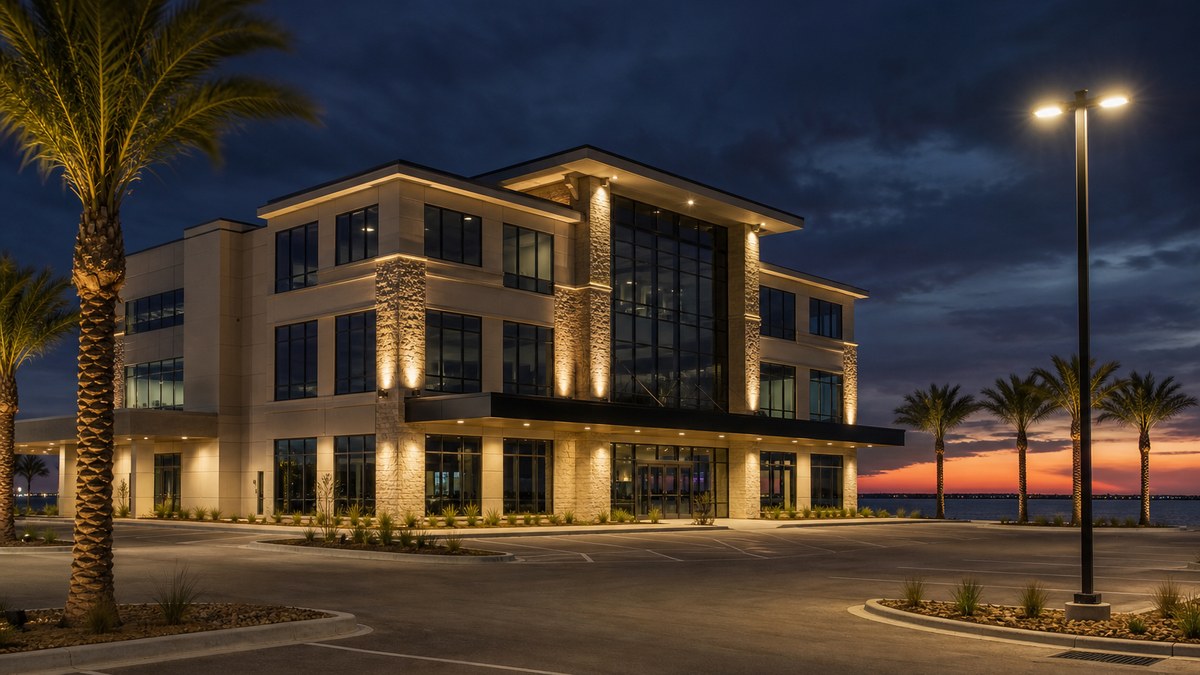
South Texas commercial LED lighting has to work harder than lighting almost anywhere else in the state. From the Coastal Bend around Corpus Christi to the Rio Grande Valley and the border logistics hub of Laredo, buildings face salt air, heavy humidity, long stretches of extreme heat, tropical storms and some of the longest operating hours in Texas. Warehouses and cold storage run around the clock, retail and hospitality stay open late, and parking lots, docks and yards need dependable light every night of the year.
This guide is for business owners, property and facility managers, school districts, cities, churches, healthcare campuses, hotels and developers across South Texas. It explains what makes the region different, how to specify LED fixtures that survive coastal and border conditions, how to light the building types that dominate the region, what codes and community rules to plan for, and how a project runs from site walk to commissioning. Texas LED Lights serves the whole region from Victoria and the Coastal Bend down to Brownsville and west to Laredo, Eagle Pass and Del Rio.
Good South Texas lighting means LED fixtures and controls specified for the region's conditions, not just picked from a catalog.
- Corrosion resistance: marine-grade finishes, stainless hardware and sealed housings near the coast
- Heat-rated drivers: components rated for high ambient temperatures in fixtures, canopies and attics
- Wind and storms: poles, brackets and mounting engineered for the local wind design requirements
- Surge protection: protection against lightning and utility switching events
- Controls: scheduling, motion sensing and dimming for 24/7 logistics, retail and hospitality sites
- Community rules: shielding for neighbors, wildlife-friendly lighting on the coast and dark-sky goals
- Pricing: a project-specific proposal after a site assessment and lighting design
What makes South Texas lighting different
"South Texas" covers a large and varied area, but most commercial properties in the region share a set of conditions that shorten the life of poorly specified lighting:
- Salt air: along the Gulf Coast, from Port Lavaca and Rockport through Corpus Christi, Port Aransas, Port Isabel and South Padre Island, airborne salt attacks painted aluminum, steel brackets, fasteners and exposed wiring. Corrosion can reach several miles inland on windy days.
- Humidity: moisture finds its way into poorly sealed fixtures, junction boxes and pole bases, leading to condensation, driver failures and flickering.
- Heat: long, hot summers push fixtures, drivers and control gear toward the top of their rated operating range, especially in canopies, enclosed soffits and high-bay applications under hot roofs.
- Wind and tropical weather: the coast is exposed to tropical storms and hurricanes, and the inland Valley and Brush Country see strong thunderstorms. Poles, arms and wall-mounted fixtures need to be properly engineered and anchored.
- Lightning and power quality: frequent storms and long rural distribution lines make surge protection important for LED drivers and controls.
- Long operating hours: cross-border logistics, cold storage, ports, refineries, hospitals and hospitality run day and night, so lighting quality and reliability matter more than in a typical nine-to-five office.
The upside is that modern LED systems handle these conditions very well when they are specified correctly. The difference between a fixture that lasts and one that fails early is usually in the details: finish, sealing, driver rating, mounting and surge protection.
Specifying fixtures for coastal and border conditions
Housings, finishes and hardware
Near the coast, look for die-cast or extruded aluminum housings with marine-grade or powder-coat finishes tested for corrosion resistance (manufacturers commonly reference salt-spray testing such as ASTM B117), stainless steel external hardware, and gaskets that resist UV and heat. Brackets, pole arms, anchor bolts and base covers should match the fixture's corrosion protection, because a sealed fixture on a rusting bracket is still a failure waiting to happen.
Ingress protection and wet-location ratings
Exterior fixtures should carry the right wet-location listing and a high ingress protection (IP) rating against dust and water. Wind-driven rain on the coast and dust from caliche lots and agricultural fields inland both find their way into weak seals. Junction boxes, pole hand holes and conduit entries need the same attention.
Drivers and thermal design
LED drivers are the most heat-sensitive part of most fixtures. Specify drivers and fixtures rated for the ambient temperatures they will actually see, which in South Texas can be well above typical design assumptions inside fuel canopies, warehouse ceilings and enclosed soffits. Good thermal design keeps light output and color stable over time.
Surge protection
Built-in and supplemental surge protective devices help protect drivers and controls from lightning and utility switching events. On sites with long exterior circuits, such as parking lots, yards and sports fields, surge protection at panels and at the fixture is worth discussing during design.
Poles, mounting and wind
New poles, arms and heavy fixtures must be selected and anchored for the local wind design requirements, and existing poles should be evaluated before new fixtures are installed on them. Coastal properties may also fall under windstorm building code requirements administered through the Texas Department of Insurance windstorm inspection program for certain structural work. Confirm what applies to your project with your engineer and the local authority having jurisdiction (AHJ).
| Condition | Risk to lighting | What to specify |
|---|---|---|
| Salt air (Coastal Bend, Lower Laguna Madre) | Corroded housings, brackets and fasteners; failed seals | Marine-grade finishes, stainless hardware, corrosion-rated brackets and poles |
| Humidity and wind-driven rain | Condensation, driver failure, flicker | Wet-location listing, high IP rating, sealed junction boxes and entries |
| Extreme heat | Driver stress, color shift, reduced output | High-ambient driver ratings, good thermal design, heat-aware placement |
| Tropical storms and thunderstorms | Pole and bracket damage, loose fixtures | Engineered poles and anchors, wind-rated mounting, structural review of existing poles |
| Lightning and power quality | Driver and control damage | Surge protection at fixtures and panels, proper grounding |
| Dust from lots and fields | Dirty lenses, clogged seals | Sealed optics, easy-clean lenses, maintenance plan |
Before you compare fixtures, walk your property and photograph what has already failed: rusted brackets, cloudy lenses, flickering wall packs and dark poles. The failure pattern tells you exactly which specifications matter most on your site.
Lighting the buildings that define South Texas
Warehouses, distribution and cold storage
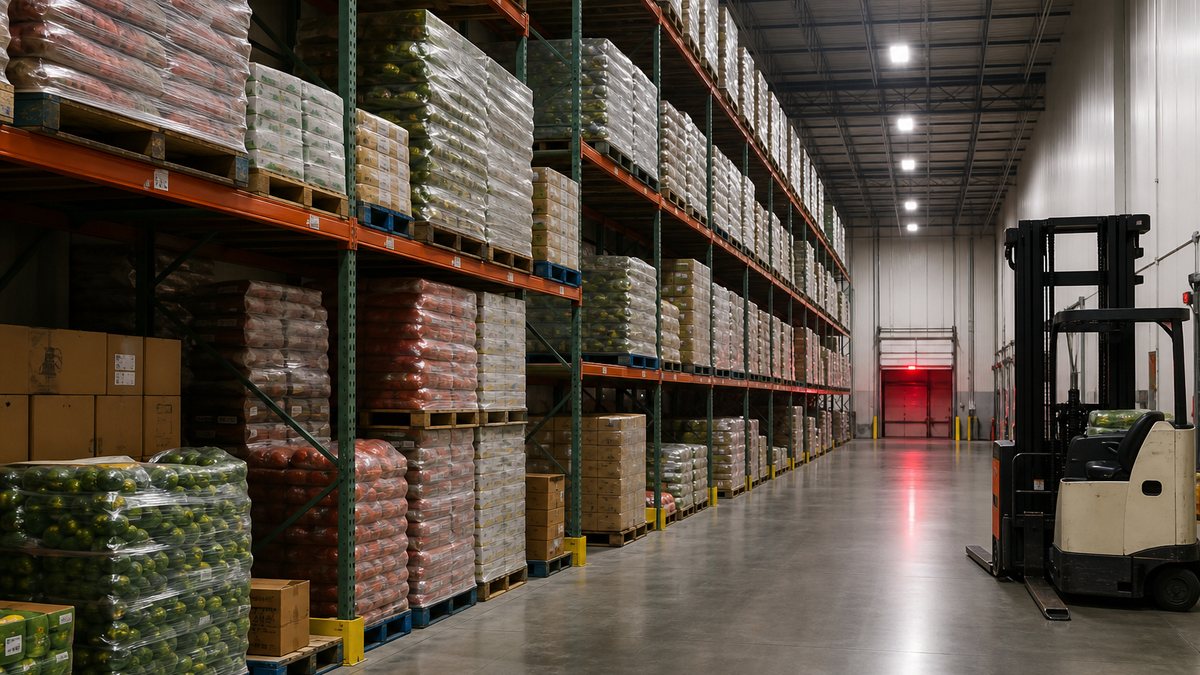
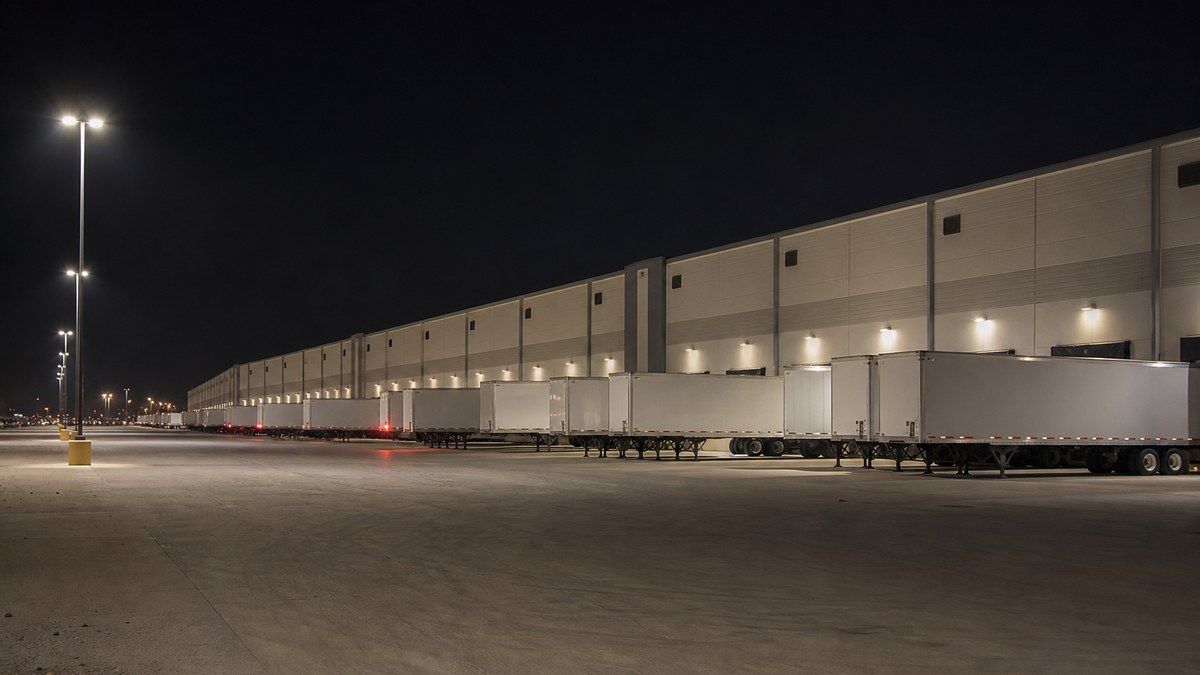
Laredo, Pharr, McAllen, Brownsville and the Corpus Christi area are home to a large concentration of warehouses, cross-dock facilities, distribution centers and refrigerated produce and food storage. These buildings need bright, uniform LED high-bay lighting on racked aisles and open floors, sealed fixtures for washdown and cold rooms, and occupancy-based controls so unused aisles dim automatically. Exterior lighting for docks, truck courts and yards supports safe night operations and security cameras. For the full approach to warehouse retrofits, see our guide to commercial LED lighting installation in Texas.
Ports, industrial and energy facilities
Industrial sites along the Coastal Bend combine every South Texas challenge at once: salt air, heat, around-the-clock operation and, in some areas, hazardous location classifications. Fixtures for classified areas must carry the appropriate hazardous location listings, and lighting plans should be coordinated with the facility's safety, electrical and engineering teams. Outdoor yards, laydown areas and perimeter roads benefit from well-aimed area lighting with tight optical control.
Retail centers, dealerships and restaurants
Shopping centers, strip centers, auto dealerships, convenience stores and restaurants in McAllen, Harlingen, Brownsville, Laredo and Corpus Christi depend on lighting to attract evening customers and make parking lots feel safe. LED area lights, canopy lights, storefront and sign lighting and building facade lighting work together. Our Texas shopping center LED lighting guide covers parking lots, storefronts and common areas in depth.
Hotels, resorts and waterfront hospitality
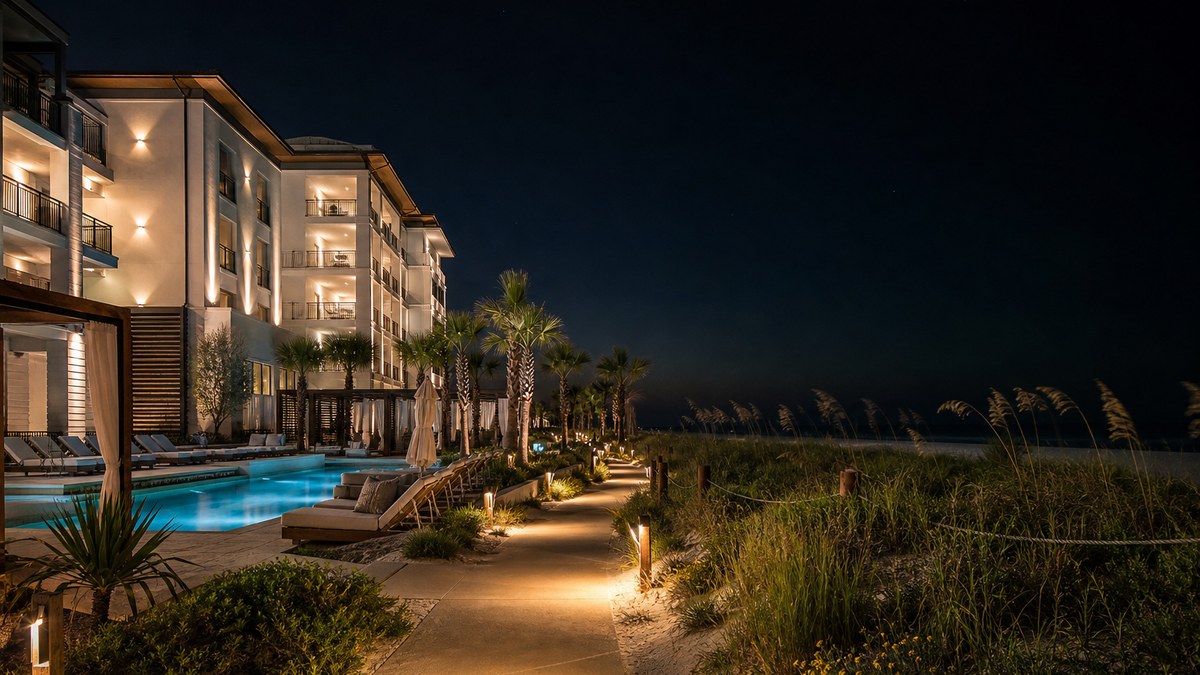
South Padre Island, Port Aransas, Rockport and the Corpus Christi bayfront draw visitors year-round. Hotels, condos, restaurants and entertainment venues want warm, inviting exterior lighting, attractive lobbies and pool decks, and fixtures that survive constant salt exposure. Pool and amenity areas need safe, code-compliant lighting; our pool and aquatic center lighting guide explains the safety side. For signature interior features such as lounges, spas and suites, fiber optic starlight ceilings keep electrical components out of the ceiling and away from moisture.
Schools, colleges and sports facilities
School districts across the Valley, the Coastal Bend and Webb County run gyms, stadiums, practice fields, natatoriums and large parking areas. LED sports lighting, gym high-bays and controlled exterior lighting improve visibility and reduce maintenance on tall poles. See our LED sports lighting guide and our sports lighting services.
Healthcare, offices and public buildings
Hospitals, clinics, medical office buildings, city halls, libraries and courthouses need comfortable, glare-controlled interior lighting, reliable emergency egress lighting and well-lit entrances and parking. LED troffers, linear fixtures and downlights paired with networked controls give facility teams scheduling and dimming without constant manual adjustments.
Churches and community spaces
Many South Texas congregations and community centers run busy evening schedules. LED lighting with dimming and scene control supports worship, events and recordings, while exterior lighting makes parking lots and walkways safer after evening services.
Upgrading a property in South Texas?
Tell us about your building or site and we will follow up to schedule an assessment and prepare a project-specific proposal.
City-by-city: what we see across the region
| Area | Typical properties | Lighting priorities |
|---|---|---|
| Corpus Christi & the Coastal Bend (Portland, Ingleside, Rockport, Aransas Pass, Kingsville, Alice) | Industrial, port-related, offices, retail, hotels, schools | Corrosion resistance, wind-rated mounting, 24/7 reliability, facade and bayfront lighting |
| Rio Grande Valley (McAllen, Edinburg, Mission, Pharr, Weslaco, Harlingen, Brownsville) | Retail, medical, education, warehouses, cold storage, dealerships | Heat-rated drivers, parking lot safety, warehouse high-bays, controls for long hours |
| South Padre Island & Port Isabel | Hotels, condos, restaurants, attractions | Marine-grade fixtures, warm hospitality lighting, wildlife-friendly beachfront lighting |
| Laredo & the border (Eagle Pass, Del Rio, Zapata) | Distribution centers, truck yards, retail, public facilities | Yard and dock lighting, security camera support, high-bay retrofits, surge protection |
| Victoria, Port Lavaca & the mid-coast | Industrial, healthcare, retail, schools | Coastal-rated exteriors, industrial lighting, campus upgrades |
We also support projects in San Antonio and the surrounding area, Austin, Houston, Dallas–Fort Worth and the rest of the state. See our full Texas service areas.
Coastal wildlife, neighbors and dark skies
Exterior lighting on the Texas coast affects more than the property it sits on. Responsible design keeps light where it is needed and helps projects move smoothly through community review.
- Sea turtles: beaches on Padre Island and nearby shores are nesting areas for sea turtles, and bright, unshielded lights visible from the beach can disorient hatchlings. Beachfront properties should use shielded, low-mounted and wildlife-friendly long-wavelength lighting where appropriate, and should check local rules and guidance before finalizing a design.
- Migratory birds: the Texas coast sits on a major migration route, and conservation groups promote programs such as Lights Out Texas that ask building owners to reduce unnecessary nighttime lighting during spring and fall migration. Scheduling and dimming controls make that easy for taller buildings.
- Neighbors: full-cutoff fixtures, correct aiming and house-side shields keep parking lot and sports lighting out of homes and off nearby roads.
- Dark skies: parts of South and West Texas value dark night skies. Limiting uplight and using controls supports those goals without sacrificing safety.
Codes, energy rules and incentives
Commercial lighting projects in South Texas follow the same core framework as the rest of the state, with local amendments that vary by city and county:
- Electrical code: installations follow the National Electrical Code as adopted locally, including the rules for wet and hazardous locations. Pool and fountain lighting follows NEC Article 680.
- Energy code: commercial energy codes adopted in Texas set lighting power and lighting control requirements for new construction and many alterations. Requirements depend on the adopted edition and local amendments.
- Local ordinances: cities may have rules on outdoor lighting, signs, glare and light trespass, and coastal communities may add beachfront lighting rules.
- Permits and inspections: your licensed installer pulls permits and coordinates inspections. Always confirm requirements with your AHJ.
On incentives: utilities and programs serving the region, including AEP Texas and some municipal utilities and electric cooperatives, may offer commercial energy-efficiency programs that qualifying lighting projects can apply to, depending on program availability and rules at the time of the project. Some building owners also look at the federal 179D deduction for energy-efficient commercial buildings; confirm eligibility with your tax advisor. We can help gather the fixture data, photometrics and documentation programs typically ask for.
Controls built for long hours
Because so many South Texas properties operate late or around the clock, lighting controls often do as much as the fixtures themselves to cut energy use and extend equipment life.
| Control | Where it fits | What it does |
|---|---|---|
| Occupancy and vacancy sensors | Warehouse aisles, storage, restrooms, back-of-house | Dims or turns off light when spaces are empty |
| Daylight harvesting | Offices, retail, warehouses with skylights | Reduces output when daylight is available |
| Astronomical scheduling | Parking lots, facades, signage | Switches exterior lights by sunset and sunrise |
| Bi-level exterior dimming | Parking lots, yards, docks | Dims after hours and brightens on motion |
| Networked lighting controls | Multi-building campuses, schools, hospitals | Central scheduling, monitoring and fault alerts |
| Scene and DMX control | Hotels, churches, venues, facades | Color and scenes for events and seasons |
Retrofit, redesign or new construction?
- Fixture-for-fixture retrofit: replace existing fixtures with LED in the same locations. Fast and practical when the existing layout works and poles and mounting are sound.
- Redesign: change fixture locations, counts and optics to fix dark spots, glare or poor uniformity. Common for parking lots and warehouses whose use has changed over the years.
- New construction: lighting designed from scratch with the building, coordinated with architects, engineers and energy code requirements.
On many South Texas sites, the best answer is a mix: retrofit interiors, redesign the parking lot, and replace corroded poles and brackets on the coast-facing side of the property.
How a South Texas lighting project works
- Site assessment: inventory fixtures, poles, controls and circuits, note corrosion and failures, and measure existing light levels.
- Goals: confirm hours of operation, safety and security needs, camera coverage, brand standards and community constraints.
- Lighting design: photometric layouts for interiors and exteriors, with fixture specifications suited to coastal or inland conditions.
- Structural and electrical review: evaluate poles, mounting, wind requirements, panels and surge protection.
- Proposal: a project-specific proposal with scope, schedule and options.
- Incentive paperwork: where a utility program is available, assemble the documentation it requires.
- Installation: licensed professionals install fixtures, poles and controls, scheduled around business hours, harvest or storm seasons.
- Commissioning: program controls, verify aiming and light levels at night, and train your staff.
- Service: ongoing support for maintenance and future phases.
What shapes the proposal
Every South Texas property is different, so Texas LED Lights prices each project after an assessment and design. The main factors are:
- Building type and size: warehouse, retail, hospitality, campus, industrial or mixed use
- Exposure: coastal salt air, inland heat and dust, or both
- Scope: interior, exterior, poles, signage, facade and controls
- Existing conditions: reusable poles and wiring versus replacement
- Special requirements: hazardous locations, cold storage, wildlife-friendly beachfront lighting
- Schedule and access: 24/7 operations, lifts, after-hours work and phasing
Who delivers your project
Texas LED Lights brings 15+ years as an authorized architectural lighting dealer and project coordinator. Our licensed installation partner has completed over 200 major sports and commercial projects across the US and Canada — NFL, NBA, NHL, MLS, NCAA and NASCAR. That experience carries over to warehouses, retail centers, hotels, campuses and industrial sites across South Texas.
Beyond general lighting, we coordinate architectural and facade lighting, LED video walls and displays, LED signage and message centers, and our Luminance design-build program for complete lighting transformations. Choosing an installer? Read how to choose a commercial lighting contractor in Texas.
Questions to ask before you buy
- Are the fixtures, brackets and hardware rated for coastal corrosion if we are near the Gulf?
- What ambient temperature are the drivers rated for, and where will they be installed?
- Have existing poles been evaluated for the new fixtures and local wind requirements?
- What surge protection is included at the fixture and at the panel?
- Can we see a photometric plan, including light trespass at the property line?
- Which controls are included, and how will they be programmed and maintained?
- Does the design account for beachfront wildlife lighting or local ordinances?
- Who handles permits, inspections and any utility program paperwork?
Frequently Asked Questions
Do you provide commercial LED lighting in South Texas?
What LED fixtures work best near the Gulf Coast?
How does South Texas heat affect LED lighting?
Do coastal properties need hurricane-rated light poles?
Can you light warehouses and cold storage in Laredo and the Valley?
What is turtle-friendly lighting?
Are there utility incentives for LED lighting in South Texas?
How much does a commercial LED lighting project cost in South Texas?
Can installation be scheduled around 24/7 operations?
How do I start a lighting project with Texas LED Lights?
Lighting built for South Texas conditions
From the Coastal Bend to the Valley and Laredo, request a consultation and we will follow up to schedule a site assessment.
Related
Our Texas lighting network: Dallas commercial LED lighting, Fort Worth LED lighting, Arlington LED lighting, Irving LED lighting, Plano LED lighting, wholesale LED components, fiber optic starlight ceilings, 360° fiber optic lighting, premium pool lighting, modular building solutions, and Dallas modular structures.