LED Video Walls & Displays in Texas: Pixel Pitch, Indoor vs Outdoor, Structure & Content
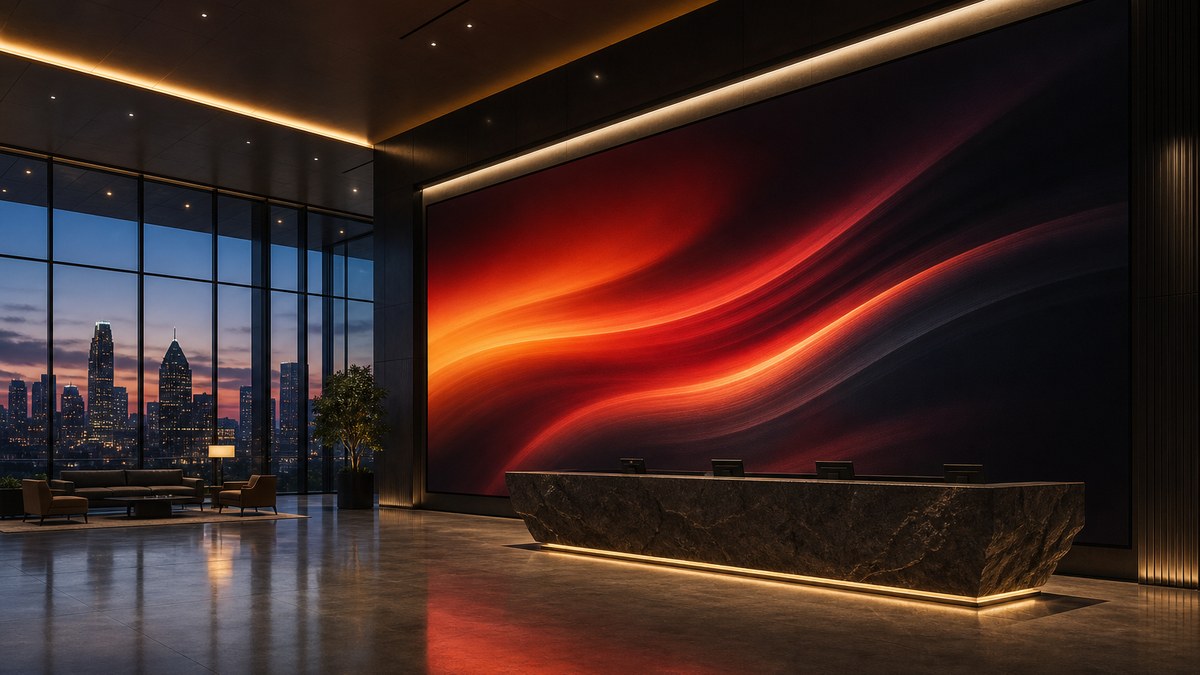
LED video walls in Texas have moved from stadium scoreboards and Las Vegas-style signage into everyday commercial buildings. Corporate lobbies, hotel ballrooms, retail flagships, houses of worship, college campuses, control rooms, restaurants, arenas and shopping center pylons now use direct-view LED displays because they are seamless, bright, scalable to almost any size and shape, and readable in conditions where projectors and tiled LCD screens struggle. The catch is that an LED wall is not a television you hang on a wall. It is a system of modules, cabinets, power, data, processing, structure and content that has to be designed for the room, the viewing distance and, outdoors, the Texas weather.
This guide is written for building owners, facility and IT managers, architects, interior designers, church and venue leaders, marketing teams and general contractors who are evaluating an LED display company in Texas. It explains how direct-view LED works, how to choose pixel pitch for your viewing distance, the differences between indoor, outdoor and fine-pitch products, what mounting, electrical and code questions come up, how content and control systems fit in, and how a project runs from site visit to commissioning. It also covers where buyers looking for wholesale LED display parts fit in.
An LED video wall is a large display built from modular direct-view LED panels that join without bezels. The right wall for a Texas project depends on viewing distance, ambient light, location and content.
- Pixel pitch: the distance between pixels; smaller pitch looks sharper up close, larger pitch suits viewers farther away
- Indoor vs outdoor: outdoor displays need much higher brightness, weather sealing, heat management and wind-rated structure
- Technology: SMD, COB, GOB and MicroLED each trade off durability, image quality and serviceability
- Structure: walls, frames, rigging and foundations must be engineered for the display's weight and, outdoors, wind
- Systems: power, data, a video processor, a content management system and service access are part of the scope
- Rules: electrical code, product listings, building and sign permits, accessibility and highway sign rules can all apply
- Pricing: every wall is quoted as a project-specific proposal after a site visit and design review
What an LED video wall actually is
A direct-view LED (often shortened to dvLED) display creates the image with the light-emitting diodes themselves. Every pixel is a tiny cluster of red, green and blue LEDs. Those pixels are mounted on modules (small tiles), modules are mounted in cabinets (the structural building blocks), and cabinets are joined into a wall of almost any width, height or shape. Because there is no frame around each cabinet, the finished surface is one continuous image.
Behind the face, a working LED wall includes:
- Receiving cards inside each cabinet that take the video signal and drive the LEDs.
- Power supplies that convert building power to the low voltage the modules need.
- A video processor or sending controller that scales the source, maps it to the exact pixel layout of the wall and manages brightness and color.
- Sources and control: media players, computers, cameras, broadcast feeds or a content management system.
- Structure: a wall mount, free-standing frame, rigging, monument or pole that carries the weight and gives service access.
Thinking of the wall as a system, not a product, is the single most useful mindset for buyers. Most disappointing installations trace back to one of those pieces being undersized or overlooked, not to the LED panels themselves.
LED walls vs LCD walls vs projection
Before choosing a pixel pitch, it helps to confirm that direct-view LED is the right technology for the space at all.
| Option | Strengths | Limitations | Typical fit |
|---|---|---|---|
| Direct-view LED wall | Seamless at any size, very bright, custom shapes and curves, long service life, works in bright rooms and outdoors | Needs structure, power and processing planning; fine pitches carry a premium | Lobbies, venues, worship, retail, outdoor signage, control rooms |
| Tiled LCD video wall | Very sharp at close range, familiar technology | Visible bezel lines between screens, fixed sizes, limited brightness for sunlit spaces | Small meeting rooms, close-viewing data displays |
| Projection | Large image from a single device | Washes out in ambient light, needs a clear throw path and a dark room | Dark auditoriums, temporary events |
For most Texas commercial spaces with daylight, high ceilings or a need for a statement-size image, direct-view LED wins. For a small huddle room where people sit very close, a single large flat panel may still be the practical choice.
Pixel pitch and viewing distance
Pixel pitch is the center-to-center distance between pixels, measured in millimeters. It is the specification that most affects image sharpness, how close viewers can stand, and the overall scope of a project.
- Smaller pitch (fine pitch) packs more pixels into the same area, so text and faces stay crisp when people stand close. It also means more LEDs, more processing and a higher-spec product.
- Larger pitch spaces pixels farther apart. Up close the pixels are visible, but from a distance the image looks smooth, which is why roadside and stadium displays use larger pitches.
A common industry rule of thumb ties the closest comfortable viewing distance to the pitch: roughly one meter of distance for each millimeter of pitch, or about ten feet per millimeter as a conservative guide. Treat that as a starting point, not a rule. The real decision depends on:
| Factor | Why it matters |
|---|---|
| Closest viewer | Lobby walls next to reception desks and walkways need finer pitch than a wall seen across an arena |
| Content type | Small text, spreadsheets and dashboards need finer pitch than full-motion video and graphics |
| Resolution needed | Wall size divided by pitch gives the pixel count; some content (such as true 4K) needs a minimum pixel count |
| Camera use | Walls used as broadcast or streaming backdrops need pitch and refresh rates chosen to avoid moiré and flicker on camera |
| Budget and scope | Pitch has the largest influence on the scope of the display itself, so it is worth getting right rather than going finer than the room needs |
Indoor, outdoor and fine-pitch displays
Indoor LED walls
Indoor products are built for controlled environments: lobbies, conference centers, ballrooms, sanctuaries, retail interiors, studios and arenas. They balance brightness against comfort, because a wall that is too bright indoors causes glare and eye strain. Good indoor walls dim smoothly to low levels without losing grayscale detail, which matters in dark rooms such as worship spaces and theaters.
Fine-pitch and close-viewing walls
Fine-pitch LED is the category for executive boardrooms, briefing centers, control and operations rooms, broadcast studios and high-end retail where viewers stand within a few feet. These walls often use COB or MicroLED packaging for a more durable, uniform surface and are designed for front service so they can sit flush against a wall.
Outdoor LED displays
Outdoor displays face the hardest conditions in Texas: direct summer sun, extreme heat, hail, high winds, lightning, dust and, along the Gulf Coast, humidity and salt air. Outdoor products are built with:
- Much higher brightness to stay readable in direct sun, plus automatic dimming at night so the sign does not glare or exceed local brightness limits.
- Weather sealing with an ingress protection (IP) rating appropriate for driving rain and dust, on the front and the rear of the cabinet.
- Thermal management: ventilation, fans or air conditioning, and components chosen for high operating temperatures.
- Corrosion-resistant cabinets, fasteners and structure, especially near the coast.
- Surge protection and grounding sized for a state with frequent thunderstorms.
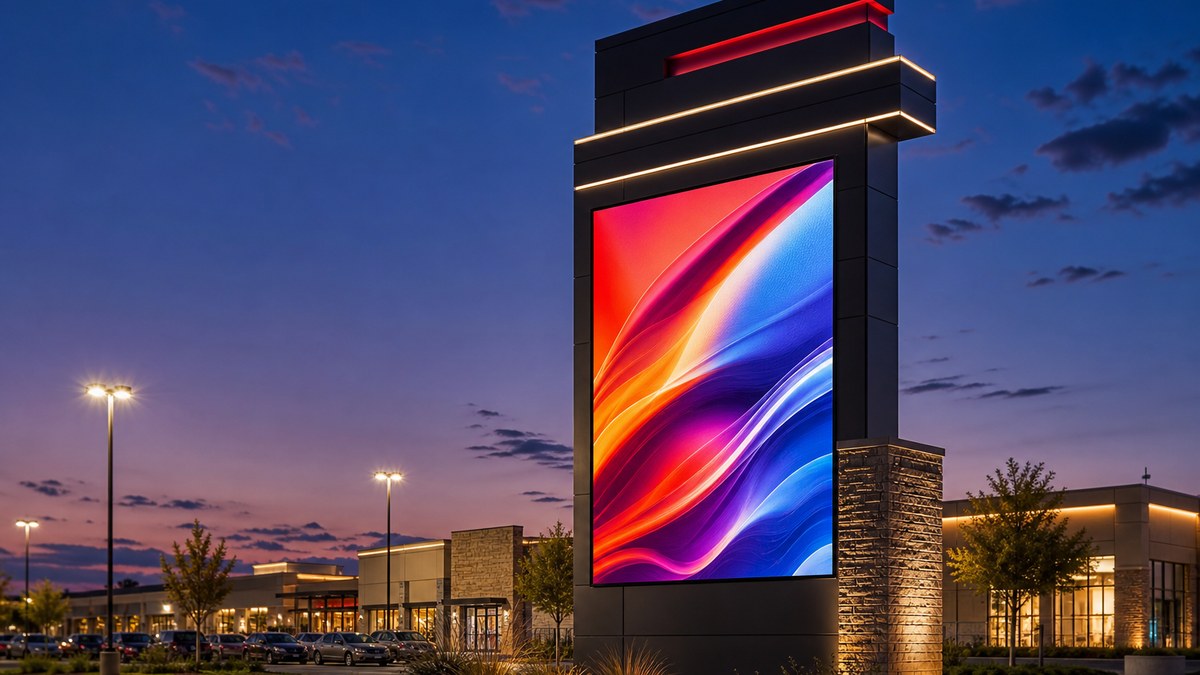
Outdoor applications include monument and pylon signs, building-mounted displays, drive-throughs, stadium and field scoreboards, campus message centers and shopping center signs. For signage-focused projects, our network partner covers LED signs and electronic message centers as well.
SMD, COB, GOB and MicroLED
The way the LEDs are packaged on the module affects durability, contrast, viewing angle and service. You will see these terms on almost every proposal:
| Technology | How it works | Good to know |
|---|---|---|
| SMD (surface-mounted device) | Individual RGB LED packages soldered onto the module | The most common and widely serviceable type; exposed LEDs are more vulnerable to knocks in reachable locations |
| GOB (glue on board) | SMD modules sealed with a protective clear coating | Adds protection against impact, moisture and dust; useful in public spaces and rental use |
| COB (chip on board) | LED chips mounted directly on the board and encapsulated as one surface | Durable, smooth surface with strong contrast; common in fine-pitch and close-viewing walls |
| MicroLED | Extremely small LED chips, typically on COB-style packaging | Premium category for the finest pitches and highest image quality |
No packaging type is best everywhere. A wall within reach of the public benefits from a protected surface; a wall high above a stage may not need it. The right choice comes from the location, viewing distance and service plan.
Image quality specs worth asking about
Two walls with the same pixel pitch can look very different. When comparing proposals, ask about:
- Brightness and dimming range: enough output for the brightest condition, and smooth dimming for the darkest.
- Refresh rate: higher refresh rates reduce flicker and scan lines on phone cameras and broadcast cameras.
- Grayscale and bit depth: how smoothly the wall renders dark scenes, skin tones and gradients, especially at low brightness.
- Contrast: darker module surfaces and black LED packages make blacks look deeper in lit rooms.
- Color uniformity and calibration: modules should be binned and calibrated so the wall looks like one surface, and spare modules should match.
- Viewing angle: wide horizontal and vertical angles matter for walls seen from balconies, stairs and side seating.
- HDR and color space: relevant for studios, galleries and premium brand experiences.
Planning a video wall anywhere in Texas?
Tell us about your space, viewing distances and content, and we will follow up to schedule a site visit and prepare a project-specific proposal.
Where Texas businesses use LED walls
| Space | What the wall does | Design priorities |
|---|---|---|
| Corporate lobbies & HQs | Brand storytelling, welcome messages, art content | Fine pitch near reception, integration with architecture and architectural lighting |
| Hotels & ballrooms | Event backdrops, wayfinding, lobby features | Flexible content, camera-friendly refresh, coordination with hotel lighting design |
| Retail & shopping centers | Storefront media, promotions, tenant advertising | High brightness near windows, durable surfaces, scheduling; see shopping center lighting |
| Houses of worship | Lyrics, sermon graphics, streaming backdrops | Low-brightness performance, camera refresh, stage integration |
| Arenas, stadiums & gyms | Scoreboards, ribbon boards, replays | Long viewing distances, outdoor ratings, coordination with sports lighting |
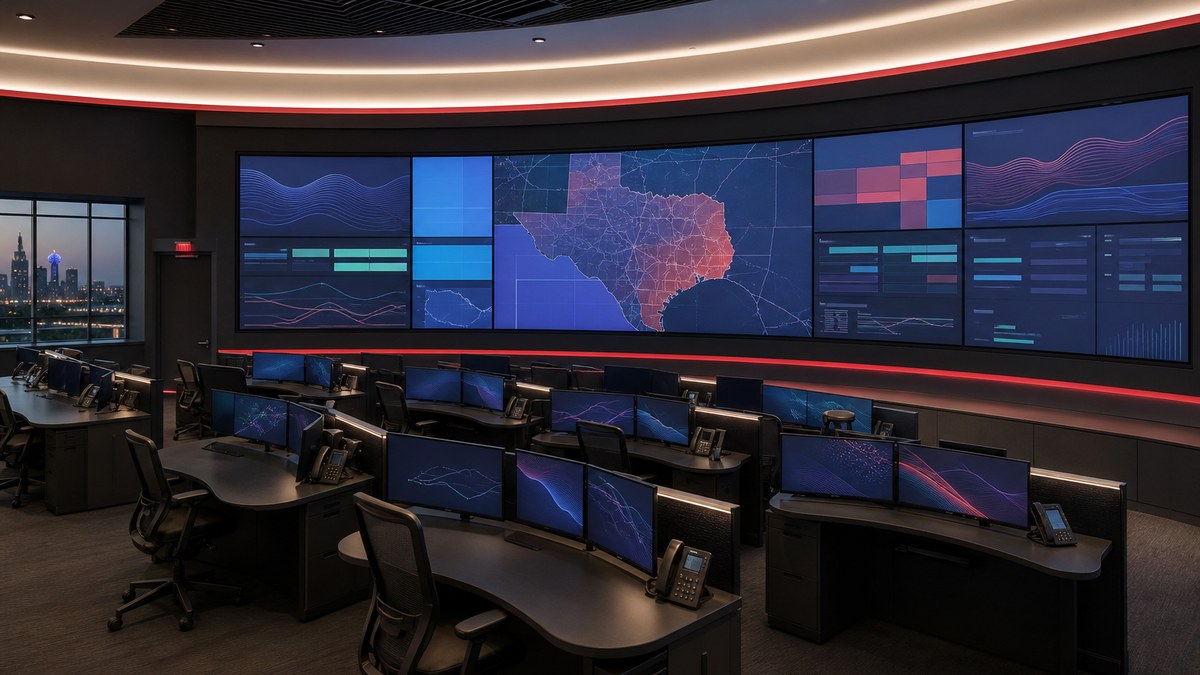
| Control & operations rooms | Dashboards, maps, camera feeds | Fine pitch, redundancy, long operating hours |
| Campuses & schools | Announcements, events, outdoor message centers | Simple content tools, scheduling, durability |
| Restaurants & entertainment | Sports viewing, ambiance, menus | Viewing angles, brightness control, sound coordination |
In many of these spaces the display and the lighting work together. A wall surrounded by glare from downlights looks washed out, while a wall in a dark room can overpower everything around it. Designing both at the same time is one of the advantages of working with a team that does commercial lighting as well as displays.
Structure, mounting and service access
LED cabinets are heavy, and a full wall can weigh far more than people expect. Structural planning is not optional:
- Wall-mounted displays: the existing wall, studs, masonry or steel must carry the load. Many projects add a dedicated steel frame or backing anchored to structure.
- Free-standing and floor-supported walls: frames or ground stacks need a floor rated for the point loads and protection against tipping.
- Flown and rigged displays: arenas and auditoriums hang displays from roof structure using engineered rigging with appropriate safety factors.
- Outdoor signs and monuments: poles, footings and attachments are engineered for Texas wind loads; coastal projects may fall inside the Texas Department of Insurance windstorm program area.
- Curves, corners and ceilings: custom shapes need cabinets and brackets designed for them, and the structure must hold tight tolerances so seams stay invisible.
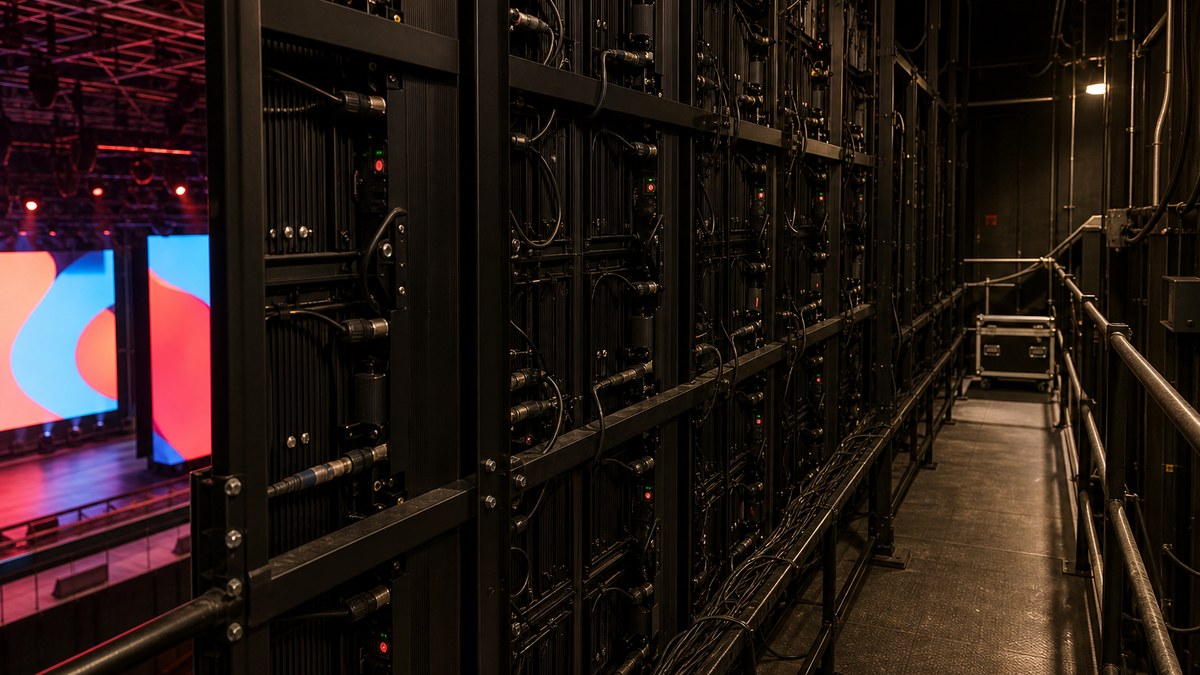
Front service vs rear service is a key decision. Front-service walls let technicians remove modules from the face with magnetic or vacuum tools, so the wall can sit tight to a wall surface. Rear-service displays need a walkway or access space behind the cabinets, which is common for outdoor signs and large venue boards. Choosing the wrong service method can make simple repairs expensive and slow.
Heat is the other structural concern. The cabinets produce heat that must go somewhere. Indoor walls flush to a wall need ventilation paths and sometimes extra HVAC capacity; outdoor displays in Texas sun need active cooling designed for summer conditions.
Power, data and control systems
An LED wall is also an electrical and IT project. Plan these items with your electrician, IT team and integrator early:
| System | What to plan |
|---|---|
| Electrical service | Dedicated circuits sized for the wall, panel capacity, surge protection and grounding; outdoor displays need wet-location wiring |
| Data cabling | Signal runs from the processor to the wall, fiber for long distances, and backup signal paths for critical displays |
| Video processor | Matched to the wall's pixel count, inputs, layering, scaling and future content needs |
| Content management system | Scheduling, remote updates, user permissions and playlists for marketing or operations teams |
| Monitoring | Remote alerts for power, temperature and module faults so problems are fixed before anyone notices |
| Redundancy | Redundant power supplies, signal loops or processors for walls that cannot go dark, such as control rooms and live events |
| Network security | Display controllers and players placed on the right network segment, with IT-approved remote access |
Codes, permits and Texas rules
The right requirements for your project come from your design team and the authority having jurisdiction (AHJ). These are the rules and documents that commonly come up on LED display projects in Texas:
- NEC (National Electrical Code): branch circuits, grounding and wet locations; Article 600 covers electric signs and outline lighting. Work by licensed electricians with permits and inspections as the AHJ requires.
- Product listings: AHJs commonly look for displays and signs listed by a nationally recognized testing laboratory, such as UL 48 for electric signs or UL 62368-1 for audio/video equipment. Confirm what your AHJ expects.
- Building code and structural review: mounting, rigging, sign structures and footings may need engineered drawings; coastal sites should check the TDI windstorm program.
- Accessibility: wall-mounted displays along walkways must respect protruding-object rules in the 2010 ADA Standards and the Texas Accessibility Standards.
- City sign codes: outdoor electronic displays usually need a sign permit, and cities regulate size, location, brightness, message hold times, animation and hours. Rules vary widely; some Texas cities restrict new digital billboards, and Dallas has held authorized hearings on its digital billboard rules.
- Highway sign rules: off-premise signs along regulated highways fall under the Texas Department of Transportation's outdoor advertising program (Texas Transportation Code chapters 391 and 394), in addition to local rules.
- Lighting and dark-sky ordinances: some Hill Country and West Texas communities limit outdoor brightness and night operation; automatic dimming helps meet them.
- Life safety: displays in assembly spaces are coordinated with egress paths, exit signs and fire alarm systems.
Codes and local rules change, so always confirm the current requirements for your specific site with your AHJ before design is finalized.
Content: the part buyers forget
A beautiful wall showing a frozen screensaver is a common sight. Content and operations deserve as much planning as hardware:
- Decide who owns it: marketing, facilities, IT, a ministry media team or event staff. Someone must have the job.
- Create to the pixel map: LED walls rarely have a standard TV resolution. Content should be built at the wall's exact pixel dimensions.
- Mind brightness and motion: fast, high-contrast motion that looks great on a laptop can be overwhelming on a huge wall.
- Schedule it: dayparts for lobbies, event modes for ballrooms, night dimming for exterior signs.
- Refresh it: a content calendar keeps the wall worth looking at months after opening day.
How a Texas LED video wall project works
- Discovery: goals, audience, content, viewing distances, ambient light and schedule.
- Site visit: measure the wall location, check structure, power, data paths, HVAC and access for installation.
- Design: pitch and product selection, layout and pixel map, structural concept, electrical and data plan, service method.
- Mockups and samples: where possible, view sample modules or similar walls at the intended distance.
- Proposal: a project-specific proposal covering display, processing, structure, installation, content tools and service.
- Engineering and permits: structural drawings, electrical permits and sign permits as required.
- Build-out: backing, frames, power and data are prepared, often by coordinating with the general contractor.
- Installation: cabinets mounted and aligned, modules installed, cabling and processors connected.
- Calibration and commissioning: seams, color and brightness tuned; control and content systems configured.
- Training and service: staff trained on content and controls; spare modules and a service plan in place.
What drives project scope
Every LED wall is priced individually after a site visit. The main factors are:
- Pixel pitch and technology: finer pitches and COB or MicroLED products sit at the premium end
- Size and shape: total area, curves, corners and custom cabinet sizes
- Indoor or outdoor: weather sealing, brightness and cooling for exterior use
- Structure: backing, frames, rigging, poles and foundations
- Electrical and data: new circuits, panel work and long cable or fiber runs
- Processing and control: inputs, redundancy, content management and integration
- Site conditions: lift access, after-hours work, occupied buildings and permits
- Service plan: spare modules, monitoring and support terms
Public entities, schools and churches often buy through bids or cooperative purchasing; we can work within your procurement process.
Wholesale LED display parts and components
Some Texas buyers are not looking for a finished installation at all: integrators, sign shops, rental companies and in-house AV teams often need modules, cabinets, receiving cards, power supplies or spare parts. Matching spares to an existing wall matters, because modules from a different production batch can look different in color and brightness. For component sourcing, our network offers wholesale LED components, while Texas LED Lights focuses on complete, designed and installed display and lighting projects.
Who builds it: our experience
Texas LED Lights brings 15+ years as an authorized architectural lighting dealer and project coordinator. Our licensed installation partner has completed over 200 major sports and commercial projects across the US and Canada — NFL, NBA, NHL, MLS, NCAA and NASCAR. That experience covers both display and lighting work, so your video wall, the lighting around it and the building's exterior can be planned as one project.
We serve all of Texas, including Dallas–Fort Worth, Houston, Austin, San Antonio, El Paso, Corpus Christi, Lubbock and the Rio Grande Valley. Local guides: commercial LED lighting in Houston, San Antonio commercial lighting services and South Texas commercial LED lighting. See where we work on our coverage map and recent work in our portfolio.
Questions to ask before you buy
- What pixel pitch do you recommend for our closest and farthest viewers, and why?
- Is the product SMD, GOB, COB or MicroLED, and why is that right for our location?
- Is the wall front service or rear service, and how is a module replaced?
- Who engineers the mounting structure, and is our wall or roof rated for the load?
- What electrical and data work is included, and what must our contractor provide?
- Which video processor and content system are included, and who will train our staff?
- How many spare modules are included, and are they from the same production batch?
- What warranty and service terms apply to modules, power supplies and processors, and who responds locally?
- For outdoor signs: who handles the sign permit, and how is brightness controlled at night?
Frequently Asked Questions
What is an LED video wall?
What pixel pitch do I need?
What is the difference between indoor and outdoor LED displays?
Is an LED wall better than an LCD video wall?
What is COB LED and do I need it?
Can our existing wall support an LED video wall?
Do outdoor LED signs need a permit in Texas?
Who creates and manages the content?
How much does an LED video wall cost?
Do you sell wholesale LED display parts?
Put a seamless display where it matters
Request a consultation and we will follow up to review your space, recommend a pixel pitch and prepare a project-specific proposal. Prefer to talk first? Book a call.
Related
More from our blog: all Texas lighting guides, commercial LED lighting installation, commercial LED fixtures, LED retrofit guide, choosing a commercial lighting contractor, starlight ceilings and all services.
Our Texas lighting network: Dallas commercial LED lighting, Fort Worth LED lighting, Arlington LED lighting, Irving LED lighting, Plano LED lighting, wholesale LED components, fiber optic starlight ceilings, 360° fiber optic lighting, premium pool lighting, modular building solutions, Dallas modular structures and LED signage.