Texas LED Hotel Lighting: Lobbies, Guestrooms, Ballrooms, Pools & Exteriors
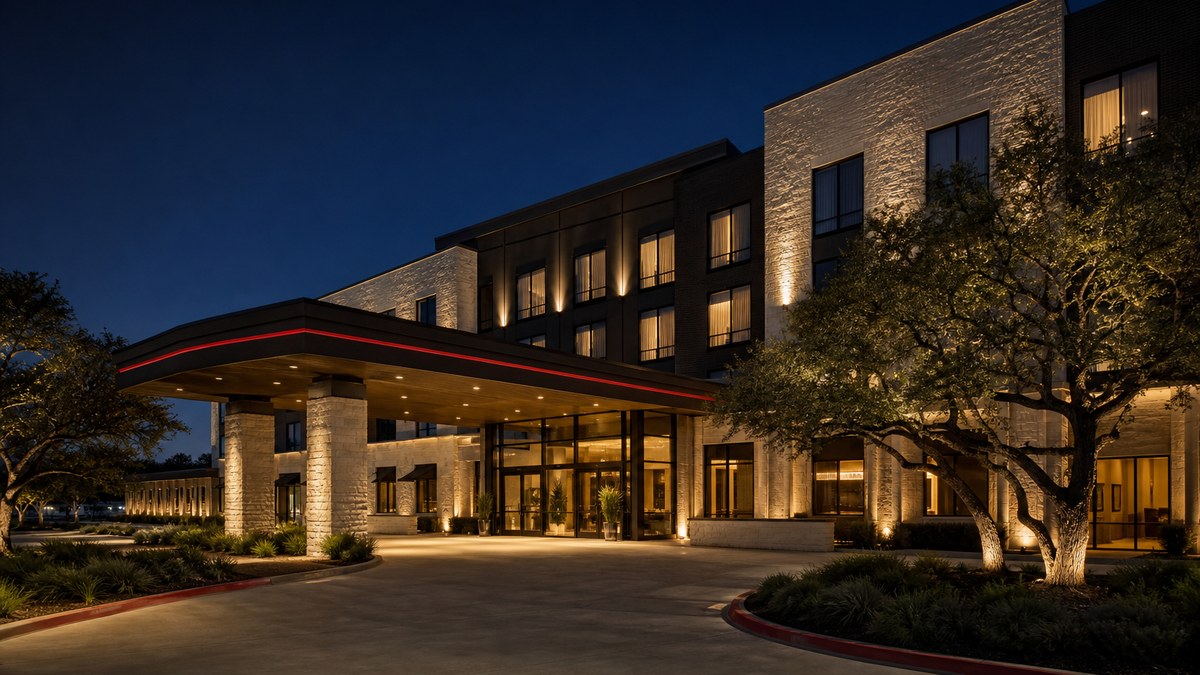
Texas LED hotel lighting shapes a guest's first impression before they ever reach the front desk. The glow of the facade from the highway, the porte-cochere at check-in, the lobby and bar, the corridor to the room, the bedside reading light, the pool deck at night and the parking lot on the walk back to the car all tell a guest whether a property feels cared for. For owners and operators, the same lighting runs around the clock, every day of the year, which makes it one of the largest and most visible systems in the building.
This guide is written for hotel owners, asset managers, general managers, chief engineers, management companies, developers and designers working on hotels, resorts, extended-stay properties and conference venues across Texas. It walks through every major space in a hotel, the codes and brand standards that apply, how lighting controls work in guestrooms and public areas, what changes on the Gulf Coast and in the Hill Country, how to phase a retrofit while the property stays open, and how a project moves from walkthrough to commissioning.
Hotel LED lighting replaces older halogen, fluorescent, metal halide and incandescent sources across guestrooms, corridors, lobbies, restaurants, meeting rooms, pools, exteriors and parking with LED fixtures and controls designed around the guest experience.
- Guest experience: warmer, dimmable, flicker-free light with good color rendering in every space
- 24/7 operation: corridors, stairs, lobbies and exteriors never switch off, so efficiency and reliability matter most there
- Controls: scenes for lobbies and ballrooms, occupancy-based controls in back-of-house and guestrooms, schedules outside
- Codes and standards: energy code, life safety egress lighting, ADA, pool rules and local exterior lighting ordinances
- Brand standards: franchise requirements and property improvement plans often specify lighting outcomes
- Phasing: work is scheduled floor by floor and space by space so rooms stay sellable
- Pricing: every property receives a project-specific proposal after a walkthrough
Why hotel lighting is different
A warehouse needs bright, even light. An office needs comfortable task light during business hours. A hotel needs both of those things and a great deal more, because it is part workplace, part home and part stage. Hotel lighting has to satisfy several audiences at once:
- Guests judge comfort, warmth and safety in seconds. Harsh, cold or flickering light in a lobby or guestroom reads as dated, no matter how new the furniture is.
- Operators live with the system 24 hours a day. Corridors, stairwells, lobbies, exterior walkways and parking lots run continuously, so every failed lamp is a maintenance call and every inefficient fixture runs all night.
- Brands and owners set standards for color, atmosphere and exterior presence, and often tie lighting to renovation cycles and property improvement plans.
- Event planners and sales teams need ballrooms and meeting rooms that can shift from bright breakout sessions to dramatic evening galas.
- Code officials review energy compliance, emergency egress lighting, accessibility and, outside, light trespass.
Texas adds its own pressures: long, hot summers that make heat from older lamps a real cooling load, coastal salt air and hurricane exposure along the Gulf, wide-open highway frontage where a hotel's facade is its billboard, and fast-growing metros where new hotels compete for the same travelers. LED technology answers most of those challenges, but only when the project is designed space by space rather than as a one-for-one lamp swap.
Lighting every space in a Texas hotel
The table below summarizes what each area of a typical hotel needs from its lighting. Every property is different, so treat it as a starting checklist for a walkthrough.
| Space | Lighting goals | Typical LED approach |
|---|---|---|
| Exterior & facade | Visibility from the road, brand presence, safe arrival | Facade grazing and washing, accent lighting, landscape lighting, porte-cochere downlights |
| Lobby & front desk | Warm welcome, clear wayfinding, faces well lit at the desk | Layered downlights, decorative pendants, cove and accent lighting on dimming scenes |
| Restaurant & bar | Atmosphere that changes from breakfast to late night | Dimmable decorative and accent lighting, warm color temperatures, bar back lighting |
| Ballrooms & meeting rooms | Flexible scenes for presentations, banquets and receptions | Dimmable downlights, color-tunable or color-changing accent, preset scenes, partition-aware controls |
| Corridors & elevator lobbies | Comfortable, even light around the clock, clear room numbers | Wall sconces, downlights or linear coves with controls permitted by code |
| Guestrooms & suites | Home-like comfort, easy controls, good mirror light | Warm dimmable fixtures, vanity and mirror lighting, night lights, bedside reading lights |
| Pool, spa & fitness | Safety, ambiance and code compliance | Wet-rated underwater and deck lighting, corrosion-resistant fixtures, fitness room panels |
| Parking lots & garages | Security, uniformity and limited light trespass | Full cutoff area lights, garage fixtures with occupancy and daylight controls |
| Back of house | Safe, efficient work areas for staff | Linear fixtures, high-bays in laundries and docks, occupancy sensors in storage and stairs |
Exterior, facade and arrival lighting
For many Texas hotels, especially along interstates and loop highways, the exterior is the most important marketing tool the property has. Travelers choose where to exit at highway speed, and a well-lit facade says open, safe and well run. A thoughtful exterior lighting plan usually includes:
- Facade lighting: grazing that brings out stone, brick or stucco texture, washing that evens out large walls, and accent lighting on towers, cornices and entry features. See our architectural and facade lighting services.
- Porte-cochere and entry: bright, warm, glare-free light where guests unload bags, check in at night and meet rideshare drivers.
- Landscape and walkways: path, step and tree lighting that guides guests between parking, entries, pool areas and outbuildings.
- Signage: monument signs, building-mounted letters and digital message displays coordinated with the facade so they do not compete. Our network partners handle LED signage and message centers.
- Color-changing features: RGBW accent lighting can mark holidays, local sports seasons and community events, programmed on schedules so staff do not have to touch it.
Exterior lighting must also respect neighbors and local rules. Full cutoff fixtures, careful aiming and automatic dimming after late-night hours limit glare and sky glow. Some Texas communities have dark-sky ordinances, particularly in the Hill Country, and properties near military installations in the San Antonio area may fall under the San Antonio Military Lighting Overlay District. Our San Antonio commercial lighting guide covers those rules in more detail. As always, confirm current exterior lighting requirements with your AHJ.
Lobbies, restaurants and bars
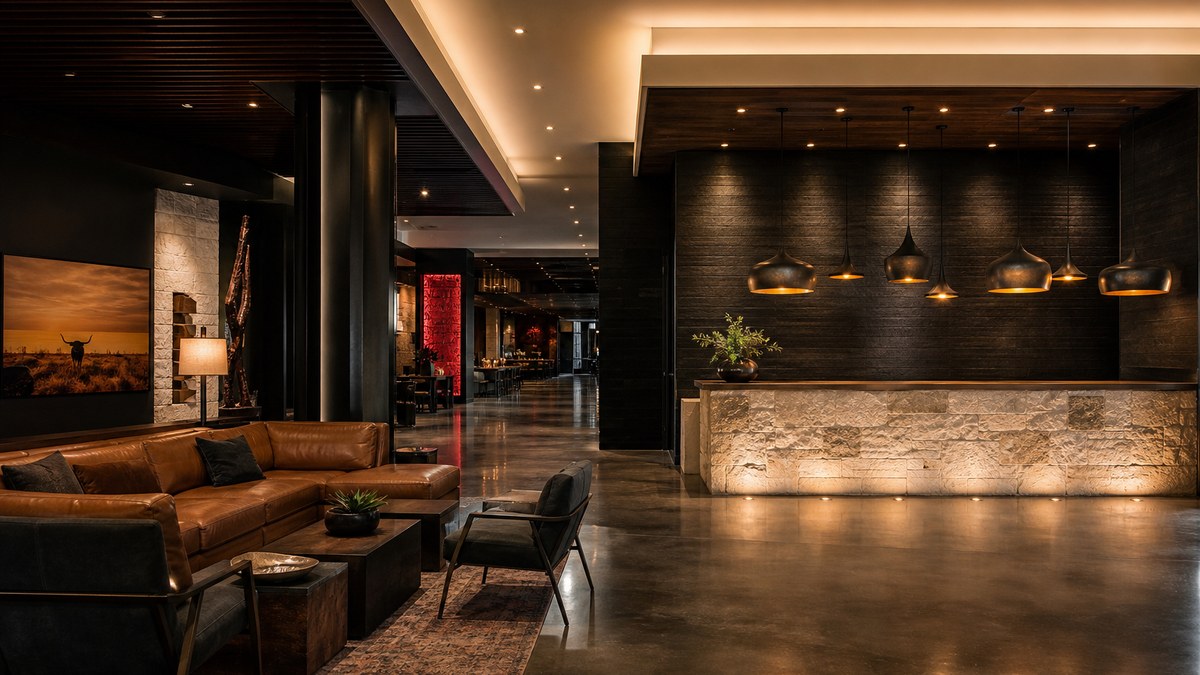
The lobby sets the tone for the whole stay. Good lobby lighting is layered: ambient light for overall brightness, task light at the front desk and concierge, accent light on art, feature walls and plants, and decorative fixtures that carry the design concept. LED makes it practical to put all of those layers on dimming controls with preset scenes, so the space can look bright and energetic in the morning and warmer and quieter at night.
A few details make a big difference:
- Faces at the desk: light falling on guests' and staff members' faces, not just on the counter, makes check-in feel friendly and helps with ID checks.
- Color quality: high color rendering makes wood, fabric, food and skin tones look natural. Poor color rendering is one of the fastest ways to make an expensive renovation look cheap.
- Consistent color temperature: mixing warm and cool sources in one space looks unplanned. A lighting schedule with specified color temperatures avoids mismatched replacements years later.
- Dimming performance: fixtures and drivers should dim smoothly to low levels without flicker or color shift, especially in restaurants and bars.
- Daylight: lobbies with large glazing can use daylight-responsive controls so electric light steps back on bright Texas afternoons.
Restaurants and bars follow the same principles with more drama: lower ambient light, tighter accent beams on tables and the bar, back-lit shelving and decorative pendants. Scene control lets staff switch from breakfast service to evening dining with one button.
Ballrooms, meeting rooms and event spaces
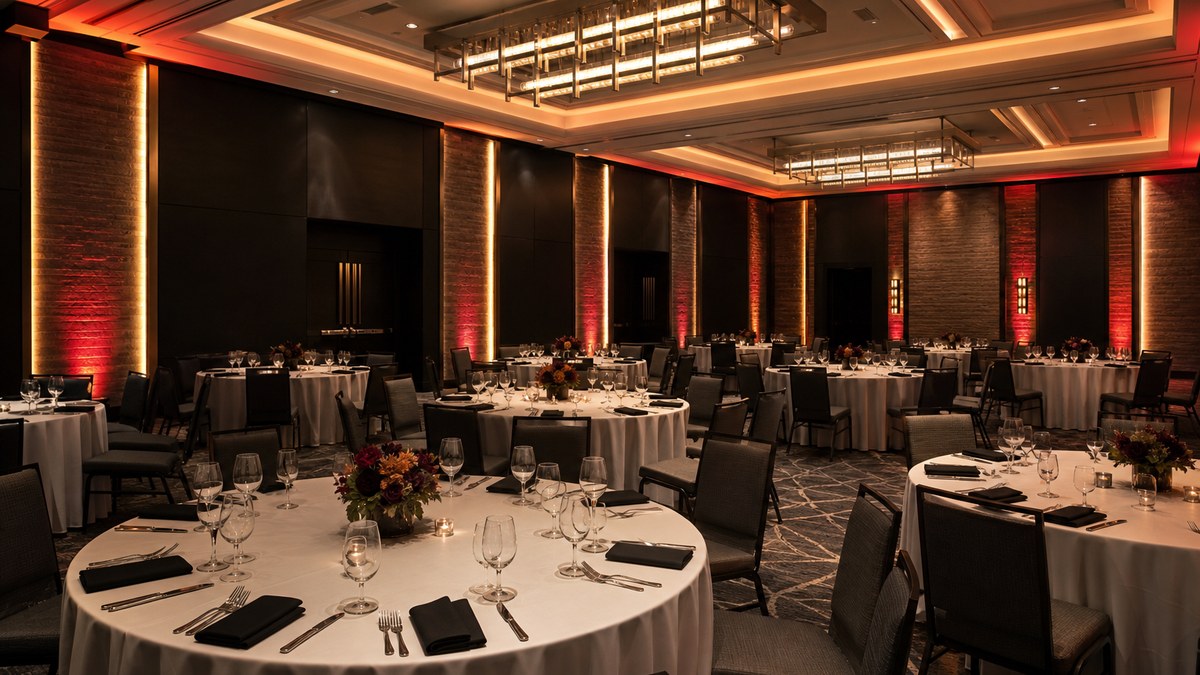
Event spaces earn revenue, and their lighting is part of what the sales team sells. A ballroom may host a corporate keynote in the morning, a banquet at noon and a wedding reception at night. Lighting should support all of those without a rental lighting crew for every event:
- Dimmable general lighting with smooth, flicker-free performance for presentations, video recording and livestreams.
- Preset scenes such as presentation, banquet, dance and cleaning, available on wall stations and, where desired, tablets.
- Partition-aware controls so divided ballroom sections can be controlled separately or together as air walls open and close.
- Color accent lighting for walls, columns and ceilings, so planners can match event colors without bringing in uplights.
- Pre-function areas and foyers lit to match, since guests gather there before and after events.
- Feature ceilings: signature spaces sometimes add a fiber optic starlight ceiling or other effect lighting as a memorable design element.
Where events are streamed or recorded, camera-friendly lighting matters: enough light on presenters' faces, consistent color and drivers that do not flicker on video. Larger venues may also add LED video walls for stages, pre-function areas and digital signage.
Corridors, stairwells and back of house
Corridors are the lighting workhorses of any hotel. They run around the clock, guests walk them at all hours, and dim or patchy corridors make a property feel unsafe. LED sconces, downlights and linear coves provide even, comfortable light with room numbers and signage easy to read.
Because corridors and stairwells are lit continuously, they are also where controls can make the biggest difference. Energy codes generally require automatic controls in many spaces, and some codes allow corridor and stairwell lighting to reduce output when unoccupied while maintaining required egress lighting. Which controls are required or permitted depends on the energy code edition adopted for your project and the life safety requirements of NFPA 101 and the local fire code, so confirm the approach with your AHJ before design is finalized.
Behind the scenes, laundries, kitchens, loading docks, storage rooms, engineering shops and employee areas benefit from bright, durable LED fixtures and occupancy sensors. Those spaces are often the last to be upgraded, yet they are where staff spend their shifts and where safety matters most. Our commercial LED fixtures buyer's guide explains the fixture types used in these areas.
Guestroom lighting and controls
The guestroom is the product a hotel sells. Guests want the room to feel like a well-designed home: warm light, a bright and flattering mirror, a good reading light on each side of the bed, a night light to find the bathroom without blinding anyone, and switches they can figure out in the dark. Common guestroom upgrades include:
- Entry and closet lighting that comes on when the door opens or with an easy switch.
- Vanity and mirror lighting with high color rendering and even light on the face.
- Bedside reading lights that are focused and individually switched so one guest can read while the other sleeps.
- Night lights in bathrooms or under beds and vanities, at a low level that does not wake anyone.
- Simple, labeled controls and a master switch at the entry or bedside.
- USB and device-friendly fixtures where the design calls for them.
Many energy codes include specific requirements for guestroom lighting and switched receptacles, such as automatic shutoff when the room is unoccupied. Properties meet that through keycard switches, occupancy sensors or guestroom management systems that tie lighting to HVAC and room status. The requirement applies to new construction and to alterations above certain thresholds, so the scope of a renovation affects which rules apply. Texas's statewide commercial energy code is based on an International Energy Conservation Code edition adopted by the State Energy Conservation Office, which has been reviewing an update to a newer edition, and some cities adopt their own editions. Confirm the applicable code with your AHJ.
Planning a hotel lighting upgrade in Texas?
Tell us about your property and we will follow up to schedule a walkthrough and prepare a project-specific proposal.
Pools, spas and outdoor amenities
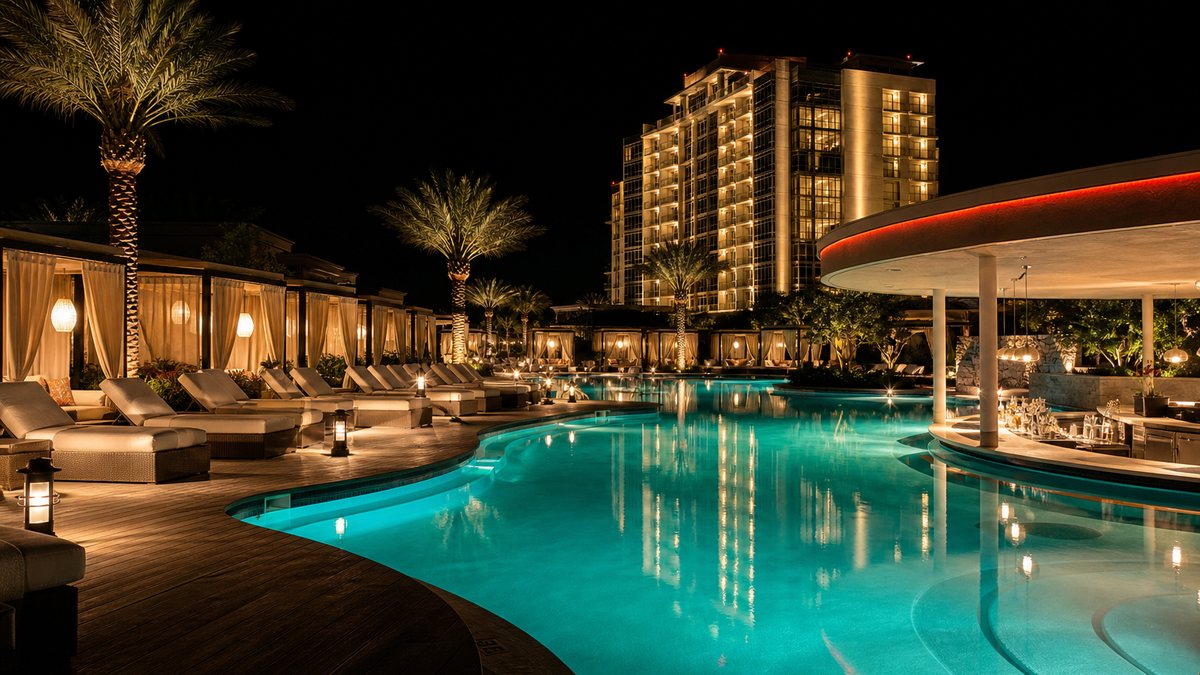
A lit pool deck at night is one of the most photographed parts of a Texas hotel, and in a warm climate the pool stays busy into the evening. Pool lighting combines underwater fixtures, deck and landscape lighting, cabana and bar lighting and, often, color-changing effects. It is also one of the most regulated areas of the property:
- Electrical safety: underwater and near-pool lighting follows NEC Article 680, with proper bonding, grounding, GFCI protection and listed fixtures.
- Public pool rules: hotel pools are public or semi-public pools under Texas DSHS rules (25 TAC 265), which address lighting for pools used after dark.
- Visibility and glare: lifeguards or staff must be able to see the pool floor clearly, and fixtures should not create blinding reflections on the water.
- Corrosion resistance: chlorine and salt systems demand fixtures, hardware and finishes rated for the environment.
Our pool and aquatic center lighting guide covers design and safety in depth, and our network partner Premium Pool Lighting focuses on pool and water feature lighting. Resorts with fountains, water walls and lazy rivers often add fiber optic and underwater effects as well. Confirm pool lighting requirements with your AHJ and the local health authority.
Parking lots, garages and security
Guests often decide how safe a hotel feels in the parking lot. Uniform light without dark pockets, good color rendering for security cameras and clear routes to entries matter more than raw brightness. LED area lights with full cutoff optics put light on the pavement instead of into the sky and neighboring properties. In parking garages, LED fixtures with occupancy and daylight controls keep light where guests are while dimming empty levels. Coordinating lighting with camera placement during design helps avoid glare in camera views and blind spots in the image.
The same principles we apply to retail properties, described in our Texas shopping center lighting guide, carry over to hotel lots: assess pole condition, model light levels and spill, and schedule dimming for late-night hours where codes and security plans allow.
Coast, Hill Country and big-city considerations
Texas is large enough that a hotel in Galveston, one on the San Antonio River Walk and one off a West Texas interstate face very different conditions.
Gulf Coast and South Texas
Salt air, humidity and hurricane season demand marine-grade finishes, sealed fixtures, stainless hardware and mounting designed for wind. Properties within the Texas Department of Insurance windstorm program areas may need certification for exterior work, so coordinate with your design team and AHJ. Our South Texas commercial lighting guide covers Corpus Christi, the Rio Grande Valley and Laredo.
Hill Country and dark-sky communities
Resorts and boutique hotels in the Hill Country often market starry skies as part of the experience. Fully shielded fixtures, warm color temperatures and curfew dimming protect that view while keeping paths safe.
Downtown and convention markets
Hotels in Dallas, Fort Worth, Houston, Austin and San Antonio compete on design and event space. Facade lighting, signature lobbies, ballrooms and rooftop bars carry more weight, and historic buildings may require design review before exterior changes.
Highway and suburban properties
Select-service and extended-stay hotels along major corridors rely on visible facades, bright and safe parking lots and efficient 24/7 corridors. Simple, durable systems with smart scheduling deliver the most value.
Retrofit or redesign?
Hotel lighting projects usually take one of three paths:
- Lamp and kit retrofits: LED lamps or retrofit kits in existing fixtures. Quick and low-disruption for back-of-house and some guestroom fixtures, but limited where existing fixtures are dated, damaged or poorly placed.
- Fixture replacement: new LED fixtures in existing locations, often paired with new controls. Common in corridors, parking lots, garages and exteriors.
- Lighting redesign: new layout, fixtures and controls as part of a renovation or property improvement plan. Best for lobbies, restaurants, ballrooms and facades, where lighting drives the guest experience.
Most properties use a mix. Our commercial LED installation guide explains how retrofits and replacements are planned and commissioned, and our Luminance design-build program covers complete lighting transformations.
How a Texas hotel lighting project works
- Walkthrough: review every space at day and night, inventory fixtures, lamps and controls, and note maintenance problems and guest complaints.
- Goals and standards: confirm brand standards, renovation scope, design concept, event needs and any property improvement plan items.
- Design and photometrics: select fixtures, color temperatures and controls, and model light levels for exteriors, parking and key public spaces.
- Code review: check energy code, egress and emergency lighting, accessibility, pool rules and exterior ordinances with the design team and AHJ.
- Mockups: install sample fixtures in a model room, corridor or lobby area so owners and brands can approve the look.
- Proposal and incentives: a project-specific proposal, plus incentive paperwork where programs apply.
- Phased installation: work floor by floor, wing by wing or by public space, often overnight or during low-occupancy periods, so rooms stay sellable and events are not disrupted.
- Commissioning: program scenes, schedules and sensors, aim exterior and accent fixtures, and verify controls in every space.
- Training and service: train engineering and front-of-house staff on controls, and keep a spare-parts and fixture schedule so replacements match.
Utility incentives and tax considerations
Texas hotel lighting upgrades may qualify for energy-efficiency incentives through utility programs such as Oncor, CenterPoint Energy, Austin Energy, CPS Energy and AEP Texas, depending on program availability, the territory and the project's details. Programs change, have deadlines and often require approval before work begins, so incentive paperwork belongs early in the schedule rather than after installation. Building owners may also want to ask about the Section 179D energy-efficient commercial buildings deduction; confirm eligibility with your tax advisor.
What drives project cost
Hotel lighting projects range from a parking lot upgrade to a full-property renovation, so we price each one after a walkthrough. The main factors are:
- Scope: which spaces are included, from back-of-house only to every room, corridor and facade
- Retrofit versus redesign: lamps and kits, fixture replacement or new layouts
- Controls: basic schedules and sensors through scene control and guestroom management integration
- Decorative and feature lighting: custom pendants, color-changing accents and signature effects
- Exterior work: poles, foundations, facade access and lift requirements
- Environment: coastal, pool and wet-location ratings
- Phasing and access: overnight work, occupied floors and event calendars
Who does the work: our experience
Texas LED Lights brings 15+ years as an authorized architectural lighting dealer and project coordinator. Our licensed installation partner has completed over 200 major sports and commercial projects across the US and Canada — NFL, NBA, NHL, MLS, NCAA and NASCAR. That experience with large, complex venues carries directly into hotels, resorts and conference properties, where schedules are tight and guests are always present.
We coordinate the full property: interior and exterior commercial LED retrofits, facades, pools, signage, video walls and ongoing service. See our services, recent project types and statewide coverage. If you are comparing contractors, our guide to choosing a commercial lighting contractor in Texas lists the questions to ask.
Questions to ask before you hire
- Will you walk the property at night as well as during the day?
- How will the design meet our brand standards and any property improvement plan items?
- Can we approve a model room, corridor or lobby mockup before full installation?
- What color temperature and color rendering are specified for each space, and how will replacements match later?
- How will guestroom and corridor controls meet the energy code that applies to our project?
- How will work be phased so rooms stay sellable and events are not disrupted?
- Which utility incentive programs may apply, and who handles the paperwork?
- What warranties apply to fixtures, drivers and controls, and who provides service?
Frequently Asked Questions
What is LED hotel lighting?
Which hotel spaces should be upgraded to LED first?
What color temperature is best for hotels?
Do hotel guestrooms need occupancy or keycard lighting controls?
Can a hotel stay open during a lighting retrofit?
How should hotel ballrooms be lit?
What codes apply to hotel pool lighting in Texas?
Are there incentives for hotel LED upgrades in Texas?
How much does hotel LED lighting cost?
What areas of Texas do you serve?
Give your guests a better first impression
Request a consultation and we will follow up to schedule a walkthrough of your hotel, resort or conference property.
Related
Our Texas lighting network: Dallas commercial LED lighting, Fort Worth LED lighting, Arlington LED lighting, Irving LED lighting, Plano LED lighting, wholesale LED components, fiber optic starlight ceilings, 360° fiber optic lighting, premium pool lighting, modular building solutions, and Dallas modular structures.