Commercial LED Lighting in Houston, TX: Offices, Warehouses, Industrial Sites & Exteriors
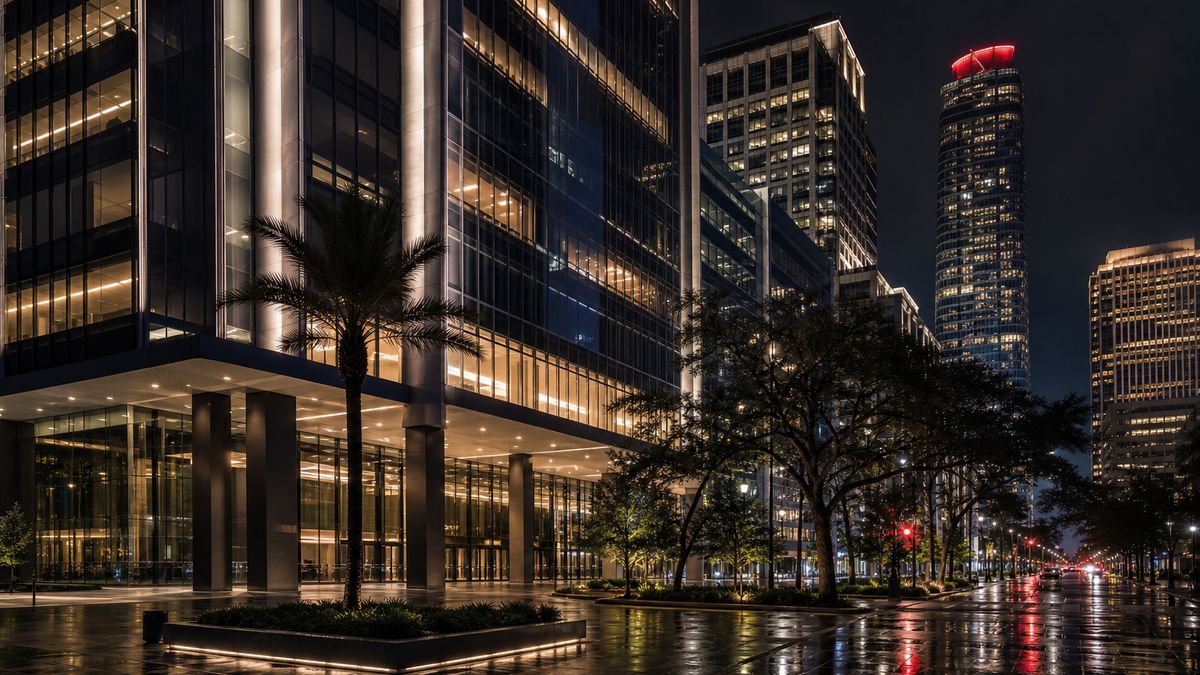
Commercial LED lighting in Houston has to work harder than almost anywhere else in Texas. The region runs on offices, distribution centers, petrochemical plants, hospitals, retail centers and port facilities, and many of them operate long hours or around the clock. Add Gulf Coast humidity, heavy rain, hurricane season, salt air near the bay and a city that spreads across several counties, and lighting becomes a real operational system, not just a line item. Older fluorescent, metal halide and high-pressure sodium fixtures across the metro are aging out, and owners are replacing them with LED fixtures and controls designed for the conditions.
This guide is for Houston-area property managers, facility and plant managers, building engineers, owners, developers, tenant-improvement teams and general contractors. It covers how commercial LED lighting is planned and installed in Houston, what changes by building type, from Downtown and Uptown offices to Ship Channel industrial sites and Northwest Houston warehouses, which codes and utility programs to know about, how to design exterior and parking lighting that survives Gulf Coast weather, and how a project moves from walkthrough to commissioning.
Commercial LED lighting in Houston means replacing older fluorescent, metal halide and HID fixtures in offices, warehouses, industrial plants, medical buildings, retail and exteriors with LED fixtures and controls specified for Gulf Coast heat, humidity and storms.
- Building types: offices, warehouses and distribution centers, industrial and process facilities, healthcare, retail, hospitality and parking
- Gulf Coast conditions: wet-location and corrosion-resistant fixtures, surge protection and wind-rated exterior poles
- Industrial sites: hazardous-location fixtures where required under NEC Articles 500–505
- Codes: the City of Houston uses its own amendments to the IECC for commercial energy compliance; confirm with your AHJ
- Incentives: CenterPoint Energy programs may apply, depending on program availability
- Controls: occupancy sensing, daylight dimming, scheduling and networked monitoring
- Pricing: every project receives a project-specific proposal after a site walkthrough
Why Houston businesses are upgrading to LED
Houston's building stock is large, varied and, in many areas, decades old. Office towers built during earlier energy booms, tilt-wall warehouses along the major freeways, industrial plants along the Ship Channel and suburban retail centers all carry lighting systems that are expensive to maintain and increasingly hard to repair. LED changes the picture in several ways:
- Lower energy use: LED fixtures deliver the same or better light with substantially less power, and controls reduce run time further.
- Less maintenance: fewer lamp and ballast changes, which matters most on high ceilings, tall poles and over production lines where every lift trip is a disruption.
- Better light quality: more uniform light, better color rendering and no flicker, which helps in offices, clinics and inspection areas.
- Instant on: no warm-up or restrike delay after a power interruption, which is common during Gulf Coast storms.
- Less heat: LED adds less heat to conditioned space, easing the load on air conditioning in a hot, humid climate.
- Controls-ready: modern fixtures connect to sensors and networked controls that support energy code compliance and remote monitoring.
Many Houston owners also upgrade lighting as part of a larger event: a lease renewal, a tenant improvement, a roof or ceiling replacement, storm repairs, an acquisition or a property improvement plan. Bundling lighting with that work usually reduces disruption.
Houston submarkets and what they need
Houston is less a single city than a collection of business districts, each with its own building types. A lighting plan that works in a Downtown office tower is different from one for a Pasadena process plant or a Katy distribution center.
| Area | Typical buildings | Common lighting priorities |
|---|---|---|
| Downtown & Midtown | Class A and B office towers, garages, hotels, venues | Lobby and amenity upgrades, tenant floors, garages, facade lighting |
| Uptown / Galleria & Greenway | Mid- and high-rise offices, retail, hotels | Architectural lighting, retail and parking, tenant improvements |
| Energy Corridor & Westchase | Corporate campuses, suburban offices, surface parking | Office retrofits, controls, parking lot and site lighting |
| Texas Medical Center area | Medical offices, clinics, research and support buildings | Color quality, glare control, 24/7 corridors, garages |
| Ship Channel, Pasadena & Baytown | Process plants, terminals, fabrication shops | Hazardous-location fixtures, corrosion resistance, high-mast and area lighting |
| Northwest, North & Katy corridors | Distribution centers, manufacturing, flex space | High-bay retrofits, dock and yard lighting, sensors |
| Suburbs: The Woodlands, Sugar Land, Pearland, Clear Lake | Offices, retail centers, schools, churches, healthcare | Retail and parking upgrades, offices, community facilities |
Whatever the district, the starting point is the same: walk the building, document what is installed, and understand how the space is actually used before choosing fixtures.
Office buildings and corporate campuses
Office lighting in Houston is often the first upgrade owners consider, because the fixture counts are large and the spaces run long hours. Typical scopes include:
- Open office and private offices: replacing fluorescent troffers with LED troffers, flat panels or retrofit kits, usually with dimming drivers and occupancy or vacancy sensors.
- Lobbies and amenity spaces: layered lighting with downlights, linear accents, cove lighting and decorative pendants to support leasing and tenant retention.
- Corridors, restrooms and stairs: efficient fixtures with occupancy control where code allows, and emergency egress lighting that is tested and documented.
- Parking garages: LED garage fixtures with bi-level sensors, which are a common high-impact upgrade in Houston towers.
For multi-tenant buildings, phasing is critical. Work is usually scheduled floor by floor, after hours or on weekends, so tenants keep operating. Our commercial LED lighting installation guide explains how installers plan and stage that work, and our LED fixture buyer's guide walks through troffers, panels, downlights and linear fixtures in detail.
Warehouses and distribution centers
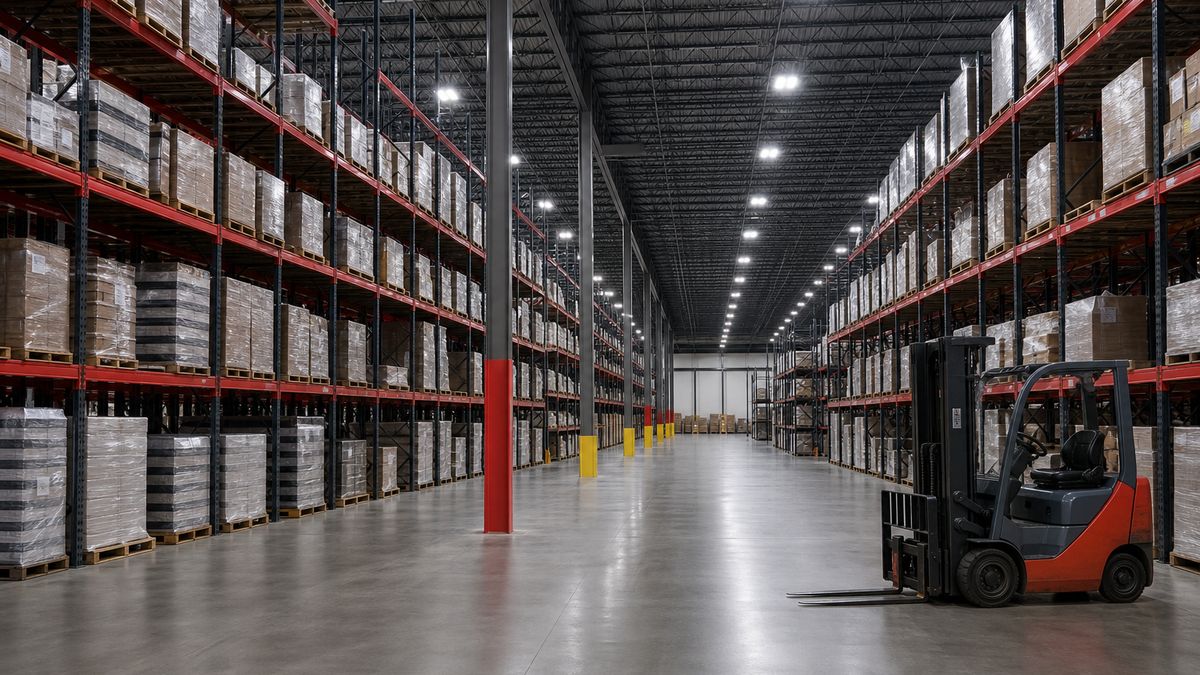
The Houston region is one of the largest logistics markets in the country, with warehouses and distribution centers along the Beltway, the Grand Parkway, I-10, US-290, I-45 and near Port Houston. High ceilings, long operating hours and forklift traffic make lighting a safety and productivity issue.
High-bay lighting
LED high-bays replace metal halide and fluorescent high-bays in racking aisles and open floors. Aisle-specific optics put light on rack faces and pick locations rather than the tops of the racks, and integrated occupancy sensors dim aisles that are not in use.
Docks, yards and trailer parking
Dock doors need good light inside trailers and on the apron, while truck courts and trailer yards need even area lighting for safety and security. Fixtures should be rated for wet locations and mounted to withstand wind.
Temperature-controlled space
Coolers and freezers require fixtures rated for low temperatures and condensation, and LED's instant start in the cold is a major advantage over older sources.
Industrial plants and the Ship Channel
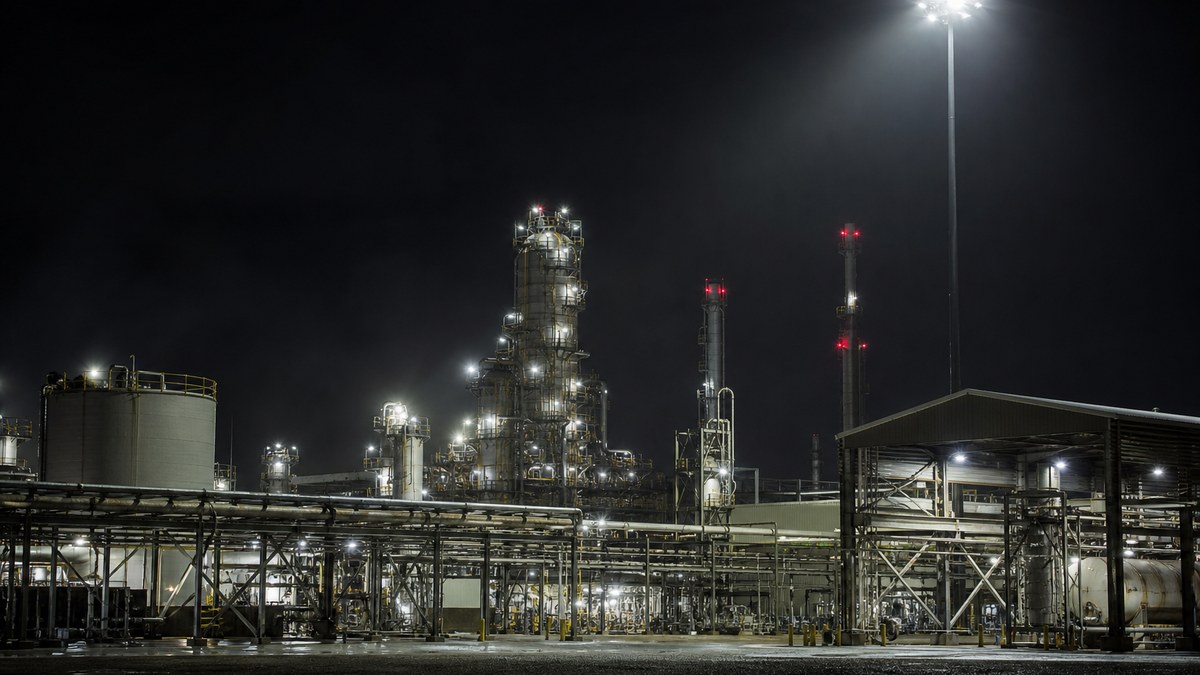
East Houston, Pasadena, Deer Park, La Porte and Baytown are home to one of the largest concentrations of refining, chemical and terminal facilities in the world. Lighting there has requirements that go well beyond a typical commercial building.
- Hazardous (classified) locations: where flammable gases, vapors or dusts may be present, fixtures must be listed for the specific class, division or zone under NEC Articles 500–505. The facility's area classification drawings drive the fixture selection.
- Corrosion: salt air and chemical exposure call for coated housings, stainless hardware and sealed optics.
- High-mast and area lighting: tank farms, laydown yards and process units often use high-mast or tall pole lighting that is costly to service, so long-life LED and remote drivers reduce trips.
- Turnarounds and access: lighting work is often scheduled around plant turnarounds and permits, with contractor safety programs and site orientation requirements.
Industrial owners should expect the lighting design to be coordinated with plant engineering, safety and electrical staff from the beginning. We work within your contractor qualification and safety requirements.
Planning a lighting upgrade in the Houston area?
Tell us about your building, plant or campus and we will follow up to schedule a walkthrough and prepare a project-specific proposal.
Healthcare, retail and hospitality
Medical offices and clinics
Medical buildings in and around the Texas Medical Center and across the suburbs need high color rendering for exam rooms, low-glare fixtures for patients lying down, dimmable lighting in waiting areas and dependable 24/7 lighting in corridors and garages. Lighting work in occupied healthcare space is coordinated with infection-control procedures and the facility's own requirements.
Retail centers
Houston's suburbs are full of strip centers, power centers and mixed-use developments. Storefront canopies, facades, pylon signs and parking lots are the most visible lighting, and they shape whether customers feel safe at night. Our Texas shopping center LED lighting guide covers parking lots, canopies and facades in depth.
Hotels and venues
Hotels near Downtown, the Galleria, the airports and the Medical Center run around the clock. Lobbies, ballrooms, guestrooms, pools and exteriors each have different needs. See our Texas LED hotel lighting guide for a space-by-space breakdown, and our starlight ceiling guide for signature hospitality features.
Exterior, parking and site lighting
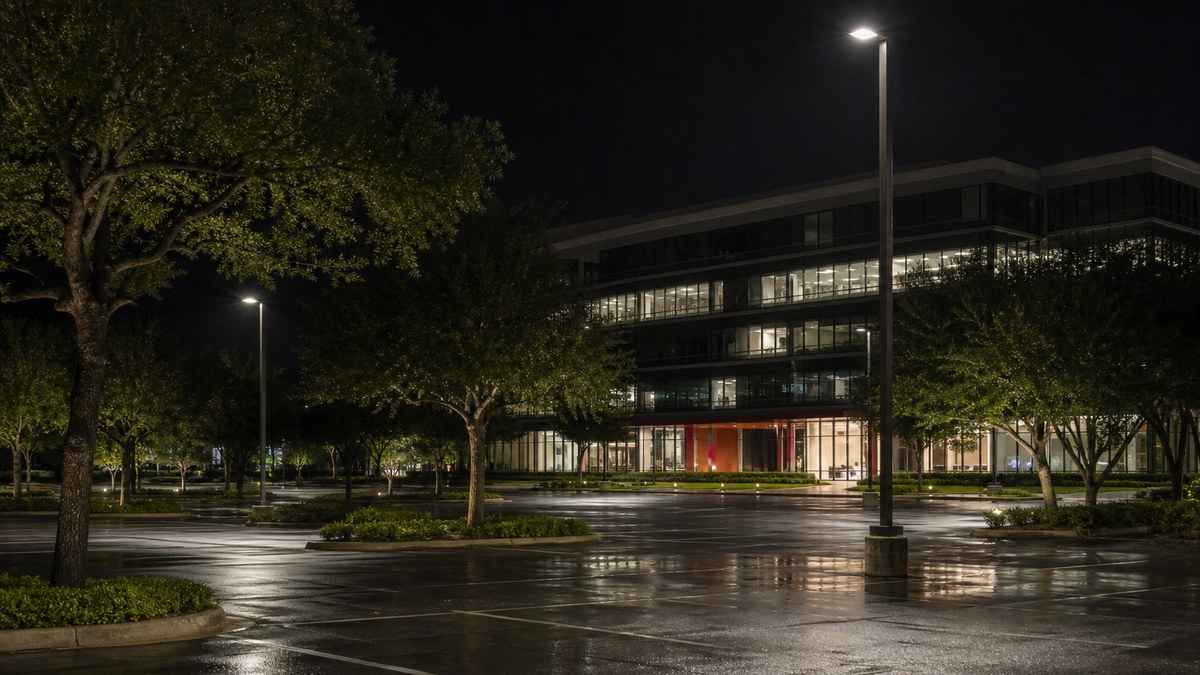
Exterior lighting is where Houston's climate matters most. Parking lots, garages, building facades, walkways and loading areas face heat, heavy rain, lightning and tropical storms.
- Area and pole lighting: full-cutoff LED area lights replace older shoebox and cobra-head fixtures, putting light on the pavement and reducing glare toward streets and neighbors.
- Poles and bases: existing poles, anchor bolts and bases should be inspected for corrosion and evaluated for wind loads before new fixtures are mounted.
- Wall packs and canopies: LED wall packs and canopy lights improve security around buildings, entries and docks.
- Surge protection: lightning and utility switching events make surge protection a standard part of exterior LED specifications.
- Controls: photocells, astronomic timers and motion-based dimming keep lights on when needed and lower after hours.
Houston is known for having no traditional zoning ordinance, but that does not mean exterior lighting is unregulated. Building codes, energy code exterior lighting provisions, deed restrictions, landlord requirements and suburban city ordinances can all apply. Confirm requirements with your AHJ and property documents before finalizing a design.
Gulf Coast weather and resilience
Hurricanes and tropical storms, flooding rains and summer heat shape every exterior lighting decision in the Houston region. Storms such as Hurricane Beryl in 2024 also showed how long power outages can last, which puts emergency and egress lighting in the spotlight.
- Wet-location and ingress ratings: exterior and washdown fixtures need appropriate wet-location listings and sealed housings.
- Coastal corrosion: near Galveston Bay, Clear Lake, Seabrook, La Porte, Kemah and Galveston, specify corrosion-resistant finishes and hardware.
- Windstorm requirements: parts of the coast fall within the Texas Department of Insurance (TDI) windstorm program area, including portions of eastern Harris County. Exterior work there may involve windstorm inspection and certification; confirm with TDI and your AHJ.
- Flood-prone sites: where sites have flooded before, the location of drivers, controls and electrical equipment deserves attention during design.
- Emergency lighting: battery-backed fixtures, central inverters or generator-backed circuits should be tested and documented under NFPA 101 and the building's fire and life safety requirements.
Codes, energy compliance and incentives
Commercial lighting in Houston touches several sets of rules. The details change, so treat this as a checklist of what to ask about rather than a list of numeric requirements.
| Topic | What applies | What to do |
|---|---|---|
| Energy code (City of Houston) | The city publishes Houston amendments to the 2021 IECC for commercial compliance | Confirm the current edition and lighting power and controls provisions with the Houston Permitting Center |
| Energy code (suburbs and counties) | Suburban cities adopt their own editions; the statewide commercial baseline is set through SECO | Confirm with the local building department |
| Electrical | National Electrical Code as adopted locally, including Articles 500–505 for hazardous locations | Permits and inspections through the AHJ; licensed electricians |
| Life safety | NFPA 101 and the fire code for egress and emergency lighting | Test, label and document emergency fixtures |
| Windstorm | TDI windstorm program in designated coastal areas | Confirm whether the site is in the program area |
| Utility incentives | CenterPoint Energy commercial efficiency programs, such as its Commercial and Industrial Standard Offer Program and SCORE program for public entities | Projects may qualify depending on program availability; apply before work starts |
| Tax deduction | Section 179D for qualifying energy-efficient commercial building improvements | Confirm with your tax advisor |
Most of the Houston area receives electric delivery from CenterPoint Energy, while some surrounding communities are served by other utilities. Incentive programs typically require pre-approval, so the paperwork should be part of the project plan from day one, not an afterthought.
Lighting controls for Houston buildings
Controls are where much of the long-term value of an LED project lives, and current energy codes require many of them in new work and major alterations.
| Control | Where it is used | Benefit |
|---|---|---|
| Occupancy and vacancy sensors | Offices, restrooms, storage, warehouse aisles | Lights run only when spaces are used |
| Daylight dimming | Perimeter offices, lobbies, warehouses with skylights | Uses daylight and reduces electric light |
| Bi-level garage controls | Parking garages | Low output when empty, full output on motion |
| Schedules and astronomic timers | Exteriors, common areas, retail | Lights follow business hours and sunset |
| Networked controls | Campuses, multi-building portfolios | Remote monitoring, fault alerts, reporting |
| Scene control | Lobbies, conference rooms, hospitality | Presets for events, cleaning and after hours |
Retrofit, relamp or redesign?
Houston owners usually choose among three paths, and many projects mix them by space:
- LED retrofit kits: new LED components installed in existing fixture housings. Fast and less disruptive, especially in occupied offices, but only if the housings are in good condition.
- Fixture replacement: new LED fixtures in the same locations. Common for high-bays, exterior lights and corroded or damaged fixtures.
- Lighting redesign: a new layout, fixture types and controls. Best for lobbies, amenity spaces, tenant improvements and warehouses with new racking layouts.
Simple lamp replacements (tube LEDs in old fixtures) can be tempting, but they may leave old sockets and ballasts in place and limit controls. A walkthrough and photometric comparison show which path makes sense for each area.
How a Houston lighting project works
- Walkthrough: document fixtures, ceilings, mounting heights, controls, electrical panels and operating hours; note corrosion, water intrusion and storm damage.
- Goals: confirm priorities such as energy, maintenance, light quality, security, tenant appeal or code compliance.
- Design: select fixtures and controls, model light levels where needed and plan phasing around operations.
- Incentives and permits: prepare utility pre-approval paperwork and permit drawings where required.
- Proposal: a project-specific proposal with scope, schedule and options.
- Procurement: order fixtures and controls, with lead times built into the schedule.
- Installation: licensed installers work in phases, after hours or around plant schedules, with recycling of removed lamps and ballasts.
- Commissioning: program sensors and controls, aim exterior fixtures, verify light levels and test emergency lighting.
- Closeout: as-built fixture schedule, control settings, incentive documentation and staff training.
For a deeper look at choosing who does the work, see our guide to commercial lighting contractors in Texas.
What drives project cost
Every Houston building is different, so Texas LED Lights prices each project after a walkthrough. The main cost drivers are:
- Scope and fixture count: number of spaces, fixture types and mounting heights
- Retrofit versus replacement versus redesign: how much of the existing system can be reused
- Controls: standalone sensors through networked, building-wide systems
- Environment: hazardous-location, corrosion-resistant, wet-location or cold-rated fixtures
- Access: lifts, high ceilings, high-mast poles and occupied or secure areas
- Schedule: after-hours, weekend or turnaround work and phasing
- Exterior structures: pole, base and wind-load evaluations or replacements
Utility incentives and tax treatment can affect the overall budget, depending on program availability and your tax situation. We can help prepare incentive documentation as part of the project.
Who builds it: our experience
Texas LED Lights brings 15+ years as an authorized architectural lighting dealer and project coordinator. Our licensed installation partner has completed over 200 major sports and commercial projects across the US and Canada — NFL, NBA, NHL, MLS, NCAA and NASCAR. That same coordination supports Houston office, industrial, healthcare, retail and hospitality projects.
Beyond general commercial lighting, we deliver architectural and facade lighting, LED video walls and displays, LED sports lighting for school and park facilities, and pool and aquatic center lighting. For complete design-build transformations, see our Luminance program. We serve all of Texas, including Houston, San Antonio, Austin, Dallas–Fort Worth and South Texas.
Questions to ask before you buy
- Was every space walked, and is there a fixture-by-fixture inventory?
- Which areas are retrofit, which are replacement and which are redesign, and why?
- Are exterior fixtures and hardware rated for wet, coastal or corrosive conditions?
- Do any areas require hazardous-location fixtures, and has the area classification been reviewed?
- How does the design meet the applicable energy code for lighting power and controls?
- Which CenterPoint Energy or other utility programs might apply, and who handles the paperwork?
- How will installation be phased around tenants, operations or plant schedules?
- What warranties apply to fixtures, drivers and controls, and who provides service?
Frequently Asked Questions
Do you provide commercial LED lighting installation in Houston, TX?
What energy code applies to commercial lighting in Houston?
Are there CenterPoint Energy incentives for LED lighting?
What lighting is required in hazardous areas at Houston industrial plants?
How do you protect exterior LED lighting from Gulf Coast weather?
Can lighting be upgraded while our building stays open?
Should we retrofit our fixtures or replace them?
Do LED upgrades help with emergency lighting?
How much does commercial LED lighting cost in Houston?
Which Houston-area communities do you serve?
Upgrade your Houston property with LED that lasts
Request a consultation and we will follow up to schedule a walkthrough of your building, campus or plant.
Related
Our Texas lighting network: Dallas commercial LED lighting, Fort Worth LED lighting, Arlington LED lighting, Irving LED lighting, Plano LED lighting, wholesale LED components, fiber optic starlight ceilings, 360° fiber optic lighting, premium pool lighting, LED signage and message centers, modular building solutions, and Dallas modular structures.