Texas Commercial LED Exterior Lighting: Parking Lots, Pole Lights, Facades & Site Controls
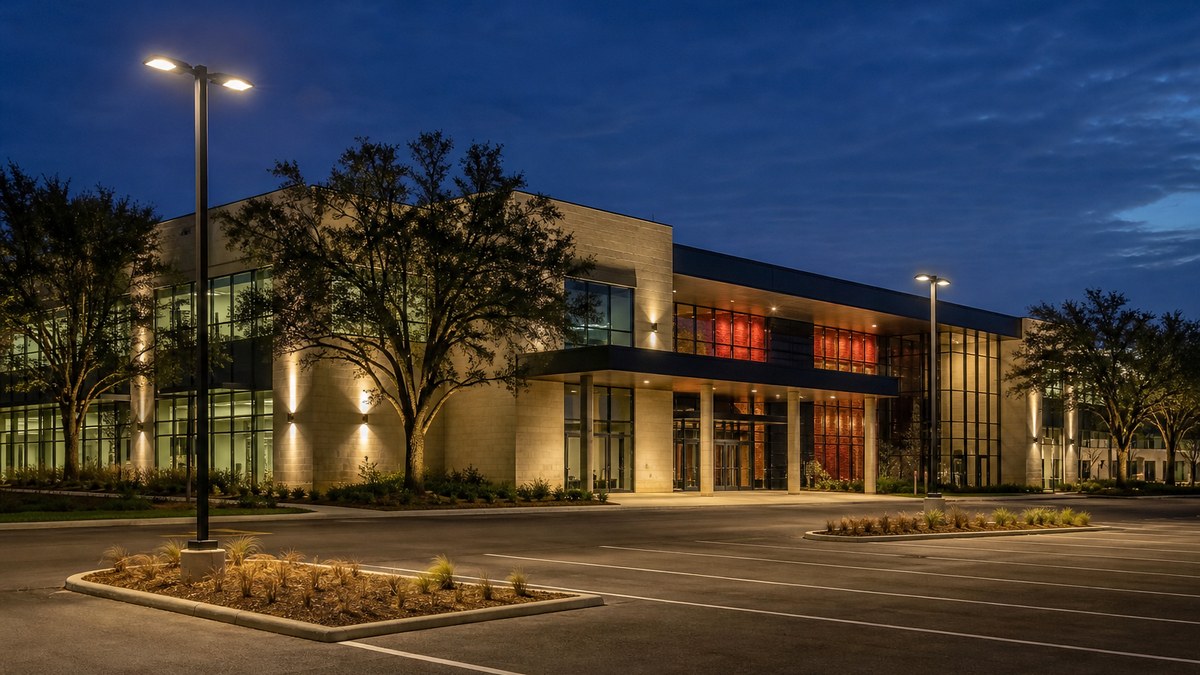
Texas commercial LED exterior lighting is the part of a property that every tenant, visitor, driver, delivery crew and neighbor sees after dark. Parking lot pole lights, building-mounted wall packs, entry canopies, loading docks, walkways, facade accents and signage all work together as one exterior system. When that system still runs on aging metal halide or high-pressure sodium fixtures, the result is usually the same across the state: dark patches between poles, orange or uneven color, fixtures cycling on and off, burned-out heads on tall poles that are hard to reach, and glare that spills into the next property.
This guide is written for owners, property managers and facility teams of office buildings, corporate campuses, industrial parks, distribution centers, manufacturing plants, medical office buildings and mixed-use sites across Texas. It explains how a modern LED exterior lighting system is planned, how to light each zone of a site, which standards and Texas rules come into play, how to handle storms, heat and coastal air, and how a project moves from site walk to night-time commissioning. Retail centers have their own guide: see our Texas shopping center LED lighting article.
Commercial LED exterior lighting replaces older pole lights, wall packs, canopy lights and floodlights with LED fixtures, precise optics and automatic controls so a site is evenly lit, easier to maintain and better behaved toward neighbors and the night sky.
- Zones: parking lots, drive aisles, entries, walkways, loading docks, truck yards, facades and signage
- Pole lighting: pole height, spacing and optics (distribution type) decide uniformity more than fixture brightness alone
- Glare control: full cutoff optics, shields and BUG-rated fixtures keep light on the property
- Controls: photocells, astronomical timeclocks, after-hours dimming and motion sensing
- Rules: the energy code adopted for your project, local lighting ordinances and, for state-funded work, Texas cutoff requirements
- Texas conditions: wind, hail, heat, lightning and coastal corrosion shape fixture, pole and surge choices
- Pricing: every site gets a project-specific proposal after a site walk and photometric layout
Why exterior lighting is a different project
Interior retrofits mostly happen above a ceiling grid. Exterior projects touch poles, foundations, underground conduit, utility-owned lights, property lines, city ordinances and the weather. That changes how a project is planned:
- Height and access: pole heads are serviced with bucket trucks or lifts, so fixture reliability and driver quality matter far more than they do indoors.
- Neighbors and roads: light that crosses a property line or hits drivers' eyes becomes everyone's problem, and many Texas cities regulate it.
- Weather exposure: fixtures, arms and poles live through summer heat, hail, high winds and, near the Gulf, salt air and humidity.
- Liability and security: dark corners, unlit walkways and shadowed doors are where trip-and-fall claims and security problems start.
- Operating hours: exterior lights run every night of the year, so controls that dim or switch off unused areas make a real difference to operating costs.
Because of all that, the best results come from treating the exterior as one designed system rather than replacing fixtures one for one. A one-for-one swap often repeats the dark spots and glare of the old layout with a brighter, whiter light.
The zones of a commercial site
Every property is different, but most Texas office, industrial and mixed-use sites break down into the same zones. Each one has its own goal and its own typical fixtures:
| Zone | Typical LED fixtures | Main design goal |
|---|---|---|
| Parking lots & drive aisles | Pole-mounted area lights | Even light between poles, low glare, clear sightlines for drivers and pedestrians |
| Building perimeter | Wall packs, cylinders, wall-mounted area lights | Light doors, sidewalks and facades without glaring into lots or roads |
| Entries & canopies | Canopy lights, recessed downlights, soffit lights | Welcoming, well-lit arrival with good face recognition |
| Walkways & plazas | Bollards, low poles, step and handrail lights | Safe footing and wayfinding at human scale |
| Loading docks & truck yards | Dock lights, high-mounted area lights, floodlights | Bright, even working light for drivers, forklifts and yard staff |
| Facades & landscape | Linear grazers, accent floods, uplights | Brand presence and architecture at night, with controlled uplight |
| Signage | Sign lighting, LED monument and pylon signs | Legible identity from the road |
Planning by zone makes it easier to set the right light level, the right control strategy and the right after-hours behavior for each part of the site.
LED pole lighting: height, spacing & optics
Pole lighting is the backbone of most commercial exterior systems and usually the largest part of the scope. Three things decide whether a parking lot looks even and comfortable or patchy and glaring.
Pole height and spacing
Taller poles spread light over a wider area and can reduce the number of poles; shorter poles fit better near homes, in landscaped areas and under tree canopies. Spacing between poles is tied to mounting height. When an existing lot was laid out for old metal halide fixtures, the pole grid may not match what a modern LED layout needs, so a photometric study tells you whether to keep every pole, add some, or relocate a few.
Optics and distribution types
LED area lights come with different light distributions, commonly described with IES types such as Type II, III, IV and V. A pole in the middle of a lot may use a wide, symmetric pattern; a pole along a property line usually needs a forward-throw pattern with a house-side shield so light lands on the lot instead of the neighbor's yard or the road. Choosing the optic for each pole position is one of the most important steps in exterior design.
Mounting arms and existing poles
Many LED pole retrofits reuse existing poles with new arms or adapters. That only works when the pole, base, anchor bolts and foundation are sound and rated for the new fixture's weight and effective projected area under Texas wind conditions. Rusted bases, cracked concrete, leaning poles and missing hand-hole covers are common findings on older lots. A structural check belongs at the start of the project, not after fixtures are ordered.
Building-mounted and entry lighting
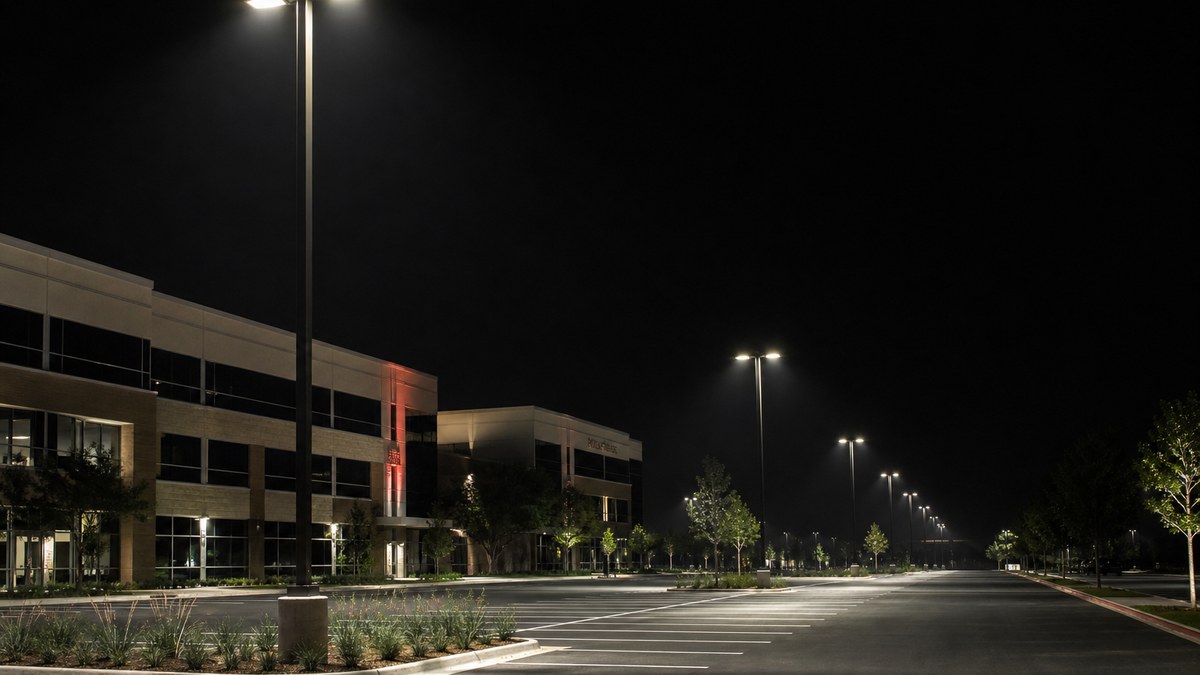
Wall packs are often the most glaring fixtures on older buildings. Many legacy units throw light outward and upward, which blinds drivers and pedestrians and lights the sky more than the sidewalk. Modern full cutoff LED wall packs aim the light down and out, so doors, sidewalks and building edges are lit without the glare.
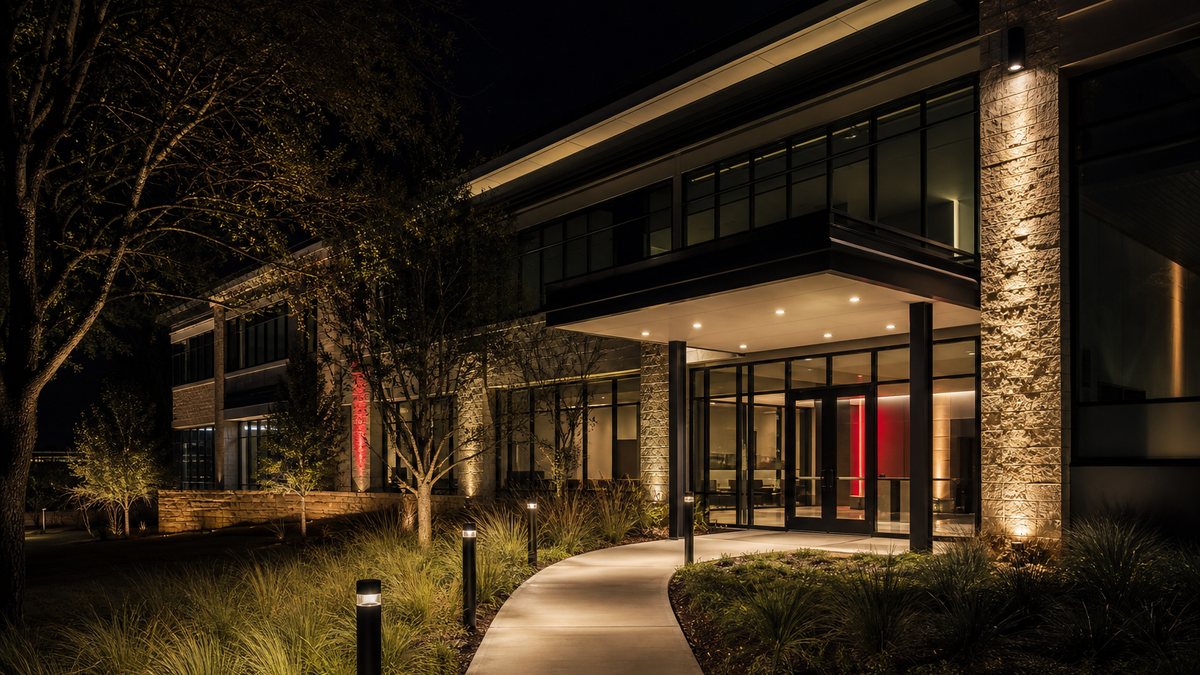
- Entries: layered lighting at main doors—canopy downlights, soffit lights and accent light on the entry facade—makes arrival feel safe and helps cameras capture faces.
- Secondary doors and service doors: every exit door needs consistent light on the door and the path away from it; emergency egress lighting at exterior discharge points should be coordinated with the life-safety design.
- Covered parking and drive-throughs: canopy fixtures with low-glare optics give even light under the roof without hot spots.
- Color consistency: using the same color temperature across poles, wall packs and canopies makes the whole property look intentional and well maintained.
For the fixture families themselves—area lights, wall packs, canopy lights and floods—see our commercial LED lighting fixtures buyer's guide.
Industrial sites, docks and truck yards
Distribution centers, manufacturing plants and logistics yards are some of the most demanding exterior projects in Texas. Trucks move around the clock, forklifts cross drive lanes, and staff work outdoors at night.
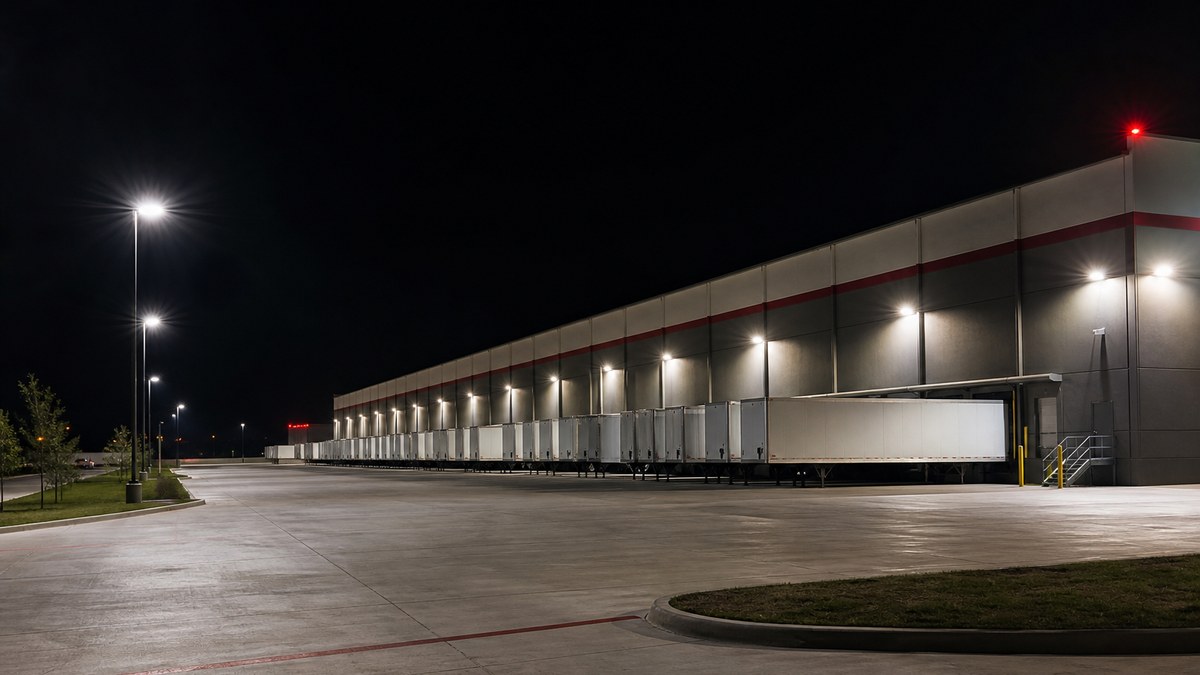
- Dock aprons: bright, even light at each door position so drivers can back in safely and staff can see trailer floors and dock plates.
- Truck courts and yards: high-mounted area lights or higher poles to cover large paved areas with fewer obstructions for trailers.
- Guard shacks and gates: good vertical light on drivers and plates at check-in points.
- Fuel islands and outdoor storage: fixtures rated for the location, with input from your safety and electrical teams where hazardous-location rules may apply.
- Perimeter and fence lines: consistent light that supports camera coverage without throwing glare onto neighboring roads.
Interior warehouse lighting is often upgraded at the same time; our commercial LED lighting installation guide and Texas commercial LED retrofit guide explain how to phase interior and exterior work together. For Gulf Coast industrial sites, see our Houston commercial LED lighting guide, and for border logistics yards, our South Texas commercial LED lighting guide.
Dark lots, glaring wall packs or dead pole heads?
Tell us about your property and we will follow up to schedule a site walk and prepare a project-specific proposal for your exterior lighting.
Standards, codes and Texas rules
Exterior lighting sits at the intersection of design guidance, energy code and local ordinance. The right targets for your site come from your design team and the authority having jurisdiction (AHJ), but these are the documents and rules that usually come up:
| Standard or rule | What it covers | What to do |
|---|---|---|
| ANSI/IES RP-8 | Recommended practice for roadway and parking facility lighting | Use it as the basis for parking lot light levels and uniformity in the photometric design |
| BUG ratings (IES TM-15) | Backlight, uplight and glare classification of outdoor fixtures | Compare fixtures by BUG rating, especially near property lines and in dark-sky areas |
| Commercial energy code (IECC) | Exterior lighting power limits and required exterior controls | Confirm which edition applies to your project; Texas adopts a statewide edition and many cities adopt their own with amendments |
| Local lighting ordinances | Shielding, light trespass, pole heights, color temperature and curfews in some cities and counties | Check city development codes early, especially in Hill Country and dark-sky communities |
| Texas Health & Safety Code Ch. 425 | Outdoor lighting installed or replaced with state funds | State-funded projects generally need cutoff luminaires above a set output and the minimum light adequate for the purpose |
| Texas Local Government Code Ch. 240 | Allows certain counties near observatories to regulate outdoor lighting | West Texas sites near McDonald Observatory should check county lighting rules |
| NEC and local electrical code | Wiring, grounding, overcurrent protection and wet-location rules | Licensed electricians, permits and inspections as the AHJ requires |
On energy code, the Texas statewide commercial code is the IECC edition adopted by the State Energy Conservation Office; as of late 2025 that was the 2015 IECC, with a review of the 2024 IECC under a newer adoption process, while large cities such as Houston publish their own amendments to newer editions. Code editions change, so always confirm the version that applies to your permit with your AHJ.
Glare, light trespass and dark skies
Brighter is not the same as better. Many complaints about LED exterior lighting come from poorly chosen fixtures—too bright, too cool in color, or aimed without shields. A good design solves the problem from the start:
- Full cutoff fixtures: no light emitted above the horizontal, which protects the night sky and reduces glare.
- Shields and optics: house-side shields and forward-throw optics on perimeter poles keep light on the property.
- Warmer color temperatures where appropriate: many dark-sky ordinances and residential neighbors prefer warmer white light; the design team picks color temperature per zone and per local rule.
- Lower uplight on facades: facade and landscape uplighting is aimed tightly at the building and dimmed or switched off late at night.
- After-hours dimming: lights drop to a lower security level when the building closes and come back up on motion.
Texas has some of the most active dark-sky communities in the country, from the Hill Country to the observatory region of West Texas. Designing for them is easier at the beginning of a project than after neighbors complain.
Controls that pay attention
LED fixtures can dim and switch instantly, which makes exterior controls far more useful than they were with metal halide. Common strategies include:
| Control | What it does | Where it fits |
|---|---|---|
| Photocells | Turns lights on at dusk and off at dawn | Every exterior zone as a base layer |
| Astronomical timeclock | Schedules by sunrise and sunset through the year | Facades, signage, landscape and after-hours schedules |
| After-hours dimming | Reduces output when the site is closed | Office and medical parking lots, perimeter lighting |
| Motion sensing | Raises light when people or vehicles are present | Back lots, walkways, docks, low-traffic areas |
| Networked or wireless controls | Zone control, scheduling, fault alerts from a phone or web portal | Campuses, industrial parks and multi-building portfolios |
| Integration | Connects lighting with security, access control or building automation | Sites with cameras, gates and central monitoring |
The energy code adopted for your project may require some of these controls, so your design team should confirm the minimum controls before choosing the rest.
Built for Texas weather
Exterior fixtures in Texas see conditions that would shorten the life of any light. Good specifications account for them:
- Heat: drivers and LED boards must be rated for high ambient temperatures, with housings that move heat away from electronics.
- Wind: fixtures, arms and poles are checked for wind loads; Gulf Coast properties may fall inside the Texas Department of Insurance windstorm program area, so confirm requirements with your AHJ and insurer.
- Hail and impact: sturdy lenses and housings hold up better in North and West Texas storms.
- Lightning and surges: surge protection at the fixture and panel, plus proper grounding of poles, protects electronics.
- Coastal corrosion: coatings and hardware suited to salt air for sites from Beaumont to Corpus Christi and the Rio Grande Valley.
- Expansive soils: new pole foundations are designed for local soil conditions.
Utility incentives and paperwork
Exterior LED upgrades may qualify for commercial energy-efficiency programs offered by Texas utilities such as Oncor, CenterPoint Energy, Austin Energy, CPS Energy and AEP Texas, depending on program availability and the rules in effect when you apply. Program steps matter: Oncor's commercial program, for example, routes projects through participating service providers and requires an approved pre-installation inspection before any work starts or existing fixtures are removed, followed by a post-installation inspection. Build those steps into the schedule before ordering. Some building owners also look at the federal 179D deduction for qualifying improvements—confirm with your tax advisor.
Retrofit, partial rebuild or new layout?
Most commercial exterior projects in Texas take one of three paths:
- Fixture retrofit on existing poles and walls: new LED heads, arms and wall packs where the layout already works and the poles pass inspection. Usually the fastest and least disruptive path.
- Partial rebuild: keep most poles but add, move or shorten some to fix dark areas, glare or light trespass, and replace failed bases or wiring.
- New site lighting design: for expansions, new buildings, re-striped or re-graded lots and properties where the old layout simply does not work.
A site walk, a review of the existing pole grid and a photometric comparison of the options make the choice clear. Many owners combine an exterior upgrade with an interior retrofit, facade lighting or architectural lighting so the whole property changes at once.
How a Texas exterior lighting project works
- Site walk and night survey: inventory poles, wall packs and canopies, note dark areas and glare, and review existing circuits and controls.
- Goals: confirm hours of operation, security needs, tenant concerns, neighbors and any planned site changes.
- Photometric design: model light levels, uniformity and light at the property lines for the proposed layout.
- Structural and electrical review: check poles, bases, foundations, wiring and panels.
- Code and incentive check: confirm the applicable energy code, local ordinance and any utility program pre-approval steps.
- Proposal: a project-specific proposal with scope, fixtures, controls and schedule.
- Installation: licensed crews install fixtures, arms, poles and controls, phased to keep the property open and safe.
- Night commissioning: aim fixtures, program photocells, schedules and dimming, and verify the results after dark.
- Close-out: as-built fixture schedule, control settings, warranty documentation and any incentive paperwork.
What shapes project cost
Texas LED Lights is quote-only, because exterior projects vary too much for a price list to be useful. The main factors are:
- Site size and layout: number of poles, wall fixtures, canopies and zones
- Pole reuse vs replacement: condition of poles, bases and foundations
- Electrical work: wiring condition, underground repairs, panels and surge protection
- Controls: from photocells to networked dimming and integration with security systems
- Optics and shielding: perimeter conditions, neighbors and dark-sky rules
- Access and phasing: lifts, traffic control, night work and keeping the property open
- Add-ons: facade lighting, landscape lighting and signage
We review your site, prepare the photometric layout and deliver a project-specific proposal.
Who builds it: our experience
Texas LED Lights brings 15+ years as an authorized architectural lighting dealer and project coordinator. Our licensed installation partner has completed over 200 major sports and commercial projects across the US and Canada — NFL, NBA, NHL, MLS, NCAA and NASCAR. That same coordination—design, photometrics, installation and commissioning—goes into office parks, industrial sites and campuses across Texas.
We work statewide from Dallas–Fort Worth to Houston, San Antonio, Austin, El Paso, Lubbock and the coast; see our coverage area and project portfolio. Exterior projects often connect to commercial interior lighting, LED video walls and LED signage and message centers. For complete design-build transformations, see our Luminance program.
Questions to ask before you buy
- Is the design based on a photometric study of our actual site, including the property lines?
- Which optic is used on each pole, and where are house-side shields needed?
- Have our existing poles, bases and foundations been inspected?
- What are the BUG ratings and color temperatures of the proposed fixtures?
- Which controls are required by our energy code, and which are optional?
- Does our city or county have an outdoor lighting ordinance that applies?
- If we apply for a utility incentive, when does the pre-installation inspection happen?
- What warranties apply to fixtures, drivers and controls, and who services them?
Frequently Asked Questions
What is commercial LED exterior lighting?
Can we keep our existing parking lot light poles?
Why does our new LED parking lot still have dark spots?
How do you stop LED lights from shining onto neighbors or the road?
What standards apply to parking lot lighting?
Do Texas rules limit outdoor lighting?
What controls should exterior LED lighting have?
Are there utility incentives for exterior LED upgrades in Texas?
How much does commercial exterior LED lighting cost?
What areas of Texas do you serve?
Light your property the right way after dark
Request a consultation and we will follow up to schedule a site walk of your parking areas, building exterior and loading zones.
Related
More from our blog: all Texas lighting guides, choosing a commercial lighting contractor, hotel lighting, sports lighting and all services.
Our Texas lighting network: Dallas commercial LED lighting, Fort Worth LED lighting, Arlington LED lighting, Irving LED lighting, Plano LED lighting, wholesale LED components, fiber optic starlight ceilings, 360° fiber optic lighting, premium pool lighting, modular building solutions, and Dallas modular structures.