Commercial Lighting in Austin, TX: LED Retrofits, New Construction, Exteriors & Controls
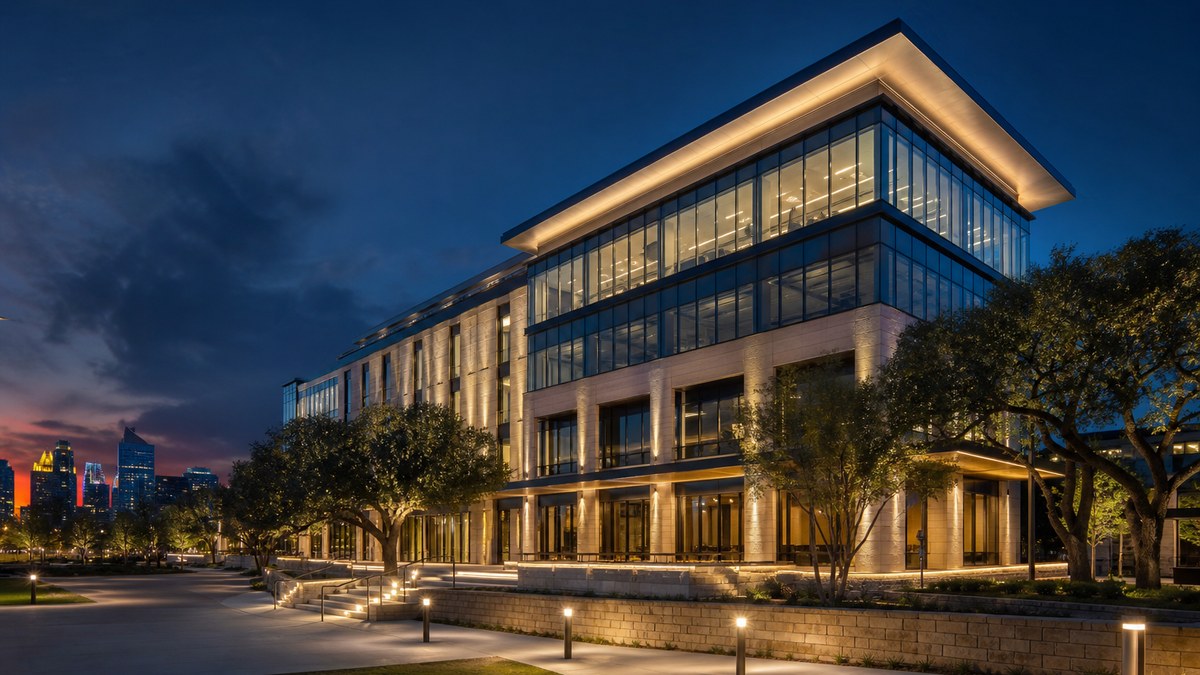
Commercial lighting in Austin, TX has its own rules of the road. The city enforces a newer energy code than much of Texas, Austin Energy runs its own commercial rebate programs with their own paperwork order, the Hill Country west of town cares about dark skies, and the region keeps adding offices, labs, warehouses, manufacturing plants, hotels, venues and mixed-use projects at a pace few metros can match. A lighting plan that works in another Texas city may not pass review, qualify for an incentive or suit the neighbors here without changes.
This guide is written for Austin-area property managers, facility directors, developers, general contractors, architects and business owners. It covers what makes the Austin market different, how to light each building type, how LED retrofits and new-construction lighting are handled under Austin's code, how Austin Energy commercial rebates generally work, how to plan exterior and parking lot lighting with dark-sky goals in mind, which controls matter, and how a project runs from site walk to commissioning. Texas LED Lights serves the whole metro, from downtown and the Domain to Round Rock, Georgetown, Cedar Park, Pflugerville, Kyle, Buda and San Marcos.
Commercial lighting services in Austin, TX cover LED retrofits of existing buildings, lighting design and installation for new construction and tenant finish-out, exterior and parking lot lighting, architectural facade lighting, and networked controls. What sets Austin apart:
- Energy code: the City of Austin lists the 2024 IECC with local amendments as its current energy code, which affects lighting power, controls and documentation on permitted work
- Austin Energy rebates: commercial lighting and controls incentives may be available to Austin Energy commercial customers, depending on program availability, and applications generally come before installation
- Other utilities: many suburbs are served by other utilities or cooperatives with their own programs
- Dark skies: shielded, well-aimed exterior lighting matters, especially toward the Hill Country
- Climate: heat, hail and severe storms shape fixture, driver and pole choices
- Pricing: every project gets a project-specific proposal after a site review
What makes Austin commercial lighting different
Austin is not just a smaller Dallas or Houston. Several local factors change how commercial lighting projects are scoped, designed and approved:
- A newer energy code. The City of Austin's building technical codes page lists the 2024 International Energy Conservation Code, with local amendments, as the energy code in force. Much of the rest of Texas works from an older edition. Newer editions generally tighten lighting power allowances and expand control requirements, so a design copied from an older project elsewhere may need changes.
- A city-owned utility. Inside its service territory, Austin Energy, the city-owned electric utility, runs its own commercial efficiency programs rather than the deregulated-market programs used in much of the state.
- A patchwork of utilities around the metro. Outside Austin Energy territory, nearby cities and unincorporated areas may be served by investor-owned utilities, municipal utilities or electric cooperatives, depending on the address. Each has its own programs, so the incentive path depends on the meter, not the city name on the mailing address.
- Fast growth in technical buildings. Labs, clean manufacturing, data halls, warehouses along the SH 130 and I-35 corridors, and large mixed-use campuses bring specialized lighting needs beyond the typical office.
- Strong community expectations. Neighborhood groups, design review and Hill Country dark-sky values mean exterior lighting is noticed and discussed.
Austin building types and how to light them
Downtown and Domain office towers
Class A offices downtown, along the Second Street district, in the Domain and North Austin, and around the Mueller redevelopment compete for tenants on experience. That means comfortable, low-glare LED in open offices, layered light in lobbies and amenity floors, tunable white in some collaboration areas, and networked controls that support hybrid occupancy. Tenant finish-out is constant, so lighting systems should be easy to reprogram as floors are reconfigured. Our commercial LED fixture buyer's guide explains the fixture families used in these spaces.
Tech, lab and clean manufacturing space
Austin's semiconductor, electronics and life-science sectors add buildings with demanding lighting: cleanroom-compatible fixtures, labs with high vertical illumination at benches, color-critical inspection areas, and spaces where flicker, maintenance access and contamination control matter as much as light level. These projects often need close coordination with process engineers and facility managers before a fixture is selected.
Warehouses and distribution centers
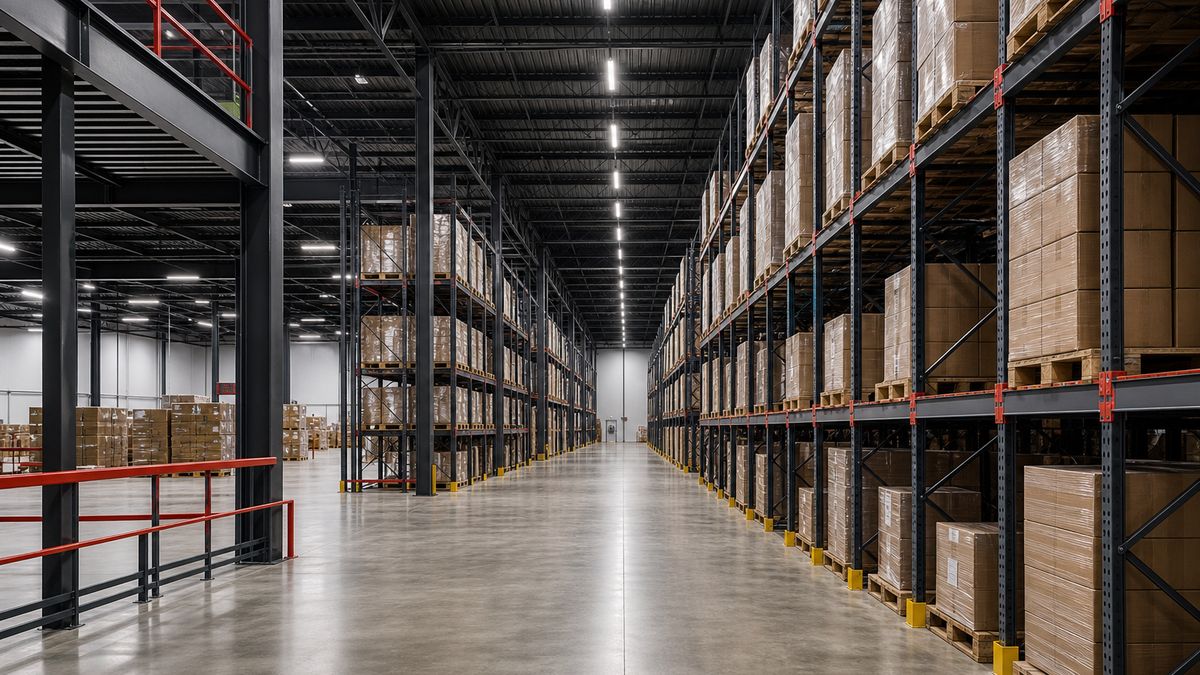
Big-box industrial buildings along SH 130, US 290, I-35 and in Round Rock, Pflugerville, Hutto, Buda and Kyle need LED high-bays laid out for rack aisles and open staging, occupancy and daylight controls, and well-lit docks and truck yards. Many older warehouses in the metro still run high-intensity discharge or fluorescent high-bays that are prime retrofit candidates.
Retail, restaurants and mixed-use
Retail centers, restaurant rows and ground-floor retail in mixed-use buildings need inviting storefronts, good vertical light on merchandise and menus, safe parking areas and signage that reads at night. See our Texas shopping center lighting guide for parking, canopy and facade strategies.
Hotels, venues and hospitality
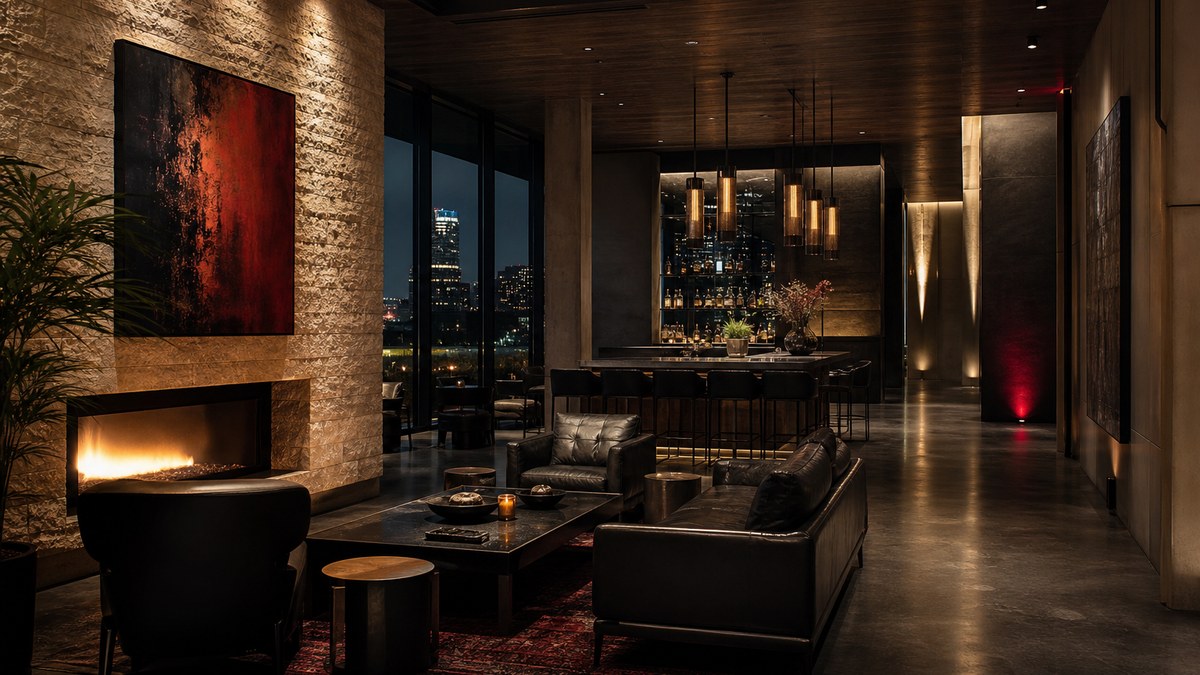
Austin's hotels, music venues, event spaces and rooftop bars rely on lighting for atmosphere: dimmable warm white, accent lighting, color-capable architectural fixtures and outdoor lighting that sets a mood without spilling into the neighborhood. Our Texas LED hotel lighting guide covers lobbies, ballrooms, pools and exteriors, and fiber optic starlight ceilings are a popular feature in lounges and private rooms.
Schools, churches, recreation and sports
Districts across Travis, Williamson and Hays counties, private schools, houses of worship and parks departments maintain gyms, fields, natatoriums and worship spaces. See our guides to LED sports lighting and natatorium lighting for those facility types.
| Building type | Typical lighting focus | Key Austin considerations |
|---|---|---|
| Office towers and campuses | Low-glare ambient, lobbies, amenity floors, controls | 2024 IECC controls inside city limits, frequent tenant finish-out |
| Labs and clean manufacturing | Task light, cleanroom fixtures, inspection areas | Process coordination, flicker, maintenance access |
| Warehouses and distribution | High-bays, aisle layouts, docks, truck yards | Occupancy and daylight controls, heat in unconditioned space |
| Retail and restaurants | Storefronts, merchandise, parking, signage | Exterior lighting rules, curfews, neighbor impact |
| Hotels and venues | Dimmable atmosphere, accent, color, outdoor spaces | Spill toward residential areas, scene control |
| Schools, churches, recreation | Classrooms, sanctuaries, gyms, fields, pools | Public procurement, scheduling around calendars |
LED retrofits in existing Austin buildings
Most Austin commercial lighting work is a retrofit: replacing fluorescent, metal halide or early-generation LED systems in occupied buildings. A good retrofit starts with a room-by-room survey, not a catalog. The main methods are:
- Lamp replacement: LED tubes or lamps in existing fixtures. Quick, but limited by the old housing and optics, and some types depend on the existing ballast.
- Retrofit kits: new LED drivers and light engines inside existing housings, such as troffer kits. Less ceiling disruption, better performance than lamps.
- Full fixture replacement: new luminaires designed for LED. Best optics, controls integration and appearance, and often the right answer where ceilings are being reworked anyway.
- Redesign: new layout and fixture types where the old layout never worked well, such as warehouses whose rack layout changed.
Retrofits in occupied buildings are usually phased by floor, zone or shift so tenants and operations keep running. Our Texas commercial LED retrofit guide covers audit, phasing and close-out in detail, and our installation guide explains how professional installers plan and commission the work.
New construction, finish-out and the Austin energy code
For new buildings, additions and many alterations inside Austin city limits, lighting is reviewed against the City's adopted energy code. The City of Austin's building technical codes page lists the 2024 IECC with local amendments. In practice that affects several parts of a lighting design:
- Lighting power: the installed lighting power for the building or each space has to stay within the code's allowances.
- Controls: requirements such as occupancy and vacancy sensing, daylight-responsive controls near windows and skylights, time-based shutoff, and exterior lighting controls.
- Documentation: compliance documentation such as COMcheck and functional testing of controls.
- Local amendments: Austin adds its own amendments to the model code, so national rules of thumb are not enough.
Outside the city limits, surrounding cities and counties adopt their own codes, and the statewide commercial baseline set through the State Energy Conservation Office has typically been an older IECC edition. Requirements change over time, so always confirm the edition and amendments with your authority having jurisdiction (AHJ) before design is finalized.
Some Austin projects also pursue Austin Energy Green Building ratings, which can be required for certain development agreements or density programs. Where that applies, lighting design, controls and documentation should be coordinated with the rating requirements from the start.
Austin Energy rebates and other utility programs
Austin Energy offers commercial efficiency programs that may cover LED lighting and lighting controls for its commercial customers, depending on program availability and funding. Based on Austin Energy's published program pages, the general pattern is:
- Existing buildings: a High Efficiency Lighting and Controls offering for retrofits, including lighting control retrofits such as occupancy and daylight sensing.
- New construction: a separate New Construction Lighting offering for lighting that goes beyond the City of Austin energy code. Components required by code are not eligible, and the application needs to be submitted before the certificate of occupancy.
- Small businesses and nonprofits: a Small Business Bundle for qualifying small businesses, nonprofits and houses of worship, installed through contractors on Austin Energy's participating list.
- Apply first: applications generally have to be submitted before installation, with no retroactive payments, and projects may require pre- and post-installation photos or site visits.
- Permits matter: work generally has to meet code and permitting requirements to qualify.
Program names, eligibility rules and incentive levels change, so check the current Austin Energy program pages before you budget. If your building is outside Austin Energy territory, your utility or electric cooperative may have its own commercial programs, and investor-owned utilities in the region such as Oncor may offer standard offer programs that run through participating service providers. Either way, the sequence is the same: confirm the program, apply and complete any pre-installation step, then install. For federal 179D deductions on qualifying building upgrades, confirm with your tax advisor.
Planning a retrofit or new build in the Austin area?
Tell us about your building and we will follow up to schedule a site walk and prepare a project-specific proposal.
Exterior, parking lot and dark-sky lighting
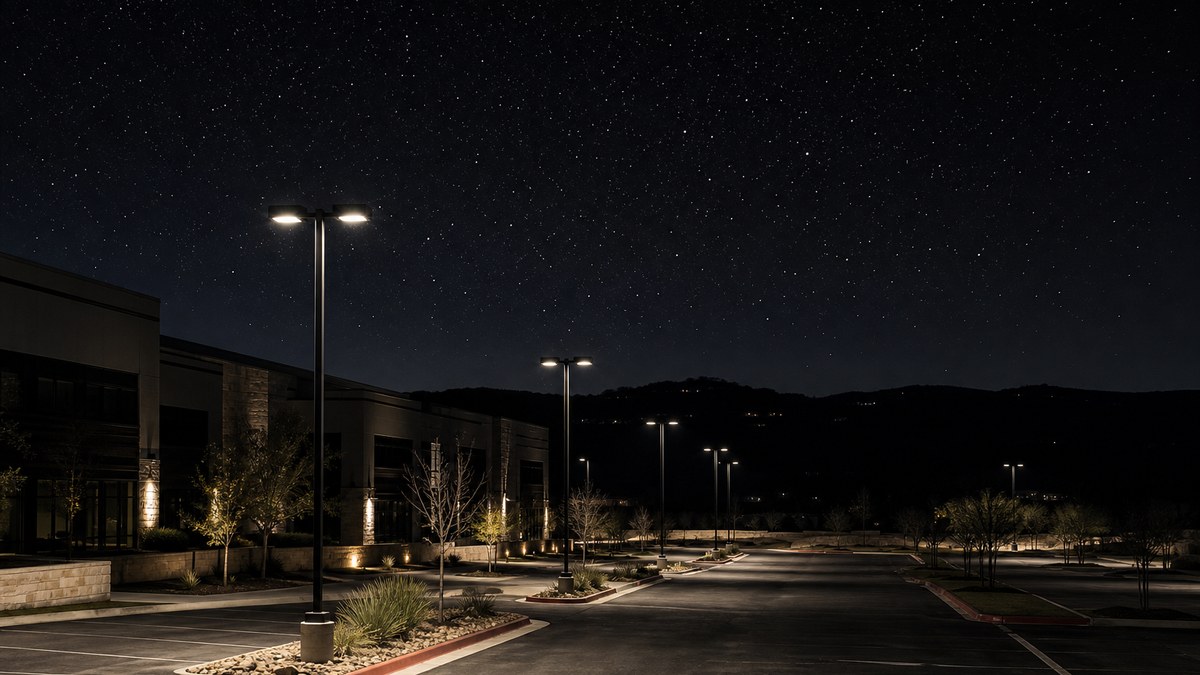
Exterior lighting is where Austin projects get the most attention from neighbors, reviewers and the public. Good exterior design balances safety, security, wayfinding and appearance against glare, spill light and sky glow:
- Full-cutoff area lights: parking lot and site fixtures that send no light above the horizontal, with optics chosen for each pole location.
- Backlight control: house-side shields or optics on poles near property lines and residential neighbors.
- Warmer color temperatures: often preferred for exterior lighting near homes and natural areas, and consistent with dark-sky guidance.
- Wall packs and entries: shielded wall-mounted fixtures and canopy downlights instead of unshielded floods that glare into drivers' eyes.
- Controls: photocells, astronomical time clocks and dimming or shutoff after business hours where code and safety allow.
Design is usually guided by IES RP-8 for roadways and parking facilities and by the BUG rating system (IES TM-15) for backlight, uplight and glare, plus the City of Austin's site and design standards and any surrounding city's lighting ordinance. Several Hill Country communities west of Austin actively promote dark skies, so projects in that direction deserve extra care. Confirm specific requirements with your AHJ. Our Texas commercial exterior lighting guide goes deeper on pole height, spacing and site controls.
Architectural and facade lighting
Austin's skyline, entertainment districts and mixed-use projects use architectural lighting to give buildings identity after dark: grazing on limestone and masonry, linear accents on canopies and parapets, uplighting on landscaping, and color-capable systems for events. The best facade lighting is precise, keeps light on the building rather than the sky, and is controlled by schedules and scenes. See our architectural lighting services for what we design and install, or the Luminance design-build program for complete transformations.
Controls that pay off in Austin buildings
| Control | What it does | Where it fits |
|---|---|---|
| Occupancy and vacancy sensing | Turns lights off or down in empty spaces | Offices, restrooms, storage, warehouse aisles |
| Daylight harvesting | Dims lights near windows and skylights | Perimeter offices, lobbies, warehouses with skylights |
| Scheduling and time clocks | Follows business hours and exterior curfews | Whole building, parking lots, signage |
| Networked lighting controls | Zoning, reporting and remote changes | Multi-tenant offices, campuses, large warehouses |
| Scene control and tunable white | Presets for events and time of day | Hotels, venues, conference and amenity spaces |
| Exterior dimming | Reduces site lighting late at night | Parking lots and campuses near neighborhoods |
Controls are often where code requirements, incentive eligibility and day-to-day savings meet, but they only deliver if they are commissioned. Sensor placement, time delays, daylight set points and schedules should be tested and documented at turnover, and building staff should be trained on how to change them.
Texas weather and Austin conditions
Central Texas heat, hail, high winds and intense thunderstorms are hard on lighting systems. Exterior fixtures and drivers should be rated for high ambient temperatures, with surge protection on site circuits in a region with frequent lightning. Poles and bases need to be evaluated for wind loads, and fixtures in low-lying sites should be placed with drainage and flooding in mind. Inside, warehouses and mechanical spaces without air conditioning can get very hot in summer, which matters for driver selection. Specifying for these conditions up front reduces callbacks and early failures.
How an Austin commercial lighting project works
- Discovery call: building type, goals, schedule and which utility serves the meter.
- Site walk and survey: fixture inventory, ceiling types, mounting heights, existing controls, electrical conditions and problem areas.
- Design and photometrics: fixture selection, layouts and photometric models for key spaces and exterior areas.
- Code and incentive check: confirm the applicable energy code and AHJ, and the utility program requirements and order of steps.
- Proposal: a project-specific proposal with scope, phasing and schedule.
- Pre-installation steps: permits, incentive applications and any required pre-installation photos or inspections before old equipment comes out.
- Installation: phased work by licensed professionals, coordinated around tenants, shifts or events.
- Commissioning: controls programmed and tested, light levels checked, documentation assembled.
- Close-out: as-builts, warranty documentation, staff training and any post-installation utility steps.
What drives project cost
Every Austin project is quoted individually after a site review. The main cost drivers are:
- Scope and square footage: number of spaces, fixtures and exterior areas
- Retrofit method: lamps, kits, full replacement or redesign
- Ceilings and access: ceiling types, mounting heights and lift requirements
- Controls: standalone sensors through networked systems
- Exterior work: poles, foundations, trenching and photometric constraints
- Phasing and hours: after-hours or weekend work in occupied buildings
- Code and documentation: permits, compliance documentation and commissioning
Utility incentives may offset part of a qualifying project depending on the program and its availability. We build the proposal around your scope and schedule, not a one-size-fits-all package.
Who does the work: our experience
Texas LED Lights brings 15+ years as an authorized architectural lighting dealer and project coordinator. Our licensed installation partner has completed over 200 major sports and commercial projects across the US and Canada — NFL, NBA, NHL, MLS, NCAA and NASCAR. We coordinate design, fixtures, controls and installation for Austin-area offices, industrial sites, hospitality, retail and public facilities as one project, so owners have one point of contact from the site walk to close-out. See our commercial lighting services and our guide to choosing a commercial lighting contractor in Texas.
Austin is part of our statewide coverage. We also work in San Antonio, Houston, South Texas and across North Texas. See our coverage area and project types.
Questions to ask an Austin lighting contractor
- Which energy code edition and local amendments apply to our address, and how will the design comply?
- Which utility serves our meter, and what is the required order of steps for its incentive program?
- Will you survey every space, or base the scope on a fixture count?
- Can we see photometrics for key interior spaces and the parking lot?
- How will exterior lighting control glare and spill toward neighbors and the sky?
- What controls are included, and who commissions and documents them?
- How will the work be phased around tenants, shifts or events?
- What warranties apply to fixtures, drivers and controls, and who handles service?
Frequently Asked Questions
What commercial lighting services are available in Austin, TX?
What energy code applies to commercial lighting in Austin?
Does Austin Energy offer rebates for LED lighting?
What if my building is outside Austin Energy territory?
Should we retrofit our fixtures or replace them?
How do you keep parking lot lighting dark-sky friendly?
Can you work in occupied offices, labs and warehouses?
Do lighting controls have to be commissioned?
How much does commercial lighting cost in Austin?
Which Austin-area cities do you serve?
Better light for your building, planned the Austin way
Request a consultation and we will follow up to schedule a site walk and prepare a project-specific proposal.
Related
Read more on the Texas LED Lights blog, browse our services, or contact our team. Our Texas lighting network: Dallas commercial LED lighting, Fort Worth LED lighting, Arlington LED lighting, Irving LED lighting, Plano LED lighting, wholesale LED components, fiber optic starlight ceilings, 360° fiber optic lighting, premium pool lighting, LED signage and message centers, modular building solutions, and Dallas modular structures.