Natatorium Lighting in Texas: LED Design for Indoor Competition Pools & Aquatic Centers
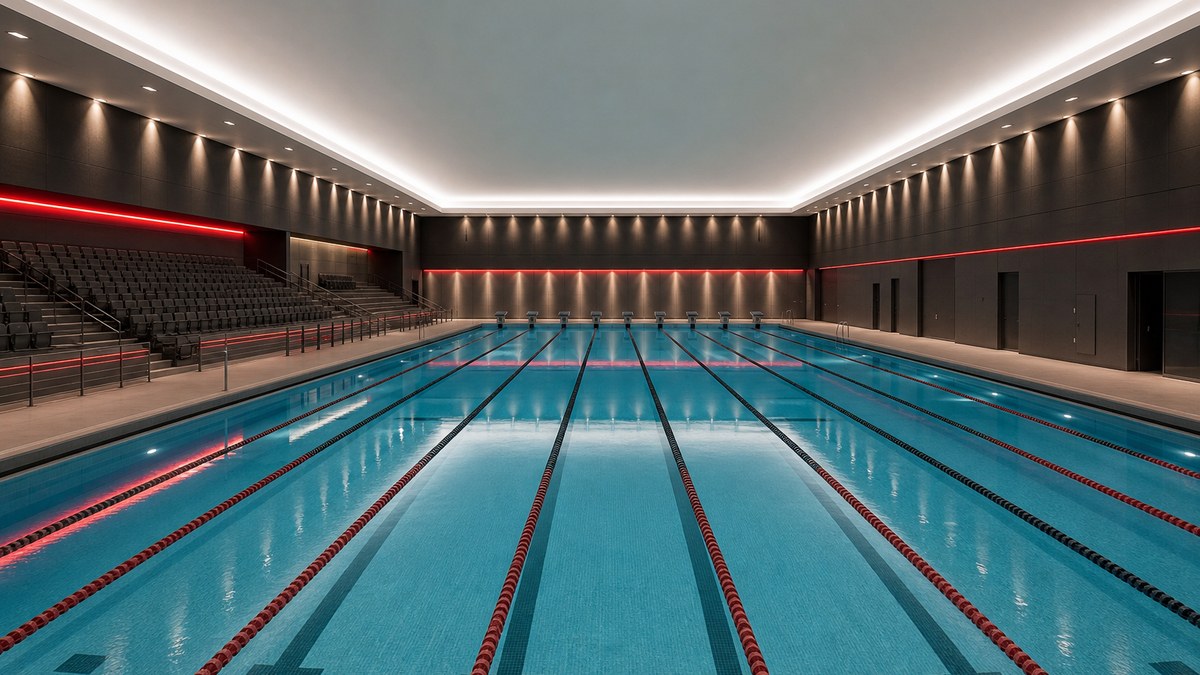
Texas natatorium lighting is one of the hardest lighting problems in any public building. An indoor pool combines warm, humid air, chemical vapor, a reflective water surface, high ceilings directly over water and a facility that must stay safe for swimmers every hour it is open. School districts, colleges, city recreation departments, YMCAs, swim clubs and hotel and fitness operators across Texas run natatoriums that host early-morning practice, learn-to-swim classes, water polo, diving, high school and college meets and community open swim, often on the same day.
Many of those buildings still run on aging metal halide or fluorescent fixtures that have dimmed, shifted color and corroded, and that can only be serviced by working over the water. This guide explains how commercial pool lighting in Texas is designed today: why natatoriums are different from other sports venues, how LED fixtures and indirect lighting control glare and reflections, what codes and standards apply, how underwater lighting fits in, what controls make sense, and how to plan a retrofit or new build without draining the pool.
Natatorium lighting uses corrosion-resistant, sealed LED fixtures, positioned and aimed to keep reflected glare off the water so lifeguards can see swimmers and swimmers are not looking into bright light. The best designs also put fixtures where they can be serviced without working over the pool.
- Glare control first: fixture placement and aiming decide whether lifeguards can see below the surface
- Built for the environment: housings, finishes and seals rated for humid, chemical-laden indoor pool air
- Maintenance access: perimeter, wall or indirect mounting so service does not require lifts over water
- Modes for every use: practice, competition, open swim, events, cleaning and overnight
- Underwater lighting: handled separately under NEC Article 680 with low-voltage and bonding requirements
- Codes: Texas DSHS public pool rules (25 TAC Chapter 265), NEC 680, NFPA 101 and your local AHJ
- Pricing: a project-specific proposal after a site assessment and photometric design
Why a natatorium is not just another gym
It is tempting to treat an indoor pool like a gymnasium with water in it. That approach is behind most of the problems facility managers deal with. A natatorium is different in four important ways.
- The air attacks fixtures. Warm, humid air carries chlorine compounds and other water-treatment byproducts. Condensation forms on cool surfaces. Standard housings, painted steel, unsealed connectors and ordinary hardware corrode, discolor and fail early.
- The water is a mirror. Light that hits the surface at the wrong angle reflects straight into lifeguards' and swimmers' eyes. That reflected glare can hide a swimmer in distress below the surface, which makes it a safety issue, not just a comfort issue.
- Fixtures hang over water. A light directly over the pool can only be serviced from a catwalk, a lift on a deck that may not support it, or a boat or scaffold in the water. Anything that falls, especially glass, can force a closure and, in the worst case, a drain-down.
- Swimmers look up. Backstrokers, divers and swimmers on their backs in lessons spend much of their time looking at the ceiling. Bright fixture images overhead are uncomfortable and disorienting.
Good natatorium lighting design starts from those four facts. Light levels matter, but where the light comes from, what it is made of and how it is maintained matter just as much.
Glare, reflections and lifeguard visibility
For any public pool the first job of the lighting is to help lifeguards see every part of the pool, including the bottom. Two kinds of glare get in the way:
- Reflected glare (veiling reflections): bright spots on the water surface caused by fixtures or daylight reflecting toward the guard's eye. They wash out the view below the surface in exactly the areas a guard needs to scan.
- Direct glare: seeing the bright source itself, for example a fixture in a backstroker's field of view or a window behind a guard stand.
Designers manage glare by controlling the geometry between the fixtures, the water and the people looking at it. The main tools are:
- Perimeter placement: mounting fixtures along the deck edges and walls, aimed so that their reflections fall away from guard positions and main spectator sightlines.
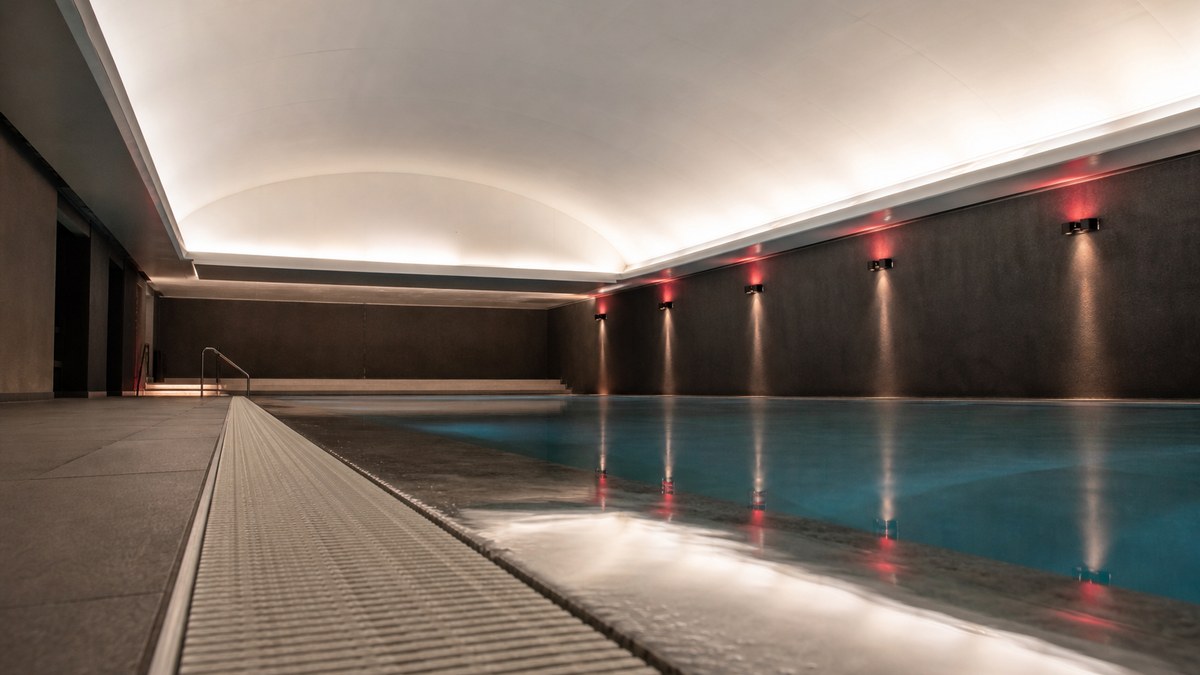
- Indirect lighting: aiming fixtures up at a light-colored ceiling or deck so the ceiling becomes a large, soft source. Indirect systems greatly reduce bright images on the water and overhead.
- Optics and shielding: LED fixtures with controlled beam patterns, visors and lenses that cut off light toward the eyes of people in the water.
- Daylight control: many Texas natatoriums have large windows or clerestories. Sun on the water can be the worst glare source in the room, so glazing, shades and guard-stand locations are part of the lighting conversation.
- Underwater light: lighting the pool from below reduces surface reflections and helps guards see the bottom, especially in the evening.
Corrosion, humidity and fixture construction
The indoor pool environment is where cheap fixtures show their weaknesses fastest. When reviewing natatorium LED fixtures, look at how the whole assembly is built, not just the LED board.
| Component | What to look for | Why it matters in a natatorium |
|---|---|---|
| Housing | Corrosion-resistant materials such as marine-grade aluminum or stainless steel, or non-metallic housings | Resists pitting and failure in chemical-laden humid air |
| Finish | Protective coatings suited to corrosive environments | Prevents peeling and flaking over the water |
| Seals and rating | At least damp-location listed; sealed, gasketed fixtures with a suitable IP rating are preferred | Keeps moisture and vapor away from LEDs and drivers |
| Lens | Shatter-resistant, non-glass lenses where fixtures are near or over water | Avoids glass in the pool and the closures that follow |
| Hardware | Stainless mounting hardware, brackets and safety cables | Mounting failures are a falling-object hazard |
| Drivers | Quality drivers, with remote mounting in a protected space where practical | Electronics last longer outside the pool air and are easier to service |
| Wiring and connectors | Sealed connectors and raceway suitable for the environment | Corroded connections are a common cause of early failures |
Texas adds its own pressure. Many natatoriums run hard on dehumidification and HVAC through long, hot summers. If the mechanical system struggles, condensation and chemical vapor get worse near the roof, right where the lights are. Lighting and mechanical designers should coordinate fixture locations with supply and return air paths so fixtures are not sitting in the wettest, most corrosive part of the room.
Maintenance access: design it in from the start
The biggest hidden problem with older natatorium lighting is maintenance. Fixtures directly over the water, at the top of a tall room, get serviced late or not at all, because every lamp change means a catwalk climb, a rented lift or a scaffold. Some facilities have had to close lanes or the whole pool just to replace lamps.
LED changes the maintenance picture because fixtures need far fewer service visits than metal halide. But less maintenance is not no maintenance. The best natatorium layouts reduce or remove over-water service altogether:
- Mount on the perimeter: wall-mounted and deck-edge fixtures can be reached from the deck with appropriate equipment.
- Use indirect uplighting: fixtures on walls or at the top of the bleachers light the ceiling, so nothing hangs over the pool.
- Lowering devices: where fixtures must be over the water, motorized or manual lowering systems can bring them to the deck for service.
- Safe catwalks: if a catwalk is used, it should be designed for safe access and fall protection, and fixture positions should be reachable from it.
- Remote drivers: putting drivers in a dry, accessible location keeps the most service-prone part out of the pool air.
A good question for any proposal is simple: how will this fixture be serviced, by whom, and will the pool have to close? If there is no clear answer, the design is not finished.
Light levels, uniformity and standards
Natatorium light levels are set by the type of use. A therapy pool, a leisure pool, a lap and fitness pool and a championship competition pool all have different needs. Designers typically work from:
- IES recommended practice: the Illuminating Engineering Society's sports and recreational area lighting practice (IES RP-6) groups facilities by level of play and spectators, which applies to competition natatoriums.
- Governing-body facility rules: organizations that sanction swimming, diving and water polo publish facility requirements for the levels of competition they govern. If your pool hosts sanctioned meets, those rules apply.
- Broadcast or streaming needs: meets that are streamed or filmed need more vertical light on swimmers and flicker-free drivers.
- Texas public pool rules: the Texas Department of State Health Services (DSHS) regulates public swimming pools and spas under 25 TAC Chapter 265, including requirements for lighting public pools and the areas around them.
- Local code: your city's adopted building and electrical codes, enforced by the local authority having jurisdiction (AHJ).
We do not quote numeric targets in a blog because the right values depend on the edition of each standard, how the pool is used and what your AHJ enforces. A photometric design shows how a proposed layout meets the applicable requirements on the water surface, on the pool bottom where needed, on the deck and in the stands before anything is ordered. Always confirm requirements with your AHJ and, for public pools, the DSHS rules in effect.
Uniformity is as important as the average light level. Bright and dark patches on the water make it harder for guards to scan, make photos and video look poor and are easy for swimmers to notice. Indirect and perimeter designs tend to produce smoother, more even light across the pool.
Underwater pool lighting and NEC Article 680
Underwater lighting is a separate system from the overhead lighting, with its own rules. In the National Electrical Code, Article 680 covers swimming pools, fountains and similar installations, including underwater luminaires, low-voltage systems, ground-fault protection and equipotential bonding. Texas cities adopt the NEC through local ordinance, so the exact edition and any amendments depend on where the pool is.
- Visibility: underwater lights help guards see the bottom and reduce surface glare after dark.
- Lane and wall lighting: competition pools may light walls and turns so swimmers can judge distance.
- Dive wells: underwater lighting helps divers and coaches see entries and the bottom.
- Color and effects: color-changing underwater LEDs add atmosphere for events, leisure swim and rentals.
- Retrofit path: many existing niches can accept LED replacement lights, but niche condition, bonding and the existing wiring must be checked by a licensed electrician.
Safety rules here are non-negotiable. Underwater lighting must be installed by licensed professionals to NEC 680 and the local code, with proper bonding and ground-fault protection. For more on keeping electricity out of the water, see our pool and aquatic center lighting safety guide, and for residential and resort pools, our network partner Premium Pool Lighting.
Upgrading an indoor pool in Texas?
Tell us about your natatorium and we will follow up to schedule a site assessment and prepare a project-specific proposal.
Lighting by pool type
Competition pools
Competition natatoriums host practices most days and meets on weekends or in season. They need even, glare-controlled light on the water and at the walls and turn ends, good light on the starting blocks and timing equipment, and enough vertical light in the stands for spectators and officials. If meets are streamed, the design should support cameras from the start. Lighting the scoreboard wall and avoiding reflections on video boards is also part of the plan; our network also delivers LED video walls and displays for aquatic venues.
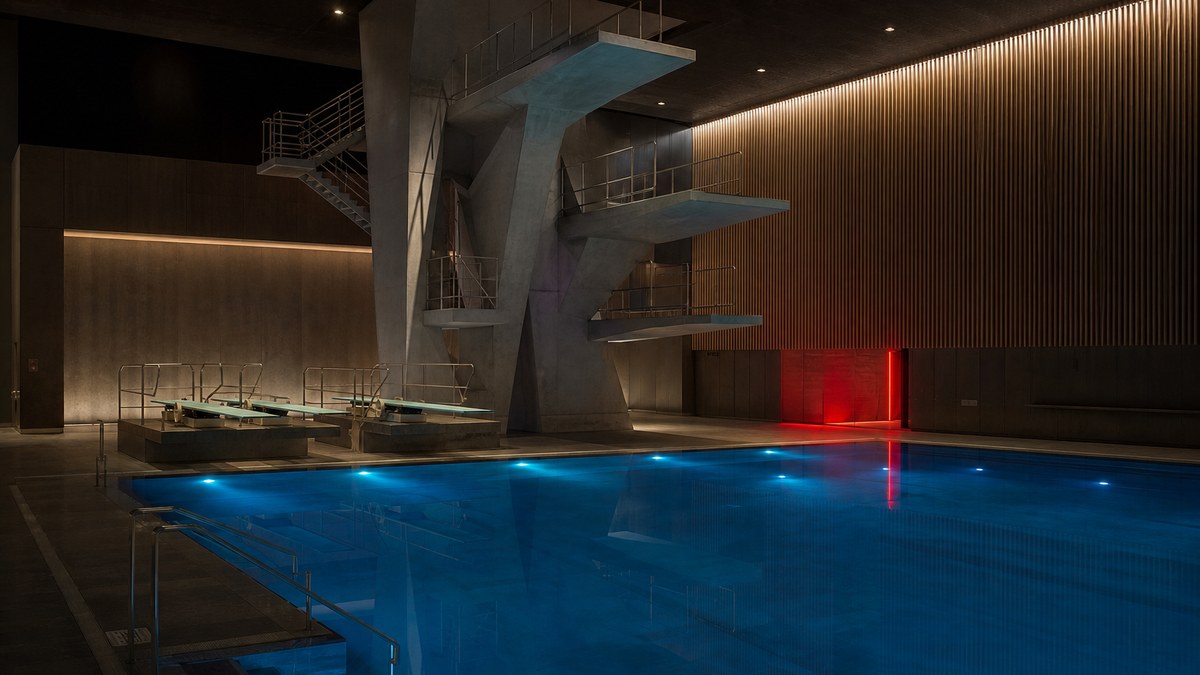
Dive wells and diving towers
Divers rotate, twist and look up during their dives. Bright fixture images overhead can disorient them, so lighting near diving platforms and springboards needs particular care with placement and shielding. Underwater lighting in the dive well helps with visibility of entries and the bottom.
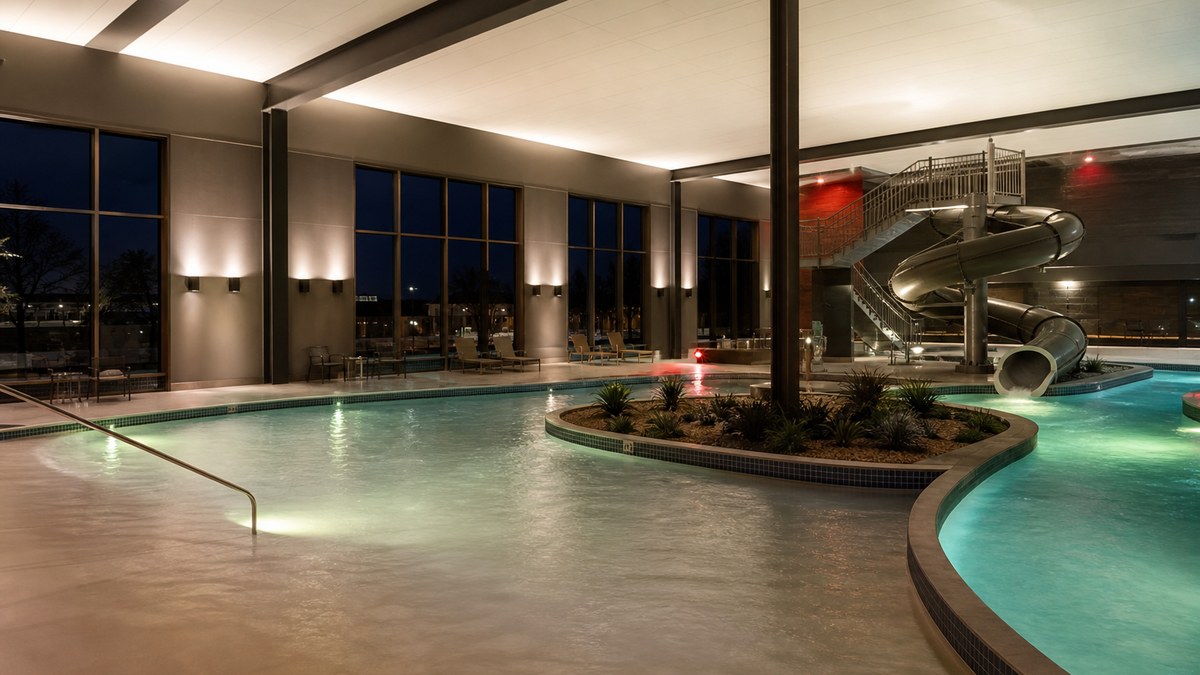
Leisure and family pools
Leisure pools with zero-depth entries, slides, lazy rivers and spray features are about atmosphere and safety together. Layered lighting, color accents and good light on slide exits and play features make the space inviting while keeping sightlines clear for guards.
Instructional and therapy pools
Learn-to-swim and therapy pools are used by people who spend a lot of time on their backs or close to the water. Softer, indirect light and warmer color temperatures are more comfortable, with no bright sources directly overhead.
School and campus natatoriums
School district natatoriums often serve physical education, swim teams, community programs and rentals. Schedules are long and varied, which makes controls and modes especially valuable. Our LED sports lighting guide covers the rest of a campus athletic program, from stadiums to gyms.
Hotel, club and fitness pools
Indoor pools at hotels, athletic clubs and fitness centers combine hospitality design with the same corrosion and glare challenges. See our Texas LED hotel lighting guide for lobbies, guestrooms and pool decks, and fiber optic starlight ceilings for spa and relaxation areas where a starfield ceiling adds atmosphere without electrical components in the wet space.
Controls and operating modes
A natatorium is used very differently across a single day. Lighting controls let staff match light to the activity instead of running everything at full output from open to close.
| Mode | Typical use | Lighting approach |
|---|---|---|
| Competition | Meets, water polo matches, diving events | Full output, stands and timing areas lit, streaming settings if needed |
| Practice | Team training, lap swim | Reduced output with uniformity maintained across the lanes in use |
| Open and family swim | Public sessions, lessons | Comfortable, glare-controlled light with accent lighting on features |
| Events and rentals | Dive-in movies, parties, ceremonies | Dimmed overhead with color underwater and accent effects |
| Cleaning and maintenance | Deck cleaning, vacuuming, inspections | Task-appropriate light in the areas being worked |
| Closed / overnight | After hours | Security and egress lighting only, with scheduling so nothing is left on |
Controls can be as simple as a scene keypad at the guard office or as detailed as a networked system with scheduling, zoning by pool, remote monitoring and integration with the building automation system. Instant-on LED also solves a long-standing natatorium problem: with metal halide, a brief power interruption could leave the pool dark for many minutes while lamps cooled and restruck, forcing an evacuation. LED returns to full output immediately.
Emergency lighting, egress and safety systems
Emergency and egress lighting in a natatorium has to work in the same corrosive environment as everything else. Exit signs, emergency fixtures and battery or inverter systems should be suited to damp, chemical-laden air and tested on schedule. Requirements come from the Life Safety Code (NFPA 101) as adopted locally and from your building and fire codes, so confirm them with your AHJ and fire marshal. A lighting upgrade is a good time to verify that emergency lighting covers the deck, stairs, bleachers and exits, and that guards can still see the water during a power loss.
Retrofit or new natatorium?
Most Texas aquatic facilities fall into one of three paths:
- Fixture-for-fixture retrofit: replacing existing fixtures with LED in the same locations. Fastest, but it keeps any glare and access problems the old layout had.
- Re-designed layout in the existing building: moving fixtures to the perimeter or switching to indirect lighting, often removing over-water fixtures entirely. Usually the best long-term answer for older natatoriums.
- New construction or major renovation: lighting designed together with the architecture, ceiling finish, HVAC and dehumidification, glazing and acoustic treatments.
The right choice depends on ceiling height and finish, existing structure and catwalks, electrical capacity, how the pool is used and how long it can be closed. A site assessment and photometric comparison of the options makes the decision clear. Our commercial LED installation guide explains how retrofits are planned and commissioned in occupied buildings.
Scheduling work around the pool calendar
Natatoriums are busy buildings, and every closure affects swim teams, lessons, members and revenue. Planning the work around the calendar is part of the design:
- Use existing shutdowns: many facilities close for annual maintenance. Lighting work over or near the water can be scheduled into that window.
- Phase by zone: perimeter and indirect designs can often be installed in phases while parts of the facility stay open.
- Protect the water: work over or near the pool needs covers, debris control and coordination with the aquatics staff and water-treatment contractor.
- Plan around season: school and club swim seasons, summer programs and hosted meets set the windows that work.
How a Texas natatorium lighting project works
- Assessment: walk the facility, measure existing light levels, map glare problem areas with guards, inventory fixtures, catwalks and access, and review electrical service and controls.
- Goals: confirm pool uses, levels of competition, streaming plans, event uses and the operating schedule.
- Photometric design: model light on the water, deck and stands for each option, with attention to reflected glare at guard positions.
- Fixture selection: choose fixtures and hardware suited to the natatorium environment, with service access defined for every location.
- Code review: coordinate with your AHJ, DSHS public pool rules, NEC 680 for underwater lighting and NFPA 101 for emergency lighting.
- Proposal and approvals: a project-specific proposal plus any board, council or procurement steps.
- Scheduling: install during planned closures or in phases, with water protection in place.
- Installation: fixtures, drivers, wiring and controls installed by licensed professionals.
- Aiming and commissioning: fixtures aimed to the design, modes programmed and glare checked from guard stands, the blocks and the water.
- Training and service: aquatics and facilities staff trained on controls, with ongoing service available.
For help evaluating firms, our guide to choosing commercial lighting contractors in Texas lists the questions that matter.
Utility programs, incentives and procurement
Natatoriums run long hours, so efficient lighting and controls can make a meaningful difference to operating costs. Some Texas utilities run commercial energy-efficiency programs. Customers of Oncor, CenterPoint Energy, Austin Energy, CPS Energy and AEP Texas may qualify for incentives on lighting and controls upgrades, depending on program availability and the rules in effect when you apply. Building owners may also want to ask their tax advisor whether the federal 179D deduction applies to their project; confirm eligibility with your tax advisor.
Public entities such as school districts, colleges and cities usually buy through competitive bids or cooperative purchasing programs. We can work within your procurement process and provide the documentation that process needs.
What drives project cost
Natatorium projects vary widely, so Texas LED Lights prices each one after an assessment and photometric design. The main factors are:
- Pool types and size: one lap pool, or competition, dive well, leisure and therapy pools under one roof
- Layout approach: like-for-like retrofit versus a re-designed perimeter or indirect layout
- Fixture construction: housings, finishes and lenses suited to the natatorium environment
- Access and installation: ceiling height, catwalks, lifts, water protection and scheduling
- Underwater lighting: niche condition, bonding review and LED replacement or new lights
- Controls: basic scheduling through networked modes, zoning and monitoring
- Competition and streaming needs: vertical light, uniformity and flicker performance
- Electrical and emergency systems: panels, circuits, emergency lighting and code updates
Who builds it: our experience
Texas LED Lights brings 15+ years as an authorized architectural lighting dealer and project coordinator. Our licensed installation partner has completed over 200 major sports and commercial projects across the US and Canada — NFL, NBA, NHL, MLS, NCAA and NASCAR. That background in demanding sports venues carries over to aquatic facilities, where glare control, uniformity and safe installation matter just as much.
We also handle the rest of the facility: gym and field lighting, architectural facade lighting, parking lots and site lighting, and interior LED retrofits for lobbies, locker rooms and offices. See our commercial LED fixture buyer's guide for the fixture types used around an aquatic center, and our Luminance design-build program for complete lighting transformations.
Serving natatoriums across Texas
We support aquatic facilities statewide, including Dallas–Fort Worth, Houston, Austin, San Antonio, El Paso, Lubbock, Corpus Christi and the Rio Grande Valley. Regional guides cover local conditions: commercial LED lighting in Houston, commercial lighting services in San Antonio and South Texas commercial LED lighting. Check our coverage area, browse our services and see the types of projects we deliver.
Questions to ask before you buy
- How does the layout control reflected glare at our guard stands?
- Can we see the photometric report for the water, the deck and the stands?
- What are the fixtures, lenses and hardware made of, and are they rated for an indoor pool environment?
- How will each fixture be serviced, and will the pool need to close?
- What operating modes and controls are included?
- Is underwater lighting included, and has the existing niche wiring and bonding been reviewed?
- Are the drivers flicker-free if we stream or film meets?
- How will installation be scheduled around our season and closures?
- What warranties apply to fixtures and drivers, and who provides service?
Frequently Asked Questions
What is natatorium lighting?
Why is glare such a problem at indoor pools?
What kind of LED fixtures work in a natatorium?
Can lights over the pool be serviced without draining it?
What codes apply to pool lighting in Texas?
Do competition pools need special lighting?
Can existing underwater pool lights be converted to LED?
Is indirect lighting a good choice for a natatorium?
How much does natatorium LED lighting cost?
Do you work with school districts, cities and colleges?
Clear water, safe guards, better meets
Request a consultation and we will follow up to schedule a site assessment of your natatorium.
Related
Our Texas lighting network: Dallas commercial LED lighting, Fort Worth LED lighting, Arlington LED lighting, Irving LED lighting, Plano LED lighting, wholesale LED components, fiber optic starlight ceilings, 360° fiber optic lighting, premium pool lighting, LED signage and message centers, modular building solutions, and Dallas modular structures.