Commercial Lighting Maintenance & Repair in Texas: Service Calls, Group Relamping, LED Driver Repair & Maintenance Plans
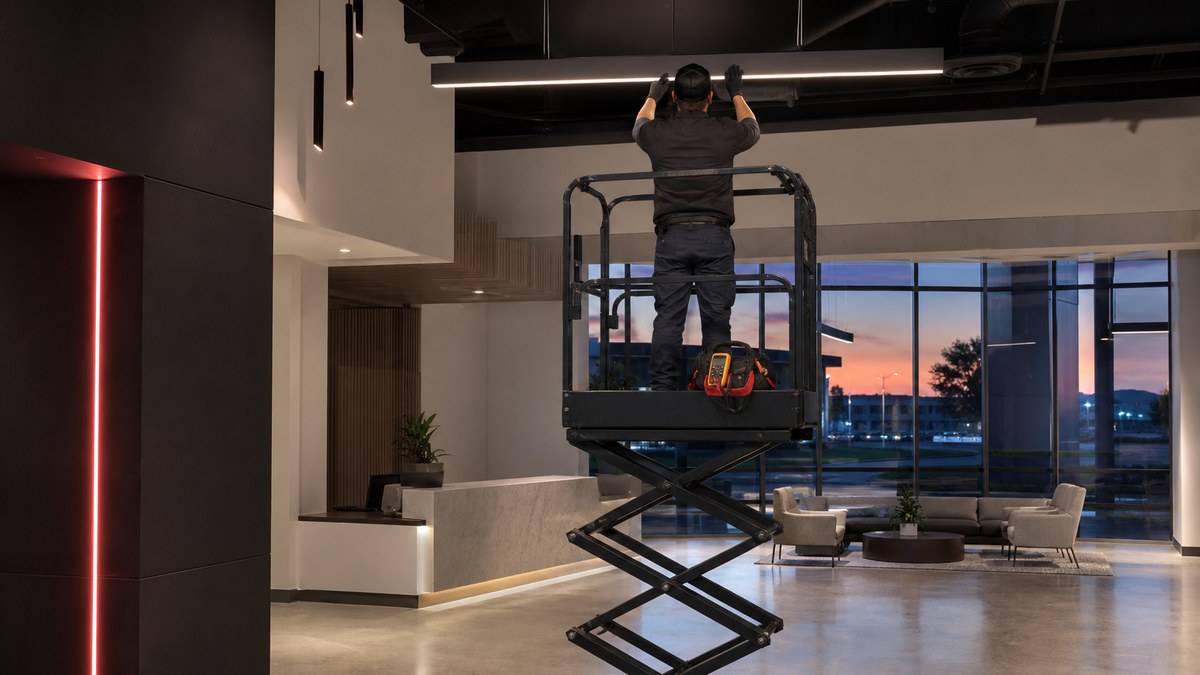
Commercial lighting services in Texas do not end when the last fixture is hung. Every office, warehouse, retail center, hotel, school and parking lot eventually needs someone to find out why a row of lights is flickering, why half a parking lot went dark after a storm, why a facade's color-changing system stopped responding, or why the emergency lights failed their test. Finding a dependable commercial lighting service contractor is often harder than finding an installer, because service work is unglamorous, scattered across many buildings and full of small problems that are easy to misdiagnose.
This guide is for Texas property managers, facility directors, building engineers, school district maintenance departments, retail and hotel operators and multi-site portfolio owners. It explains what commercial lighting maintenance and repair actually covers, the most common failures in LED and legacy systems, how group relamping and planned maintenance compare with fixing things as they break, what codes and rules apply to emergency lighting, lamp disposal and licensed electrical work, how Texas heat, storms and humidity shorten system life, and how to structure a maintenance plan and choose a service partner.
Commercial lighting services cover the diagnosis, repair, maintenance and upgrade of lighting systems in commercial buildings and sites, from single fixture failures to planned maintenance programs for whole portfolios.
- Repair calls: flicker, dark rows, dead poles and control faults traced to the real cause (driver, wiring, sensor, photocell or power)
- Group relamping and retrofit: replacing aging lamps and ballasts on a schedule, or converting to LED so the cycle ends
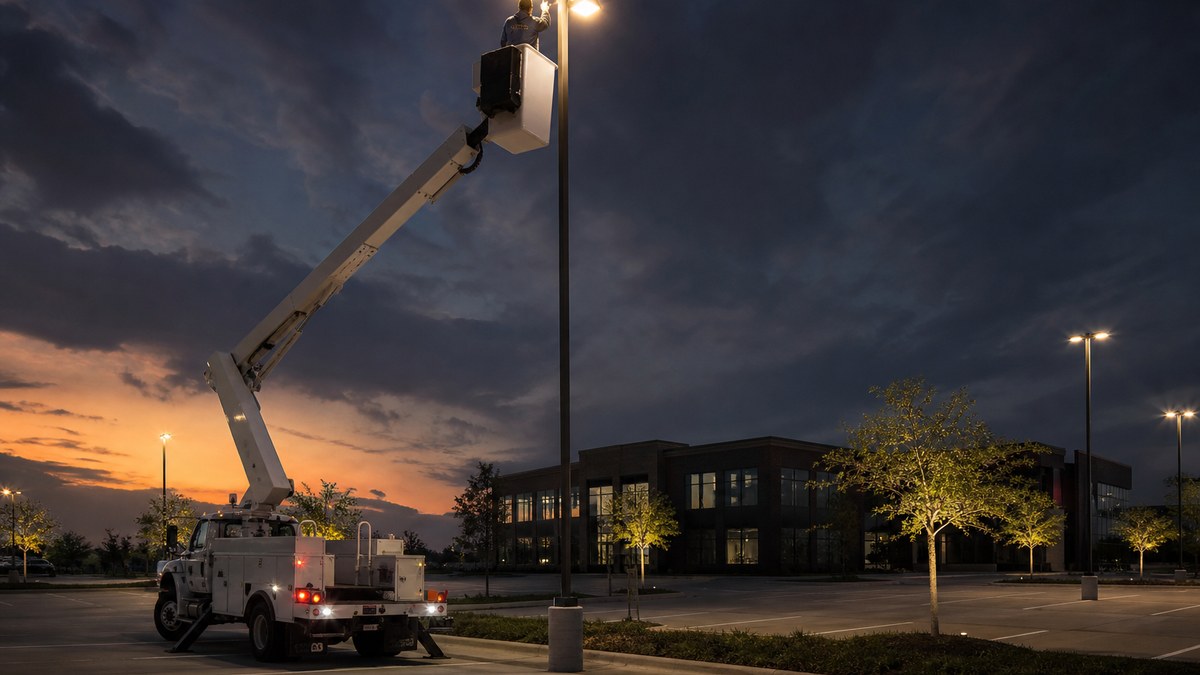
- Exterior and pole service: parking lot, wall pack and pole lighting checked and repaired with lifts after storms and outages
- Life-safety: emergency and exit lighting inspected and tested as required by NFPA 101 and the local fire code
- Controls: sensors, timeclocks, photocells, DALI and DMX systems recalibrated or upgraded
- Maintenance plans: scheduled inspections and reporting so small problems never become dark buildings
- Pricing: quoted per site after a walkthrough, as a project-specific proposal
What commercial lighting services include
"Lighting services" means different things to different contractors. Some only install new fixtures; some only change lamps; some only program controls. A complete commercial lighting service partner covers the whole life of the system. In practice that usually breaks down into six kinds of work:
| Service | What it covers | Typical trigger |
|---|---|---|
| Troubleshooting & repair | Diagnosing and fixing failed fixtures, drivers, ballasts, wiring, sensors and photocells | Tenant complaints, dark areas, flicker, tripped breakers |
| Exterior & pole service | Parking lot poles, wall packs, canopies, signs and landscape lighting | Storm damage, dark lots, security concerns, insurance or lease requirements |
| Group relamping | Replacing all lamps (and often ballasts) in an area on a planned schedule | Aging fluorescent or HID systems with frequent random failures |
| LED retrofit & upgrade | Converting legacy fixtures to LED, or replacing early LED fixtures that are failing | Rising maintenance calls, discontinued parts, energy goals |
| Emergency & exit lighting | Inspection, testing, battery and fixture replacement, documentation | Fire inspections, insurance audits, failed tests |
| Controls service | Sensors, timeclocks, dimming, networked, DALI and DMX systems | Lights on all night, lights off when occupied, frozen color shows |
Our repair and service team handles all six, and the same people who design and install new systems through our commercial LED retrofit services stand behind the work afterwards.
The most common lighting failures we see in Texas buildings
Most service calls fall into a handful of patterns. Knowing them helps facility teams describe the problem clearly and avoid paying for the wrong fix.
Flicker and strobing
In LED systems, flicker usually points to a failing or incompatible driver, a loose neutral or connection, a dimmer that is not compatible with the driver, or voltage problems on the circuit. In fluorescent systems it is usually a lamp at end of life or a failing ballast. Replacing the lamp or the "bulb" again and again without checking the driver, dimmer or wiring is the classic mistake.
Dark rows, zones or whole floors
When a whole row or zone goes out at once, the fixtures themselves are rarely the cause. Check the breaker, the relay or lighting control panel, the occupancy sensor or timeclock, and the emergency transfer device if one is installed. A single bad sensor can make a whole office area look like a fixture failure.
Early LED fixtures failing
Many Texas buildings converted to LED early, with fixtures and tubes that were not designed for heat, poor ventilation or the electrical environment they ended up in. Common symptoms are color shift between fixtures, dim or dead sections in LED strips and panels, and drivers failing in clusters. Sometimes the fix is a driver replacement; sometimes the honest answer is that the fixture family is no longer worth repairing and should be replaced with a better-built product. Our commercial LED fixture buyer's guide explains what separates commercial-grade fixtures from the rest.
Exterior lights on during the day or off at night
Parking lot, wall pack and canopy lighting is usually controlled by photocells, astronomical timeclocks or a building automation system. Photocells fail, get dirty or get pointed at another light source; timeclocks lose their settings after an outage; and a building automation schedule may never have been updated after daylight saving time. These are cheap fixes once diagnosed, but they generate a lot of calls.
Dead poles after storms
Lightning, hail, high winds and flooding are a fact of life across Texas. Surge damage to drivers, water in hand holes and junction boxes, cracked lenses, loose heads and damaged underground wiring are common after severe weather. Pole lighting service needs the right lift, the right test equipment and sometimes underground locating and repair. See our Texas commercial LED exterior lighting guide for how site lighting is designed and protected.
Controls that nobody understands anymore
Lighting control systems outlive the people who programmed them. Networked controls, DALI and DMX systems often end up locked, undocumented or running schedules that make no sense for how the building is used today. A controls service visit recovers the programming, documents it and resets schedules and sensor settings to match current occupancy.
Reactive repair, group relamping or a maintenance plan?
There are three basic ways to keep a commercial lighting system running. Most Texas properties use some mix, and the right balance depends on the age of the system, the number of buildings and how much downtime the business can accept.
Reactive (run-to-failure) repair
Fix things when someone complains. This works for a small building with a modern LED system and few fixtures in hard-to-reach places. It gets expensive and unpredictable when lifts are needed for every call, when failures are spread across many sites, or when dark areas create safety and liability concerns.
Group relamping
For legacy fluorescent and high-intensity discharge (HID) systems, group relamping replaces all lamps in an area at once on a planned schedule rather than one at a time as they fail. The logic is simple: lamps installed together tend to age and fail together, and a crew with a lift can replace a whole area far more efficiently than responding to dozens of individual calls. Group relamping also restores light levels, because older lamps lose output before they fail.
The catch is that group relamping keeps you on the lamp-and-ballast treadmill. Parts for older systems are getting harder to find, and every relamping cycle is a good moment to ask whether an LED retrofit makes more sense than another round of lamps. Our Texas commercial LED retrofit guide walks through that decision by building type.
Planned maintenance programs
A maintenance plan schedules regular inspections of interior, exterior and life-safety lighting, records what was found and fixed, and flags problems before they become outages. For multi-site portfolios, retail centers, hotels and campuses, a plan turns lighting from a stream of emergencies into a predictable line item with documented condition reports.
| Approach | Best fit | Watch out for |
|---|---|---|
| Reactive repair | Small buildings, modern LED, easy access | Unpredictable call volume, lift charges per visit, dark areas between calls |
| Group relamping | Large legacy fluorescent or HID areas | Keeps you on aging technology; parts availability; lamp disposal rules |
| Planned maintenance | Multi-site portfolios, retail, hotels, campuses, schools | Needs a clear scope, schedule and reporting format to be worth it |
| LED retrofit | Systems with rising failures or obsolete parts | Needs a proper audit and layout, not just lamp swaps |
What a good maintenance plan covers
A lighting maintenance plan is only as useful as its scope. These are the elements we recommend Texas facilities ask for in writing:
- Inventory: a list of fixture types, quantities, locations, control devices and circuits, so every visit starts with facts.
- Inspection schedule: interior areas, exterior site lighting at night, emergency and exit lighting, and controls, each on a schedule that fits the property.
- Night checks: exterior lighting can only be judged after dark. A night walk of parking lots, entries, docks and walkways finds outages that daytime inspections miss.
- Cleaning: dust, insects, nests and grime on lenses and reflectors reduce light output, especially in warehouses, kitchens, garages and outdoors.
- Controls review: confirm schedules, sensor timeouts and photocell operation still match how the building is used.
- Life-safety testing and records: emergency and exit lighting tests documented for the fire marshal and insurer.
- Reporting: what was inspected, what failed, what was fixed and what needs a decision, with photos.
- Parts strategy: which spare drivers, lamps, photocells and sensors to keep on site, especially for fixture families that are hard to source.
- Response expectations: how service requests are submitted and how urgent issues such as dark parking lots are prioritized.
Tired of chasing lighting problems?
Tell us about your property or portfolio and we will follow up to schedule a walkthrough and prepare a project-specific proposal for repairs, upgrades or a maintenance plan.
Emergency and exit lighting: the service that cannot slip
Emergency and exit lighting is the one part of a lighting system that is inspected by someone outside your organization. NFPA 101, the Life Safety Code, requires emergency lighting systems in many occupancies to be tested periodically, with both short functional tests and longer duration tests, and requires written records of those tests. Texas jurisdictions enforce life-safety requirements through the fire codes they have adopted, so the exact requirements and inspection practices depend on your city, county and occupancy type. Confirm the testing intervals and documentation your fire marshal expects with your AHJ.
Typical problems we find on emergency lighting service calls include batteries that no longer hold a charge, units that were disconnected during renovations, exit signs that were never replaced after a remodel moved a door, and emergency drivers inside LED fixtures that were never tested at all. Self-testing and centrally monitored emergency systems can reduce the manual effort, but they still need someone to read and act on the results.
Rules that apply to lighting service in Texas
Lighting maintenance looks simple, but several rules apply to who does the work and how materials are handled:
- Licensed electrical work: the Texas Department of Licensing and Regulation (TDLR) licenses electricians and electrical contractors. Work beyond simple lamp replacement, such as replacing drivers or ballasts, rewiring fixtures, adding circuits or retrofitting fixtures, should be performed by properly licensed electrical professionals. Ask any service contractor how their licensing covers the work they will do.
- National Electrical Code: Texas jurisdictions enforce an adopted edition of the NEC, and many cities add local amendments and permit requirements. Confirm with your AHJ whether a repair or retrofit needs a permit.
- Lamp disposal: fluorescent and HID lamps contain mercury. The Texas Commission on Environmental Quality (TCEQ) allows hazardous lamps to be managed under its universal waste rules (see TCEQ publication RG-377), which set requirements for storage, labeling and shipping to a recycler. Ask how your contractor handles and documents lamp recycling during group relamping and retrofits.
- Life Safety Code and fire codes: emergency and exit lighting testing and records, as described above.
- Energy code: when lighting is altered or replaced beyond like-for-like repair, energy code requirements for controls and lighting power may apply. The Texas statewide commercial energy code is based on the IECC edition adopted by the State Energy Conservation Office, and several cities, including Houston and Austin, have adopted their own editions and amendments. Confirm with your AHJ.
- Outdoor lighting rules: some cities and counties have outdoor lighting ordinances, and certain counties near observatories have lighting rules under Texas Local Government Code chapter 240. Replacement fixtures in those areas should be checked against local requirements.
How Texas weather wears out lighting
Texas is hard on lighting systems, and maintenance plans should reflect it:
- Heat: drivers and electronics run hotter in uninsulated warehouses, attic spaces above ceilings, canopies and enclosed fixtures. Heat is one of the main reasons LED drivers fail early, so service visits should note fixtures in hot locations and recommend products rated for those conditions.
- Lightning and surges: storms and utility switching can damage drivers, photocells and control electronics. Surge protection at panels and at poles is worth reviewing after repeat failures.
- Hail and wind: lenses crack, heads loosen and poles take damage. A post-storm inspection of site lighting helps with both safety and insurance documentation.
- Humidity and coastal air: along the Gulf Coast, corrosion attacks fixtures, hardware and pole bases. Our South Texas commercial LED lighting guide and Houston commercial LED lighting guide cover coastal product choices.
- Dust and insects: West Texas dust and insects drawn to lights coat lenses and reduce output, so cleaning belongs in the plan.
Service needs by building type
Offices and corporate campuses
Offices generate frequent small calls: a flickering troffer, a sensor that turns lights off on someone at their desk, a dimming system that no longer dims. Tenant comfort is the priority, so after-hours service and quick diagnosis matter. Our commercial LED installation guide explains how controls should be commissioned so they are easier to service later.
Warehouses and industrial facilities
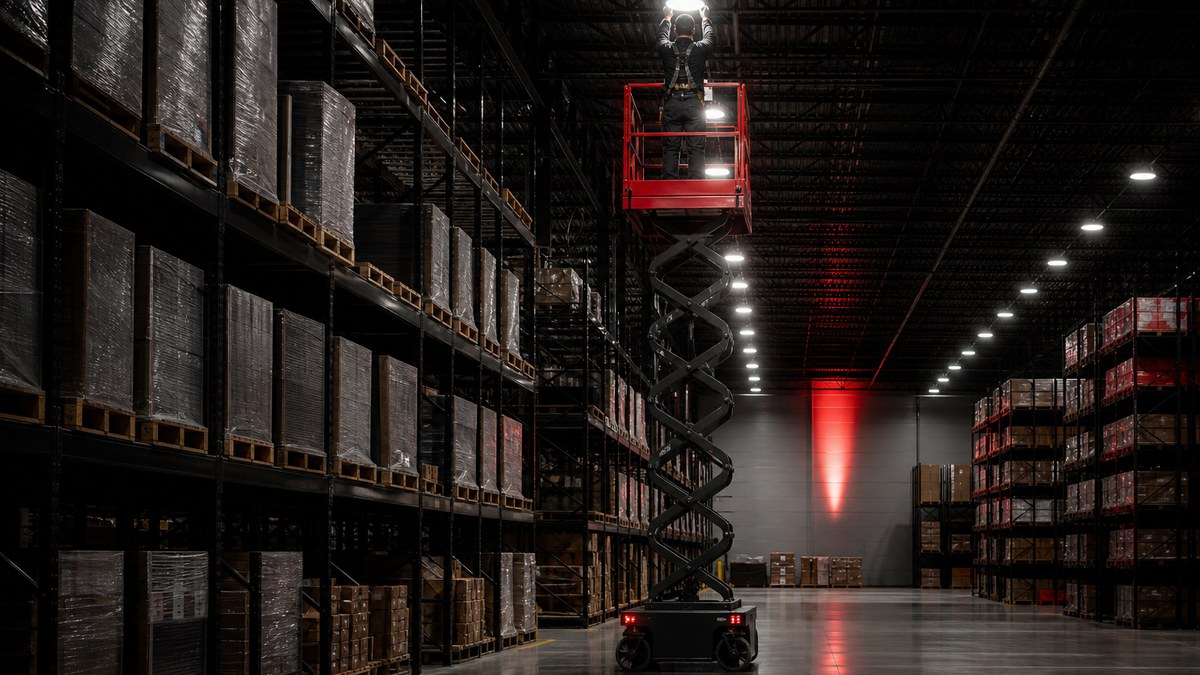
High-bay fixtures above racking need lifts and coordination with operations, so planned maintenance and group work are far more efficient than one-off calls. Heat, dust and forklift impacts are common causes of failure.
Retail and shopping centers
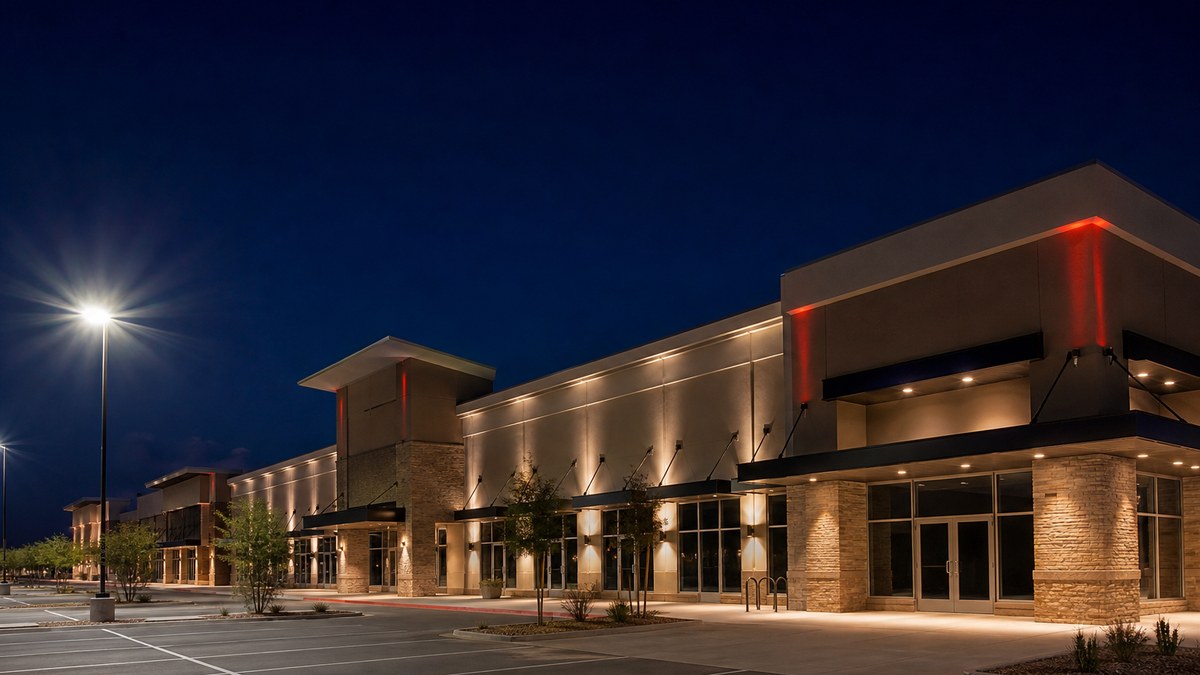
Parking lots, canopies, storefronts and signs drive customer perception and safety. Owners and property managers often juggle landlord and tenant responsibilities, so a clear inventory of who maintains what avoids finger-pointing. See our Texas shopping center LED lighting guide.
Hotels and hospitality
Hotels need lobby, corridor, guestroom, ballroom, pool and exterior lighting working every night, plus scenes and dimming that look right for events. Service is usually scheduled around occupancy. See our Texas LED hotel lighting guide.
Schools, gyms, sports and aquatic facilities
School districts and recreation departments manage gyms, fields, natatoriums, parking and campuses with limited maintenance staff. Field and pole lighting needs specialized equipment, gyms need impact-rated fixtures serviced around the school calendar, and aquatic environments are especially hard on fixtures. See our guides to Texas gym lighting, LED sports lighting in Texas and natatorium lighting, and our sports and aquatic lighting services.
Facades, architectural and display systems
Color-changing facade lighting, DMX shows and LED video walls fail differently from ordinary lighting: a single data fault can freeze a whole facade or blank a section of a screen. These systems need technicians who understand data networks and programming, not only power. See our architectural lighting services and our LED video walls and displays guide.
Repair or replace? Making the call
Every service program eventually faces the same question: keep fixing an aging system, or replace it? A good service partner gives you the information to decide instead of defaulting to whichever answer is easier for them. Signs that replacement deserves a serious look:
- Repeat failures in the same fixture family, especially drivers or ballasts
- Parts that are discontinued or increasingly hard to source
- Legacy fluorescent or HID systems approaching another group relamping cycle
- Light levels or color that no longer match what the space needs
- Controls that cannot meet current code or how the building is used
- A renovation, re-tenanting or re-roofing project that already requires access to the ceiling or site
Utility energy-efficiency programs from Oncor, CenterPoint Energy, Austin Energy, CPS Energy and AEP Texas may offer incentives for qualifying lighting upgrades, depending on program availability. Several programs require approval or a pre-installation inspection before existing fixtures are removed, so check the rules before work starts. For tax questions such as Section 179D, confirm with your tax advisor.
How to choose a commercial lighting service contractor
The right service partner saves money by diagnosing correctly the first time and by telling you the truth about when to stop repairing. Questions worth asking:
- How is your electrical work licensed under TDLR, and who performs work beyond lamp replacement?
- Do you have the lifts and test equipment for our high-bays, poles and facades?
- Can you service controls (sensors, timeclocks, networked, DALI and DMX), or only fixtures?
- How do you document what you inspected, what failed and what you fixed?
- How do you handle and document mercury lamp recycling?
- Can you cover all of our locations across Texas, and how are urgent calls prioritized?
- When something keeps failing, will you tell us whether repair or replacement makes more sense?
- What warranty terms apply to replacement parts and labor, and who honors manufacturer warranties?
Who services it: our experience
Texas LED Lights brings 15+ years as an authorized architectural lighting dealer and project coordinator. Our licensed installation partner has completed over 200 major sports and commercial projects across the US and Canada — NFL, NBA, NHL, MLS, NCAA and NASCAR. We design, supply, install, program and service commercial, sports, aquatic and architectural lighting across Texas, so the team that troubleshoots your system understands how it should have been designed in the first place.
We serve all of Texas, including Dallas–Fort Worth, Houston, Austin, San Antonio, El Paso, Corpus Christi, Lubbock and the Rio Grande Valley. See what we do, browse our work, or read about our Luminance design-build program for complete lighting transformations. For San Antonio and Austin properties, see our San Antonio commercial lighting services and Austin commercial lighting guides.
How a service engagement works
- Request: tell us what is failing, where, and how urgent it is, or that you want a maintenance plan.
- Walkthrough: we review interior, exterior and life-safety lighting, controls and the electrical setup, including a night check of site lighting where needed.
- Diagnosis and report: what is wrong, what is at risk, and repair-versus-replace options.
- Proposal: a project-specific proposal for repairs, upgrades or a scheduled maintenance plan.
- Scheduling: work planned around tenants, guests, students or operations, including after hours.
- Service and repairs: performed by licensed professionals, with parts, lamp recycling and permits handled as required.
- Verification: lights, controls and emergency systems checked after the work, with documentation.
- Ongoing plan: scheduled inspections and reporting so issues are caught early.
Frequently Asked Questions
What do commercial lighting services include?
Why do my LED lights flicker?
What is group relamping?
Is a lighting maintenance plan worth it?
How often should emergency lighting be tested?
Do I need a licensed electrician for lighting repairs in Texas?
How should old fluorescent lamps be disposed of?
Should we repair our old lighting or replace it with LED?
How much do commercial lighting services cost?
What areas of Texas do you serve?
Keep every light working, every night
Request a walkthrough and we will follow up with repair options, upgrade recommendations or a maintenance plan built around your property.
Related
Our Texas lighting network: Dallas commercial LED lighting, Fort Worth LED lighting, Arlington LED lighting, Irving LED lighting, Plano LED lighting, wholesale LED components, fiber optic starlight ceilings, 360° fiber optic lighting, premium pool lighting, LED signage and message centers, modular building solutions, and Dallas modular structures. Read more lighting guides on our blog or contact us to talk about your property.