Commercial Lighting Contractors in Texas: The Complete Guide to Professional LED Installation
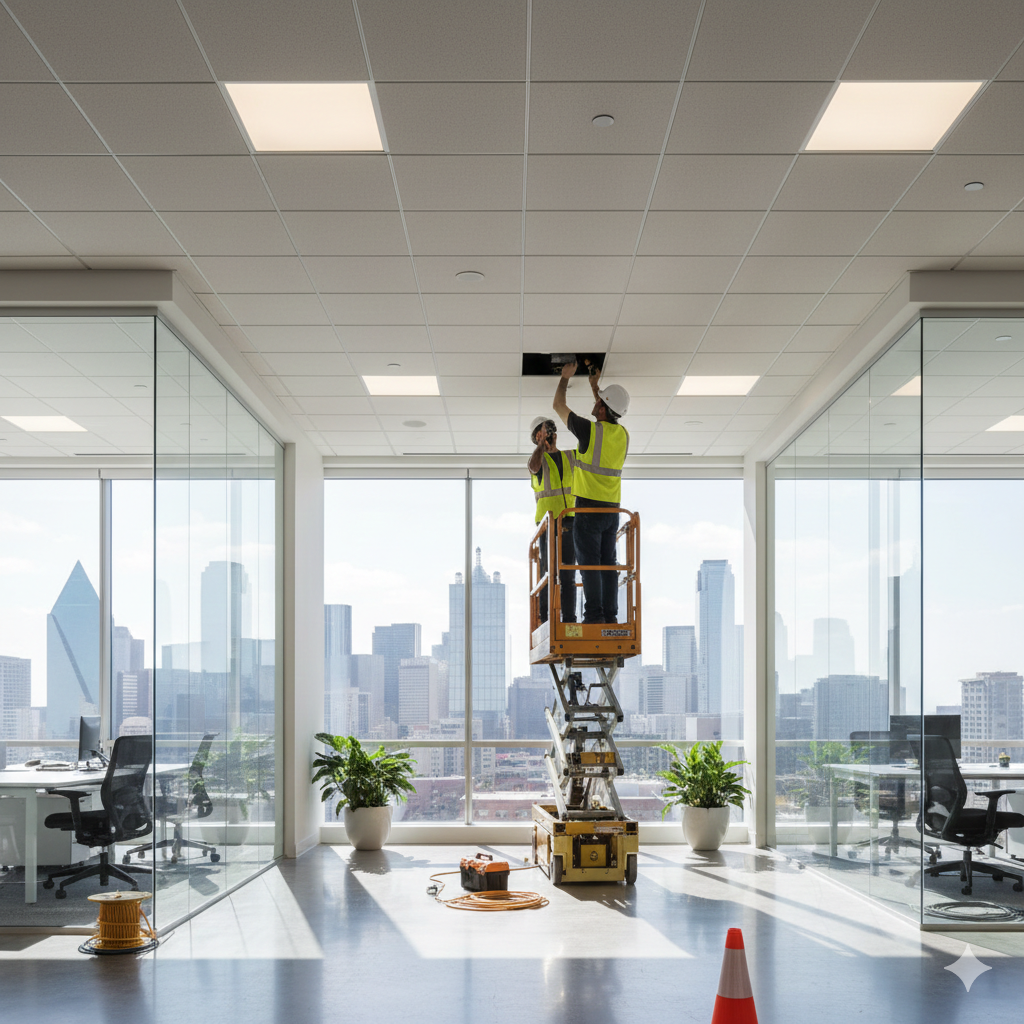
When the lights go out in a Texas warehouse, a retail store loses its appeal, or an office building drains thousands in outdated energy costs, business owners quickly learn that commercial lighting isn't just about fixtures and bulbs—it's about finding the right contractor who understands both the technical demands and unique challenges of the Lone Star State. From the sweltering summer heat that tests outdoor fixtures to the complex utility rebate programs offered by Oncor, CenterPoint Energy, and Austin Energy, Texas commercial lighting projects require specialized expertise that goes far beyond basic electrical work.
The challenge facing most Texas business owners isn't a shortage of contractors—it's finding one who can deliver true value. Too many commercial lighting projects end with disappointing results: fixtures that don't meet code requirements, missed rebate opportunities that leave thousands of dollars on the table, installations that create glare and discomfort for employees, or systems that fail to deliver the promised energy savings. With the average commercial building spending 35-40% of its electricity budget on lighting, a poorly executed upgrade doesn't just waste money—it compounds losses year after year.
This comprehensive guide cuts through the confusion to help Texas businesses find, evaluate, and hire the right commercial lighting contractor for any project. Whether you're retrofitting a 100,000-square-foot warehouse in Dallas, designing architectural lighting for a luxury hotel in Austin, or upgrading parking lot fixtures in Houston, you'll discover exactly what to look for, what to expect to pay, how to maximize rebates, and how to ensure your project delivers lasting results. Let's illuminate the path to your commercial lighting success.
Quick Answer: What Do Commercial Lighting Contractors Do?
Commercial lighting contractors are licensed professionals who design, install, retrofit, and maintain lighting systems for businesses, warehouses, offices, retail stores, restaurants, and other non-residential properties. They handle everything from basic LED upgrades to complex architectural lighting designs, and they navigate utility rebate programs to minimize project costs.
5 Key Takeaways:
- Cost Range: Texas commercial lighting projects typically cost $2-$4 per square foot for retrofits and $3.20-$5+ for new construction
- Energy Savings: LED upgrades reduce lighting energy consumption by 50-75% with 2-3 year payback periods
- Texas Rebates: Oncor, CenterPoint, and other utilities offer $500-$10,000+ in rebates for qualifying commercial lighting projects
- Project Timeline: Most commercial lighting retrofits complete in 1-4 weeks depending on facility size
- ROI: Businesses save 30-50% on energy costs and reduce maintenance expenses by up to 75% with professional LED installations
In This Guide:
What is Commercial Lighting?
Commercial lighting refers to the electrical lighting systems designed specifically for non-residential spaces—offices, retail stores, warehouses, restaurants, healthcare facilities, hotels, educational institutions, and other business environments. Unlike residential lighting, commercial systems must meet rigorous performance standards, energy codes, safety regulations, and often operate 12-24 hours per day under demanding conditions.
The fundamental difference between commercial and residential lighting lies in the scale, complexity, and technical requirements. Commercial installations require careful consideration of foot-candle levels (the amount of light reaching work surfaces), color rendering index (how accurately colors appear under the lighting), color temperature (the warmth or coolness of light measured in Kelvin), and energy efficiency compliance with ASHRAE 90.1 and Texas-specific building codes. A professional Dallas LED lighting contractor understands these requirements and ensures your installation meets or exceeds all applicable standards.
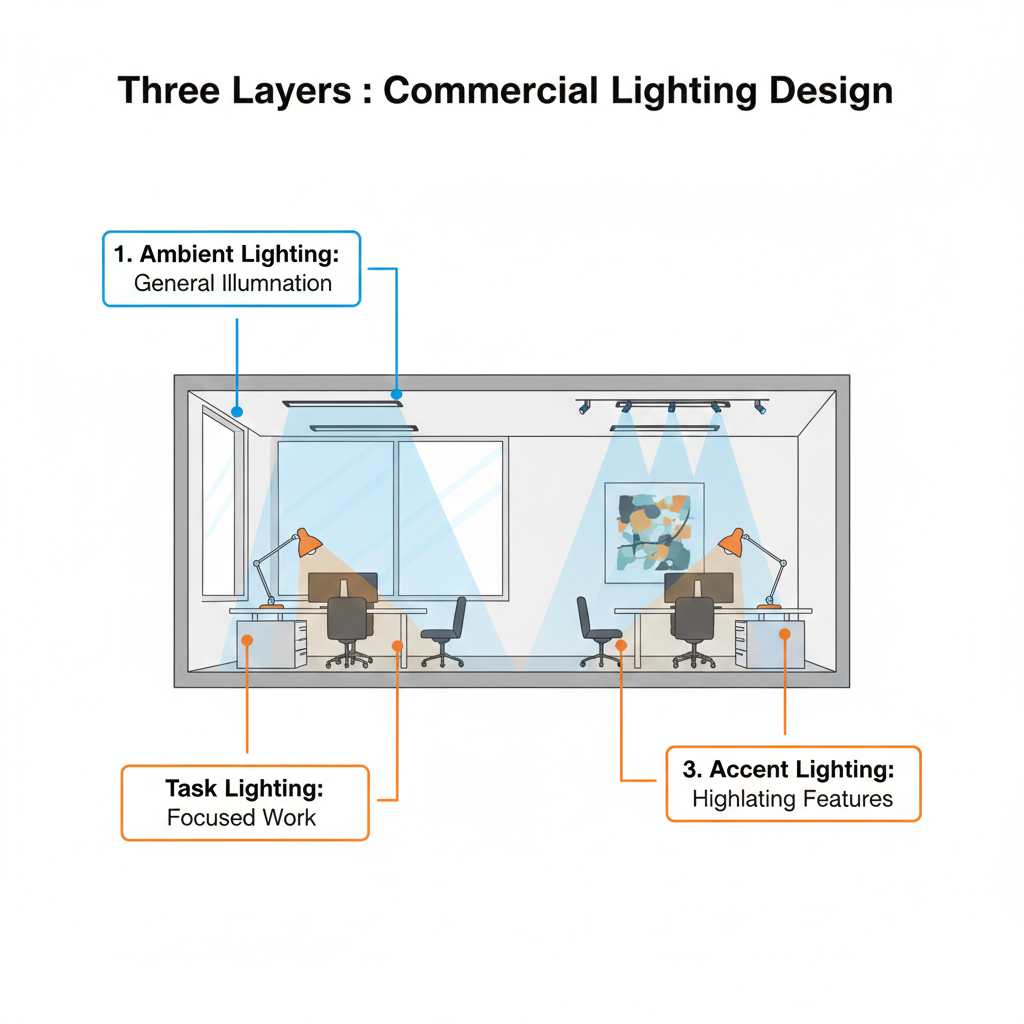
The Three Layers of Commercial Lighting Design
Professional commercial lighting contractors approach every project with a layered lighting strategy that addresses functionality, safety, and aesthetics:
Ambient Lighting provides the general, overall illumination that allows people to see and move safely through a space. This is typically achieved through ceiling-mounted fixtures like troffers, panels, high bays, or recessed downlights. The goal is even, comfortable illumination without harsh shadows or overly bright spots.
Task Lighting delivers focused, higher-intensity light to specific work areas where detailed tasks are performed. Assembly lines, inspection stations, checkout counters, reception desks, and individual workstations all benefit from dedicated task lighting that supplements ambient levels and reduces eye strain.
Accent Lighting creates visual interest, highlights architectural features, guides attention to merchandise or displays, and reinforces brand identity. While sometimes considered optional, accent lighting can dramatically impact how customers, employees, and visitors perceive a space.
Types of Commercial Lighting Projects in Texas
Commercial lighting contractors handle diverse project types, each with unique requirements, fixture selections, and design considerations. Understanding these categories helps you communicate your needs effectively and evaluate whether a contractor has relevant experience for your specific situation.
Office Lighting
Modern office lighting has evolved far beyond rows of fluorescent tubes. Today's best practices emphasize human-centric lighting that supports productivity, reduces eye strain, and can even adjust color temperature throughout the day to align with natural circadian rhythms. Office lighting projects typically require 300-500 lux (30-50 foot-candles) for general areas and 500-750 lux for detailed task work, with a Color Rendering Index (CRI) of 80+ and color temperatures between 3500K-5000K.
Key considerations for Texas office lighting include glare control (essential for computer work), integration with daylight harvesting systems to take advantage of abundant natural light, and compliance with energy codes that increasingly mandate occupancy sensors and automatic dimming. A Plano LED lighting specialist can design office systems that meet these requirements while creating productive, comfortable work environments.
Warehouse & Industrial Lighting
Warehouses present unique challenges: high ceilings (often 20-40+ feet), demanding operational schedules, extreme temperature variations, dust and debris exposure, and the critical need for safety in areas with forklift traffic and heavy machinery. High bay LED fixtures have become the standard solution, offering superior lumen output, energy efficiency, and durability compared to legacy HID (High-Intensity Discharge) lighting.
Industrial lighting projects require fixtures rated IP65 or higher for dust and moisture protection, operating temperature ranges suitable for non-climate-controlled Texas facilities (-20°C to +45°C), and CRI of 80+ for areas where color differentiation matters (such as quality control and picking operations). Illumination levels typically range from 300-500 lux depending on the specific activities performed.
Retail Lighting
Retail lighting directly impacts customer behavior, product appeal, and sales. Studies show that well-designed retail lighting can increase sales by up to 20% compared to poorly lit spaces. The goal is creating an inviting atmosphere while ensuring products are displayed at their best with accurate color rendering (CRI 90+ is recommended for apparel, cosmetics, and food displays).
Texas retail lighting projects must balance higher illumination levels (750-1000 lux general, 1000-2000+ lux for displays) with energy efficiency requirements and the heat generated by lighting systems in spaces that may require significant air conditioning. Track lighting, adjustable spotlights, and display case lighting all play roles in creating dynamic retail environments.
Restaurant & Hospitality Lighting
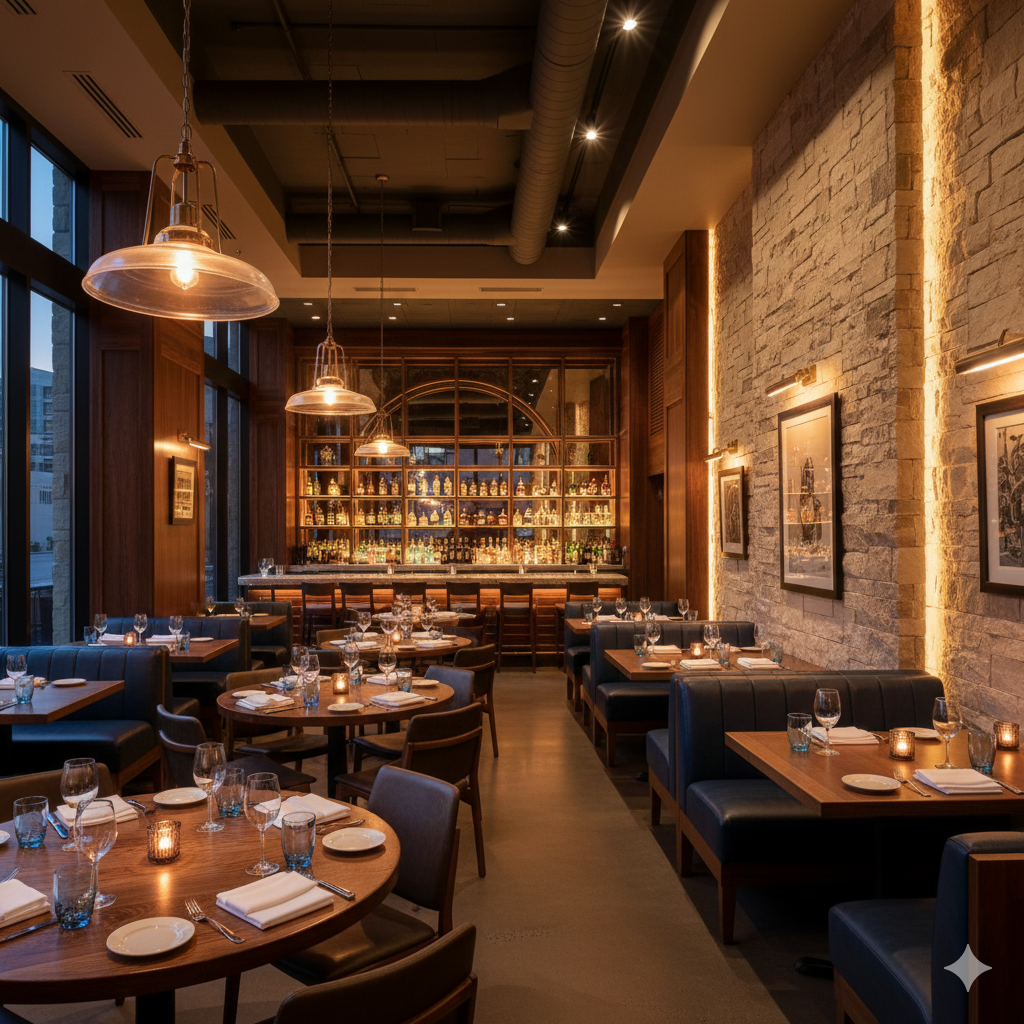
Hospitality lighting is perhaps the most nuanced commercial application—it must create atmosphere, support brand identity, adapt to different times of day and uses, and still provide functional illumination for staff operations. Fine dining restaurants require dramatically different approaches than fast-casual concepts, and hotels need lighting that transitions seamlessly from dramatic lobby presentations to comfortable, functional guest room environments.
Specialty applications like starlight ceiling installations and fiber optic lighting systems are increasingly popular in high-end hospitality venues, creating memorable visual experiences that differentiate properties and elevate guest perceptions. These architectural lighting elements require contractors with specialized expertise beyond standard commercial installation.
Parking Lot & Exterior Lighting
Exterior commercial lighting serves dual purposes: safety and security. Well-lit parking areas, building perimeters, walkways, and entries reduce accident liability, deter criminal activity, and create positive first impressions. Texas municipalities often have specific requirements for parking lot lighting, including minimum and maximum illumination levels to prevent both inadequate coverage and light pollution.
LED parking lot fixtures—shoebox lights, area lights, and wall packs—have revolutionized exterior commercial lighting with their energy efficiency, long life spans (50,000+ hours), and superior light distribution. Motion sensors and photocell controls optimize operation and reduce energy waste. A Fort Worth LED lighting contractor can ensure your exterior installation meets all local codes while maximizing safety and minimizing energy costs.
Healthcare & Medical Facility Lighting
Healthcare lighting requires exceptional precision—patient rooms need adjustable lighting for comfort and clinical examination, surgical suites demand precise color rendering and shadow-free illumination, and corridors must provide safe navigation while supporting 24/7 operations. Infection control considerations increasingly influence fixture selection, with smooth, cleanable surfaces and UV-C disinfection compatibility becoming standard requirements.
Sports & Recreational Facility Lighting
Athletic facilities, from high school gymnasiums to professional stadiums, require high-output lighting systems designed to eliminate shadows, provide uniform coverage, and support broadcasting requirements where applicable. LED technology has transformed sports lighting with instant-on capability (no warm-up time), superior flicker-free performance for high-speed video, and dramatic energy savings compared to metal halide systems.
Commercial Lighting Requirements by Space Type
| Space Type | Recommended Lux | Color Temp (K) | Minimum CRI | Common Fixtures |
|---|---|---|---|---|
| General Office | 300-500 | 3500-5000 | 80+ | Troffers, panels, recessed |
| Warehouse | 300-500 | 4000-5000 | 70-80+ | High bay, linear |
| Retail (General) | 750-1000 | 3000-4000 | 90+ | Track, spot, pendant |
| Restaurant | 150-500 | 2700-3500 | 85+ | Pendant, sconce, decorative |
| Parking Lot | 50-100 | 3000-5000 | 70+ | Area, shoebox, wall pack |
| Manufacturing | 500-1000 | 4000-5000 | 80+ | High bay, task lighting |
How to Choose a Commercial Lighting Contractor in Texas
Selecting the right commercial lighting contractor is perhaps the most consequential decision in any lighting project. The contractor you choose will impact not only the immediate quality of your installation but also your long-term energy costs, maintenance requirements, and the return on your investment. Here's what to evaluate:
Licensing & Insurance Requirements
Texas requires electrical contractors to hold appropriate state licensing through the Texas Department of Licensing and Regulation (TDLR). Commercial lighting work typically requires a Master Electrician license or work under a licensed contractor's supervision. Always verify:
- Valid Texas electrical contractor license – Request the license number and verify it through the TDLR website
- General liability insurance – Minimum $1 million recommended to protect against property damage
- Workers' compensation coverage – Protects you from liability if a worker is injured on your property
- Bonding – Provides financial protection if the contractor fails to complete the project or meet obligations
Experience & Specialization
Not all electrical contractors specialize in commercial lighting, and experience matters significantly. Ask potential contractors:
- How many commercial lighting projects have they completed?
- Do they have experience in your specific industry or facility type?
- Can they provide references from similar projects?
- Do they employ or work with certified lighting designers?
- Are they familiar with current LED technology and smart lighting controls?
A contractor who primarily does parking lot lighting may not be the best choice for a hospitality project requiring nuanced architectural design. Conversely, a contractor specializing in decorative lighting may lack the industrial experience needed for a warehouse retrofit. Companies like Texas LED Lights offer comprehensive services across commercial sectors while maintaining deep expertise in specialty applications.
DLC Certification & Product Knowledge
The DesignLights Consortium (DLC) certifies commercial LED lighting products for energy efficiency and performance. DLC-listed products are required for most utility rebate programs, including Oncor's Commercial Standard Offer Program. Your contractor should:
- Specify DLC-listed fixtures for all applicable installations
- Understand the difference between DLC Standard and DLC Premium classifications
- Be brand-agnostic and recommend products based on your needs, not their preferred vendors
- Stay current with rapidly evolving LED technology
Rebate & Incentive Expertise
Texas utilities offer substantial rebates for commercial lighting upgrades, but navigating these programs requires specific knowledge and administrative capability. The best contractors are registered service providers with major utility programs and handle rebate applications as part of their service. Ask:
- Are you an approved service provider for Oncor, CenterPoint, Austin Energy, or other local utilities?
- Do you handle rebate paperwork and submissions?
- Can you provide a pre-project estimate of expected rebates?
- What documentation do you provide for rebate verification?
Full-Service Capabilities
The most efficient commercial lighting projects involve contractors who can handle the complete scope of work under a single contract. Look for these capabilities:
- Lighting Audit – Comprehensive assessment of existing conditions and opportunities
- Photometric Design – Light level calculations ensuring code compliance and optimal coverage
- Product Specification – Selection of appropriate fixtures for your application
- Installation – Professional installation by licensed electricians
- Disposal & Recycling – Proper handling of old fixtures and ballasts (some contain hazardous materials)
- Rebate Processing – Complete handling of utility incentive applications
- Ongoing Maintenance – Service agreements for long-term support

Questions to Ask Before Hiring
10 Essential Questions for Commercial Lighting Contractors:
- What is your Texas electrical contractor license number?
- How many commercial lighting projects have you completed in the past year?
- Do you have experience with my specific type of facility?
- Are you an approved service provider for local utility rebate programs?
- Will you provide a photometric lighting design before installation?
- Do you specify DLC-listed fixtures for rebate eligibility?
- What warranty do you offer on labor and materials?
- How do you minimize disruption to our business operations during installation?
- Do you handle disposal and recycling of old fixtures?
- Can you provide references from similar projects?
Commercial Lighting Costs & Pricing in Texas
Understanding commercial lighting costs helps you budget appropriately, evaluate proposals accurately, and recognize when a quote is unusually high or suspiciously low. Pricing varies significantly based on project type, facility conditions, fixture quality, and contractor expertise.
Cost Per Square Foot Guidelines
While every project is unique, these ranges provide general benchmarking for Texas commercial lighting projects:
| Project Type | Cost Per Sq Ft | Notes |
|---|---|---|
| LED Retrofit (Basic) | $2.00 - $3.00 | Replacing existing fixtures with LED equivalents |
| LED Retrofit (Complete) | $3.00 - $4.50 | Full fixture replacement with controls |
| New Construction | $3.20 - $5.00+ | New installation including wiring |
| Office Lighting | $5.00 - $12.00 | Higher density, quality fixtures |
| Warehouse High Bay | $1.50 - $3.50 | Large open spaces, fewer fixtures |
| Retail | $8.00 - $15.00 | Includes accent and display lighting |
| Architectural/Luxury | $15.00 - $50.00+ | Custom designs, premium fixtures |
Project Size Cost Examples
Here's what Texas businesses typically invest in commercial lighting projects:
- Small Business LED Upgrade (5,000-10,000 sq ft): $10,000 - $20,000
- Medium Office Building (25,000-50,000 sq ft): $40,000 - $100,000
- Large Warehouse (100,000+ sq ft): $150,000 - $350,000
- Retail Store (10,000-20,000 sq ft): $80,000 - $200,000
- Luxury Hotel Lobby: $50,000 - $250,000+
Individual Fixture Costs
Understanding fixture pricing helps evaluate the material component of contractor proposals:
- LED Troffer (2x4): $80 - $200
- LED Panel Light: $60 - $150
- LED High Bay (150-240W): $150 - $400
- LED Wall Pack: $80 - $250
- LED Parking Lot Light: $200 - $600
- Track Light Head: $50 - $200
- Architectural Pendant: $200 - $2,000+
Factors That Increase Costs
Several factors can push commercial lighting projects above baseline estimates:
- Ceiling Height: Projects requiring lifts, scaffolding, or specialized access equipment
- After-Hours Work: Installations during nights/weekends to avoid business disruption
- Electrical Upgrades: Panel capacity increases, new circuit runs, or wiring replacement
- Controls Integration: Occupancy sensors, daylight harvesting, DALI or 0-10V dimming systems
- Hazardous Materials: Disposal of PCB-containing ballasts or mercury-content lamps
- Architectural Elements: Custom fixtures, cove lighting, specialty applications like fiber optic systems
- Permitting Requirements: Complex permit processes in certain municipalities
Return on Investment Analysis
Modern LED lighting systems typically pay for themselves in 2-3 years through energy savings alone. Consider these typical savings:
Example ROI: 50,000 sq ft Warehouse LED Retrofit
- Project Cost: $100,000 (before rebates)
- Oncor Rebate: -$20,000 (estimated)
- Net Investment: $80,000
- Annual Energy Savings: $35,000 (75% reduction)
- Annual Maintenance Savings: $8,000 (fewer replacements, no re-lamping)
- Total Annual Savings: $43,000
- Simple Payback: 1.9 years
- 10-Year Net Savings: $350,000+
Texas Utility Rebates for Commercial Lighting
Texas offers some of the most generous commercial lighting rebate programs in the country. These incentives can offset 20-35% of project costs, dramatically improving your return on investment. However, programs have specific requirements, limited funding, and annual deadlines that require careful navigation.
Oncor Commercial Standard Offer Program (DFW Area)
Oncor serves the Dallas-Fort Worth Metroplex and surrounding areas, offering substantial rebates through their "Take A Load Off, Texas" initiative:
- Basic Commercial Program: Minimum $500 incentive per project
- Custom Commercial Program: Projects with $10,000+ in verified savings qualify for custom incentives
- Program Period: Typically January through November annually
- Requirements: DLC-listed or ENERGY STAR certified fixtures, approved service provider
- Bonus: 15% additional incentive for projects outside the core Metroplex area
Businesses in Arlington, Irving, and throughout the DFW area can take advantage of Oncor rebates when working with approved service providers who handle all documentation and submission requirements.
CenterPoint Energy (Houston Area)
Houston-area businesses served by CenterPoint Energy have access to similar commercial lighting incentives through their energy efficiency programs. Key points:
- Rebates based on verified energy savings (kWh) and demand reduction (kW)
- Must use CenterPoint-approved service providers
- Pre-approval required before project commencement
- LED lighting, controls, and occupancy sensors eligible
Austin Energy Commercial Programs
Austin Energy offers comprehensive rebates for businesses within their service territory:
- Performance-based incentives calculated on energy savings
- Technical assistance available for lighting design
- Small business programs with streamlined applications
- Integration with solar and other efficiency measures
CPS Energy (San Antonio)
San Antonio's municipal utility provides commercial lighting incentives through their sustainability programs:
- Prescriptive rebates for standard LED upgrades
- Custom incentives for complex projects
- Combined programs for lighting plus HVAC efficiency
Federal Tax Incentives: Section 179D
Beyond utility rebates, the federal Energy-Efficient Commercial Buildings Deduction (Section 179D) provides additional tax benefits:
- 2025-2026 Rates: $0.57 - $1.13 per square foot for qualifying lighting improvements
- Requirements: Must achieve specified energy reduction targets compared to ASHRAE 90.1 baseline
- Application: Claimed as a tax deduction, requires certification by qualified professional
- Stacking: Can be combined with utility rebates for maximum benefit
⚠️ Important Rebate Considerations:
- Programs are funded annually and can close early when budgets are exhausted
- Most require pre-approval before starting work
- Only approved service providers can submit applications for some programs
- Incentive rates may change during the program year
- Documentation requirements are strict—incomplete applications are rejected
The Commercial Lighting Installation Process
Understanding what to expect during a commercial lighting project helps you plan appropriately, minimize business disruption, and ensure the project delivers expected results. Here's the typical process from initial contact to project completion:
Phase 1: Assessment & Audit (1-2 Weeks)
Every quality commercial lighting project begins with a thorough assessment:
- Site Survey: Physical inspection of the facility, including ceiling heights, existing fixtures, electrical infrastructure, and special conditions
- Current State Analysis: Documentation of existing lighting types, quantities, wattages, and operating hours
- Light Level Measurements: Foot-candle readings at various points to identify over-lit and under-lit areas
- Energy Analysis: Review of utility bills to establish baseline energy consumption
- Goals Discussion: Understanding your priorities—energy savings, improved light quality, code compliance, aesthetic enhancement
Phase 2: Design & Proposal (1-2 Weeks)
Based on the assessment, your contractor develops a comprehensive proposal:
- Photometric Design: Computer modeling showing proposed light levels throughout the space
- Fixture Specification: Detailed product selections with cut sheets and specifications
- Energy Projections: Calculated energy savings compared to existing conditions
- Rebate Analysis: Estimated utility incentives and application requirements
- Pricing: Itemized costs for materials, labor, and any ancillary services
- Timeline: Proposed installation schedule with milestones
Phase 3: Pre-Installation (1-2 Weeks)
Once you approve the proposal, preparation begins:
- Permit Applications: Submission to local authorities where required
- Rebate Pre-Approval: Documentation submitted to utility programs
- Material Ordering: Fixtures and components procured with delivery scheduled
- Logistics Planning: Lift equipment arranged, work areas identified, schedule coordinated
Phase 4: Installation (Varies by Project Size)
Professional installation follows careful procedures:
- Safety Setup: Work areas secured, appropriate signage and barriers in place
- Systematic Removal: Old fixtures safely disconnected and removed (often during off-hours)
- New Installation: LED fixtures installed, wired, and tested section by section
- Controls Setup: Sensors, dimmers, and control systems configured and programmed
- Quality Checks: Light level verification, visual inspection, safety testing
Installation timelines vary significantly:
- Small Office (5,000 sq ft): 1-3 days
- Medium Commercial (25,000 sq ft): 1-2 weeks
- Large Warehouse (100,000+ sq ft): 2-4 weeks
- Multi-location Rollout: Varies by scope
Phase 5: Completion & Documentation
Project wrap-up includes critical documentation:
- Commissioning: Final testing and adjustment of all systems
- Training: Staff instruction on controls operation and basic maintenance
- Documentation Package: As-built drawings, product specifications, warranty information
- Rebate Submission: Final documentation and photos submitted to utility programs
- Disposal Certification: Documentation of proper recycling/disposal of old materials
Architectural & Luxury Commercial Lighting
While standard commercial lighting focuses primarily on functionality and efficiency, architectural lighting elevates spaces through deliberate design that shapes perception, creates emotion, and supports brand identity. This specialized discipline merges technical expertise with artistic vision to deliver environments that are genuinely memorable.
When to Consider Architectural Lighting
Architectural lighting investment makes sense for:
- Hospitality: Hotels, restaurants, bars, and entertainment venues where atmosphere directly impacts guest experience and willingness to pay premium prices
- Luxury Retail: High-end boutiques and flagship stores where lighting presentation affects brand perception and purchase decisions
- Corporate Headquarters: Reception areas, boardrooms, and public spaces that communicate company culture and status
- Healthcare: Patient experience areas where thoughtful lighting reduces anxiety and supports healing
- Cultural Institutions: Museums, galleries, theaters, and performance spaces requiring precise light control
- Residential Projects: Luxury homes, especially home theaters, master suites, and entertainment spaces
Specialty Lighting Applications
Texas businesses and luxury homeowners are increasingly incorporating dramatic specialty lighting:
Fiber Optic Starlight Ceilings: These stunning installations transform ordinary ceilings into captivating night-sky experiences. Using hundreds or thousands of fiber optic strands connected to LED illuminators, starlight ceiling systems create twinkling star effects, shooting stars, constellation patterns, and color-changing displays. Popular applications include home theaters, master bedrooms, restaurants, hotel lobbies, and spa facilities. Premium installations from specialists like 360 Fiber Lighting combine acoustic panel integration with fiber optic elements for both visual impact and sound control.
Cove & Indirect Lighting: Light concealed in architectural coves washes walls and ceilings with soft, ambient illumination that creates sophisticated, shadow-free environments without visible fixtures.
Facade & Exterior Architectural Lighting: Building exteriors transformed into nighttime landmarks through strategic grazing, washing, and accent techniques that highlight architectural features.
Pool & Water Feature Lighting: Underwater and perimeter lighting for pools, fountains, and water features creates dramatic effects. Premium Pool Lighting specialists understand the unique requirements of wet-location fixtures, color-changing systems, and integration with pool control systems.
Smart Lighting & Controls Integration
Modern architectural lighting projects typically incorporate sophisticated control systems:
- Scene Control: Pre-programmed lighting scenes that transform spaces at the touch of a button
- Tunable White: Color temperature adjustment from warm (2700K) to cool (6500K) to support circadian rhythms and different activities
- RGBW Color: Full-spectrum color capabilities for dramatic effects and brand-specific hues
- Integration: Control via Lutron, Control4, Crestron, Savant, and other automation platforms
- Voice Control: Amazon Alexa, Google Assistant, and Apple HomeKit compatibility
Frequently Asked Questions
How much does commercial lighting installation cost in Texas?
Commercial lighting costs in Texas typically range from $2-$4 per square foot for basic LED retrofits to $15-$50+ per square foot for architectural and luxury installations. A small business LED upgrade (5,000-10,000 sq ft) usually costs $10,000-$20,000 before rebates, while large warehouse projects (100,000+ sq ft) can range from $150,000-$350,000. Utility rebates from Oncor, CenterPoint, and other providers can offset 20-35% of these costs.
What utility rebates are available for commercial lighting in Texas?
Texas utilities offer substantial rebates for commercial LED lighting upgrades. Oncor's Commercial Standard Offer Program provides a minimum $500 incentive for basic projects and custom incentives for projects achieving $10,000+ in verified savings. CenterPoint Energy (Houston), Austin Energy, and CPS Energy (San Antonio) offer similar programs. Most programs require pre-approval, use of DLC-listed fixtures, and work with approved service providers. Programs typically run January through November and can close early when funding is exhausted.
How long does a commercial lighting retrofit take?
Timeline varies by project size and complexity. A small office (5,000 sq ft) typically takes 1-3 days of installation work. Medium commercial buildings (25,000 sq ft) require 1-2 weeks. Large warehouses (100,000+ sq ft) take 2-4 weeks. Add 2-4 weeks for the assessment, design, permitting, and pre-approval phases before installation begins. Many contractors offer after-hours and weekend installation to minimize business disruption.
What should I look for when hiring a commercial lighting contractor?
Key qualifications include: valid Texas electrical contractor license (verify through TDLR), adequate insurance coverage (general liability and workers' compensation), experience with your specific type of facility, registration as an approved service provider for utility rebate programs, knowledge of DLC-listed products, and full-service capabilities including design, installation, disposal, and rebate processing. Always request references from similar projects and verify licensing before signing contracts.
How much energy will I save with LED lighting?
LED lighting typically reduces lighting energy consumption by 50-75% compared to fluorescent systems and up to 90% compared to HID (metal halide, high-pressure sodium) fixtures. Combined with smart controls like occupancy sensors and daylight harvesting, total savings can reach 75-90%. Most commercial LED retrofits achieve payback periods of 2-3 years through energy savings alone, with additional maintenance savings extending returns further.
What is DLC certification and why does it matter?
The DesignLights Consortium (DLC) is an organization that certifies commercial LED lighting products for energy efficiency and performance. DLC-listed products meet rigorous standards for light output, efficacy (lumens per watt), and quality. Most utility rebate programs, including Oncor's, require DLC-listed fixtures for rebate eligibility. Using non-DLC products can disqualify your project from thousands of dollars in incentives.
Do I need permits for commercial lighting work in Texas?
Permit requirements vary by municipality and project scope. Most commercial electrical work, including lighting installation, requires permits in Texas cities. Some jurisdictions have exemptions for like-for-like fixture replacements where no wiring changes occur. Your contractor should know local requirements and handle permit applications as part of their service. Working without required permits can result in fines, failed inspections, and voided insurance coverage.
What's the difference between retrofit and new construction lighting?
Retrofit projects upgrade existing lighting systems, replacing old fixtures with new LED technology while typically using existing electrical infrastructure. This is faster and less expensive than new construction. New construction lighting is installed as part of building a new facility or major renovation, involving new wiring, circuits, and fixtures from scratch. Retrofit typically costs $2-$4/sq ft while new construction runs $3.20-$5+/sq ft due to additional electrical work.
How long do commercial LED lights last?
Quality commercial LED fixtures are rated for 50,000-100,000 hours of operation. At typical commercial usage rates (12-16 hours/day), this translates to 8-20+ years before reaching L70 (70% of original light output). This dramatically exceeds fluorescent tubes (20,000-30,000 hours) and HID lamps (10,000-20,000 hours). Beyond lamp life, LED fixtures have no ballasts to fail, further reducing maintenance requirements and costs.
Can commercial lighting affect employee productivity?
Research consistently shows that lighting quality significantly impacts workplace productivity, with studies indicating improvements of 3-15% from optimized lighting. Key factors include appropriate light levels (reducing eye strain), good color rendering (CRI 80+), reduced glare, and color temperatures that support alertness during work hours. Human-centric lighting that adjusts color temperature throughout the day can further support natural circadian rhythms and employee well-being.
Ready to Transform Your Commercial Space?
Texas LED Lights delivers expert commercial lighting solutions across Dallas-Fort Worth and throughout Texas. From warehouse retrofits to architectural designs, we handle every aspect of your project—including maximizing your utility rebates.